



You’re spending real money to drive traffic. Paid ads, SEO, content—the whole stack. But if the people landing on your site aren’t converting, you’re basically filling a leaky bucket.
That’s the problem conversion rate optimization services are designed to fix.
CRO is a structured process that uses data, user research, and testing to convert more of your existing traffic into customers, leads, or sign-ups. And when it’s done right, it can become one of the most efficient ways to get more value from traffic you already paid to acquire.
This guide breaks down exactly what CRO services include, what they cost, and how to find an agency worth paying for.
Highlights
- CRO services help businesses convert more existing traffic without increasing ad spend. A full-service engagement typically includes conversion audits, user research, A/B testing, and landing page optimization — all designed to identify and reduce friction in the buyer journey.
- The average landing page converts just 6.6% of visitors, according to Unbounce’s 2024 Conversion Benchmark Report. For most businesses, the traffic isn’t the problem — what happens after the click is.
- CRO pricing ranges from $75–$200/hour for freelance consultants to $10,000–$30,000+ per month for enterprise agency engagements. The right investment level depends on traffic volume, lead or order value, and whether you need strategy, execution, or both.
- Effective CRO agencies lead with user research before running a single test. According to Convert, 60% of A/B tests deliver less than a 20% performance lift, which means disciplined hypothesis development and statistical rigor are what separate meaningful gains from random noise.
- When evaluating a CRO agency, ask to see documented results from losing tests, not just wins. The best teams build a learning repository from every experiment — including inconclusive ones — that makes future testing faster and more targeted.
What are conversion rate optimization services?
At the most basic level, CRO services are about improving the percentage of your website visitors who take a desired action: buying something, filling out a form, scheduling a demo, or signing up for a newsletter. For many businesses with low conversion rates, this means using data-driven optimization strategies to improve the website conversion rate without increasing traffic spend.
But the work required to move that number is surprisingly deep.
A comprehensive CRO engagement typically involves several interconnected workstreams:
- Auditing your current funnel
- Conducting qualitative user research
- Generating hypotheses based on that data
- Running controlled experiments (usually A/B tests)
- Iterating based on what you learn
Together, these steps show that CRO is an ongoing strategy. Why does that matter? Because most conversion problems aren’t obvious. They’re buried in heatmaps, session recordings, exit surveys, and form analytics.
Surface-level changes, such as swapping a button color or tweaking headline copy, rarely move the needle on their own. The real gains come from understanding why users aren’t converting and systematically testing solutions.
To put this in perspective: Unbounce’s 2024 Conversion Benchmark Report found that the average landing page conversion rate is just 6.6% across all industries. For most businesses, the traffic isn’t the problem. What happens after the click is.
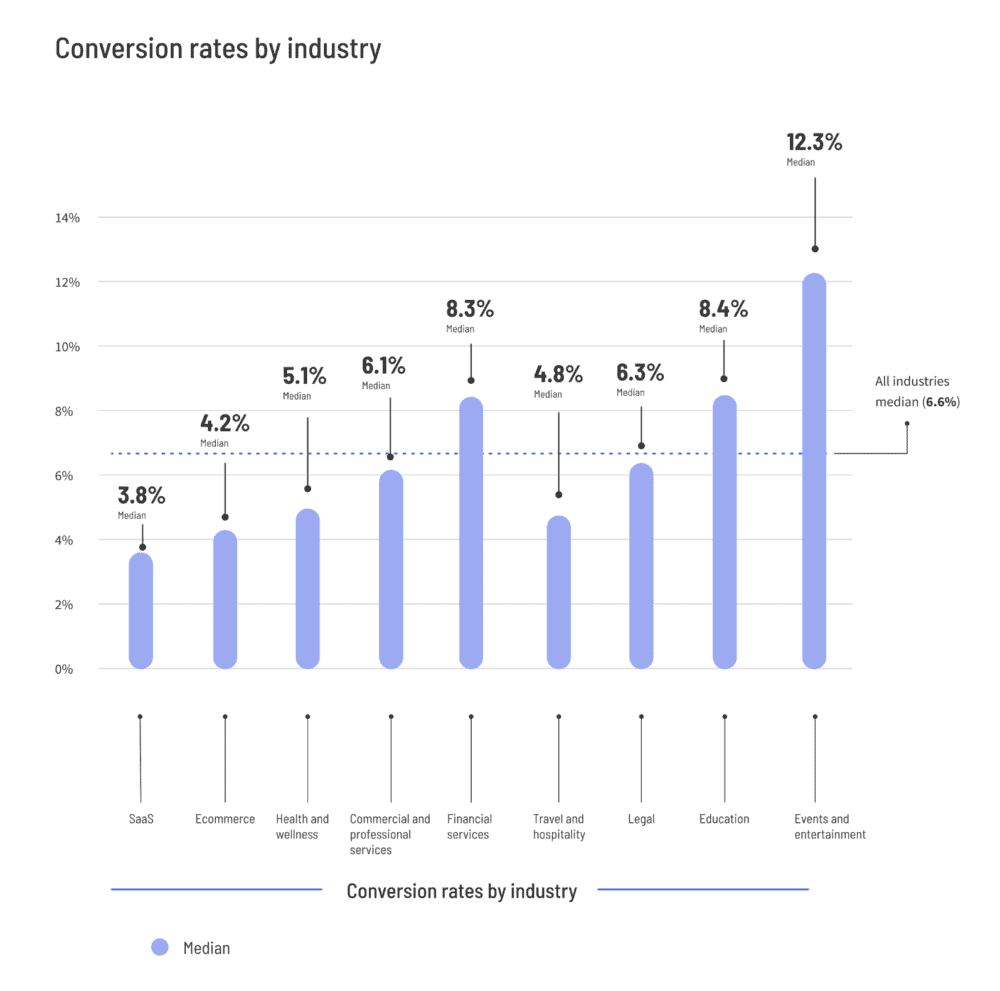
Image source: Unbounce
What’s actually included in CRO services?
The scope of CRO work varies by agency and budget, but most full-service engagements cover the following areas.
Conversion audits
Before anything is tested, a good CRO team needs to understand where your funnel is leaking. That means a full CRO audit of your analytics, user flows, landing pages, and checkout or lead-gen processes.
They’re looking for friction points:
- Page speeds that are slow enough to cost you conversions
- Calls to action that are unclear
- Pages with high drop-off rates
- Forms that are too long
Page speed is worth taking seriously. Contentsquare’s 2025 Digital Experience Benchmarks show that frustration still affects the visitor journey, including issues such as slow-loading pages, rage clicks, and excessive hovering. For CRO teams, that makes technical performance a practical conversion lever, not just a UX concern.
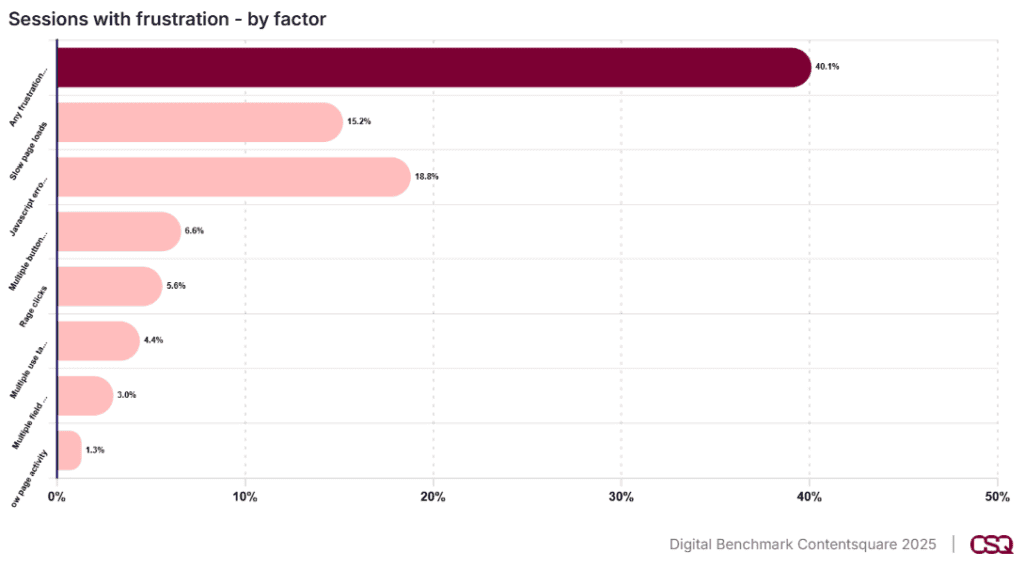
Image source: Contentsquare
A thorough audit reveals exactly these kinds of wins and shows where the user experience is creating unnecessary friction.
User research and qualitative analysis
Numbers tell you exactly what is happening. User research tells you why.
This typically includes heatmaps and session recordings, on-site surveys, customer interviews, and usability testing.
The goal is to build a picture of the user’s experience from their perspective, not just from your analytics dashboard.
Contentsquare’s 2025 Digital Experience Benchmark report revealed that 40% of site visits show user frustration.
This often includes rage clicks, dead ends, or repeated back-and-forth navigation. You can’t fix what you can’t see. User research gives you the visibility needed to understand where visitors hesitate and why.
Hypothesis development
Once you’ve gathered enough data, the next step is generating testable hypotheses. A hypothesis is a structured statement: “If we do X, we expect Y to improve because Z.”
Without this process, you’re just running random tests and hoping something sticks.
A/B testing and experimentation
This is where you validate your hypothesis. A/B testing, or more sophisticated multivariate testing, involves showing different versions of a page to different segments of traffic and measuring which performs better.
Done right, this is scientific. Done wrong, it produces false positives that lead teams in the wrong direction.
A reputable CRO agency will run tests to statistical significance, document results carefully, and build a learning repository that informs future experiments—even the ones that don’t win.
Landing page and UX optimization
Many CRO engagements include actual design and copy work, not just recommendations. That might look like landing page optimization based on test results, rewriting headlines, restructuring a product page, or simplifying a checkout flow.
One of the most reliable methods here is proof. Buyers don’t just want to understand what you offer. They want evidence that it works.
According to MarketingProfs’ 2024 B2B Content Marketing Benchmarks, case studies and customer stories were used by 78% of B2B marketers, up from 67% the year before.
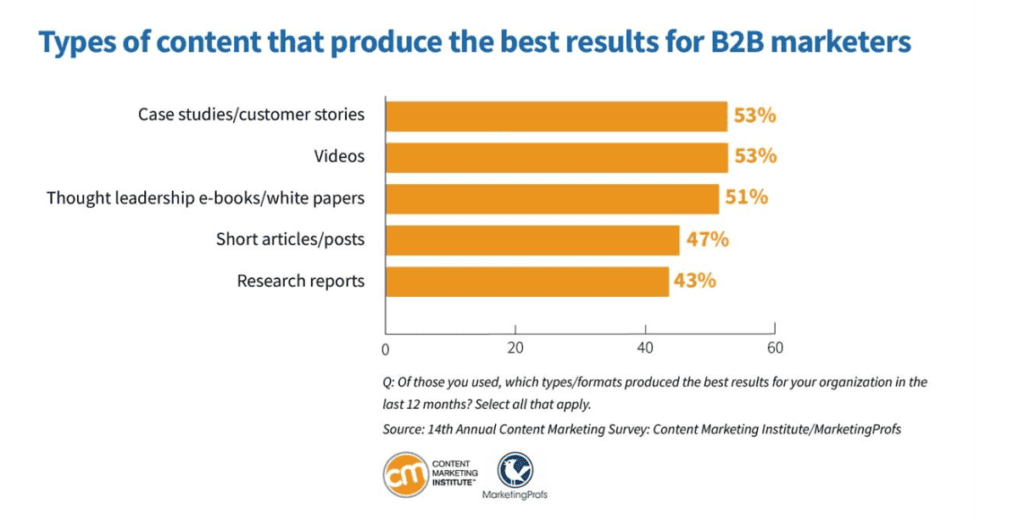
Image source: Content Marketing Institute
Adding the right social proof to your landing pages is a common, often high-impact outcome of a CRO engagement because it can improve conversion by reducing hesitation at key website conversion points.
Landing page performance becomes even more important once you’re paying for traffic. You can dial in your targeting, refine your keywords, and test ad creative all day. But if the page people land on creates hesitation or confusion, performance will plateau.
Benchmarks make this easier to spot. According to Wordstream’s Google Ads Benchmarks 2025, paid search ads on Google currently average a 7.52% conversion rate.
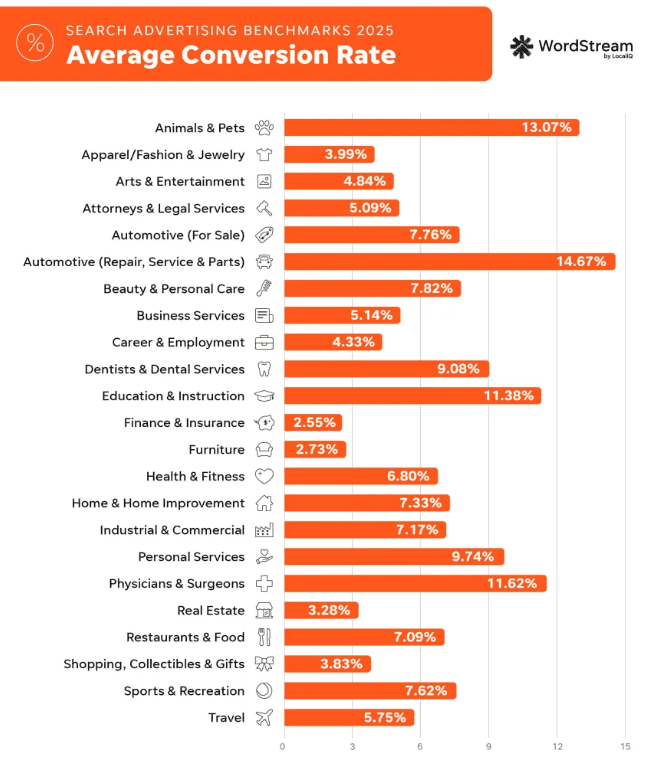
Image source: WordStream
If your campaigns sit well below that, the issue often has less to do with your ads and more to do with what happens after the click.
This is where CRO services tend to deliver the fastest return. Instead of pushing more budget into acquisition, the focus shifts to increasing the conversion rate of existing website traffic and using CRO efforts to increase conversion rates from visitors already reaching the site.
In practice, that often comes down to removing friction. For teams fielding inquiries through chat or social DMs, AI agents for lead generation can collect contact details and ask qualifying questions before a person ever picks up the thread.
Simplifying your website often leads to higher conversions. One of the easiest places to start is your lead generation form.
Cutting unnecessary fields reduces friction and makes it easier for visitors to take action. In one example shared by HubSpot, FSAstore.com streamlined its funnel by simplifying form inputs, resulting in a 53.8% increase in average revenue per visitor.
Changes like these are small adjustments based on how people move through your site.
That’s the core of CRO work. You’re not guessing what might help. You’re identifying where people hesitate, testing solutions, and building on what works.
How much do conversion rate optimization services cost?
CRO pricing ranges from a few hundred dollars a month for entry-level tools and consulting to $10,000–$30,000+ per month for full-service enterprise engagements.
Here’s a rough breakdown of the market:
- Enterprise CRO agencies: $10,000–$30,000+/month. Full-service engagements with dedicated teams, advanced testing infrastructure, and a heavier emphasis on research and iterative optimization.
- Mid-tier CRO agencies: $3,000–$10,000/month. Typically includes audits, testing strategy, and experiment management. You’ll usually get a dedicated strategist and access to their toolset.
- Freelance CRO consultants: $75–$200/hour, or $1,000–$5,000/month for ongoing retainers. Good for smaller sites or teams that need guidance but have internal resources to execute.
- CRO software: Tools range from $200–$2,000/month, depending on traffic volume and feature set.
The right investment level depends on your traffic volume, average order value or lead value, internal capacity, and whether you need a consultant, software tool, or full-service optimization company. An ecommerce site generating $50,000/month that converts 1% of its traffic could double revenue with a single percentage-point lift.
That’s why CRO pricing should be evaluated against revenue opportunity, not just monthly service cost.
To understand what opportunity looks like in context, it helps to benchmark your current performance.
The average global ecommerce conversion rate is 2.76%, based on Dynamic Yield’s ecommerce Benchmarks.
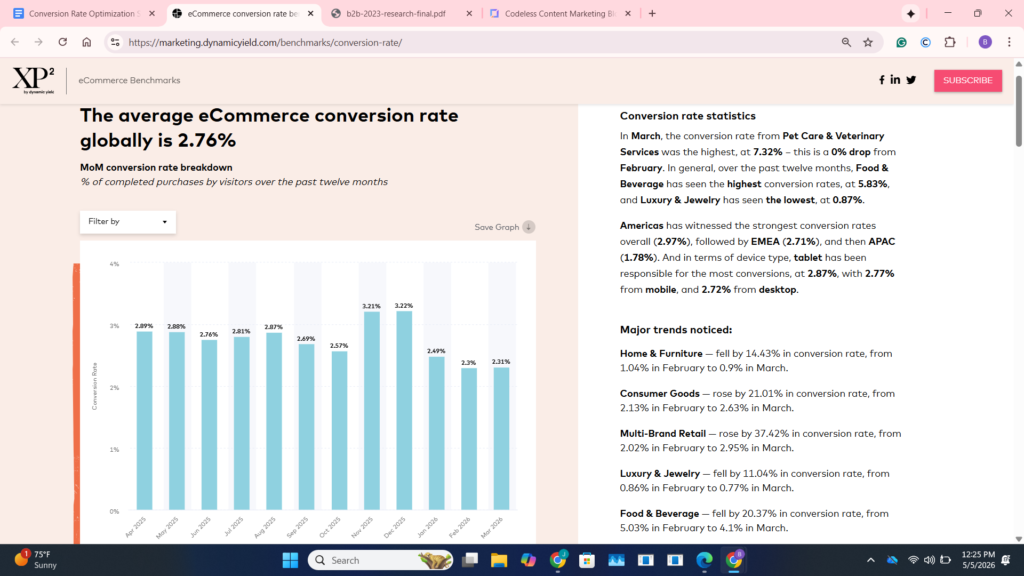
Image source: Dynamic Yield
If you’re running paid traffic and converting well below that number, you’re overpaying for every customer you acquire. CRO helps close this gap.
How to choose the right CRO agency
There’s no shortage of agencies claiming to specialize in CRO. Here’s how to separate the best from the rest.
Look for a research-first process
Any agency can run A/B tests. Not every agency starts with rigorous user research before touching a test. Ask them directly: how do you identify what to test? If the answer is gut feel or “best practices,” move on.
The best CRO agencies are obsessive about understanding your users before they start changing things.
That matters because CRO is not just a list of tactics. A good agency should be able to explain why a test matters, what business outcome it connects to, and what the team will do if the result is flat, inconclusive, or negative.
Ask to see documented test results
Not just wins, losses too. A good CRO team learns as much from failing tests as winning ones, and they document everything.
If an agency can’t show you a clear history of experiments with outcomes and learnings attached, that’s a red flag.
Evaluate their testing rigor
Ask how they determine statistical significance. Ask how long they run tests before calling a winner. Ask how they handle traffic segmentation.
Sloppy testing produces sloppy results. A conversion boost that isn’t statistically significant isn’t a boost at all.
Look for relevant experience
An agency that’s spent years optimizing ecommerce checkout flows might not be the right fit for a B2B SaaS lead-gen funnel. CRO principles transfer, but industry context is key. Look for case studies or client examples that are relevant to your model.
What to ask any CRO agency
According to original data from Convert, 60% of A/B tests deliver less than a 20% lift in performance, and 84% produce under a 50% lift.
This shows how difficult it is to generate meaningful gains without a structured strategy. It also places greater emphasis on how an agency approaches testing and decision-making.
That means the right agency should be able to explain not just what it tests, but how it decides, measures, and learns from each experiment. Before committing to a retainer, get clear answers to these questions:
- What does your research process look like before the first test goes live?
- How many tests do you typically run per month, and what’s your win rate?
- Who specifically will be working on our account, and what are their backgrounds?
- How do you handle inconclusive or losing tests?
- Can you show me a case study from a company in our industry or one that uses our business model?
- What tools do you use, and are they included in your fee?
- How do you connect test outcomes to revenue impact in your reporting?
CRO best practices
Knowing what good CRO looks like isn’t the same as running it. The playbook helps you evaluate an agency’s work and how well it executes its strategies.
Here’s what your chosen agency’s process should look like:
Start with the funnel
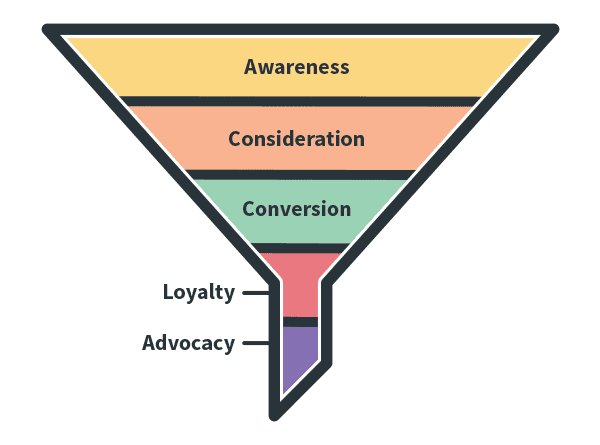
Image source: Sprout Social
Good conversion optimization services start with how users move through the site. Where do they drop off? What steps underperform? What does high-intent traffic actually do?
Without that context, testing turns into guessing.
Focus on high-impact pages
Not every page matters equally. Blog posts may support discovery, but checkout flows, pricing pages, and lead forms usually have a more direct impact on revenue. In ecommerce CRO, that usually means watching where shoppers stall between cart and payment before deciding what to test.
Strong programs focus on pages that drive conversion.
Isolate meaningful changes
Full redesigns make it hard to know what worked. CRO avoids that.
You test one meaningful change at a time. Messaging, layout, form structure. If performance changes, you know why.
Baymard Institute’s 2024 research found that most ecommerce sites still have usability issues across checkout flows. This shows how common friction is even in mature funnels.
Without isolating variables, it can be difficult to identify which of these issues is impacting performance.
Build a consistent testing cadence
CRO is iterative. A few tests here and there won’t produce much.
The value comes from running tests consistently, documenting outcomes, and using those learnings to guide what to test next.
Measure beyond conversion rate
Conversion rate is useful, but incomplete.
A page can generate more form fills and still produce lower-quality leads. An ecommerce test can lift purchases while reducing average order value. That’s why CRO work usually ties back to CRO metrics like revenue per visitor, average order value, or lead quality. If those don’t improve, the result doesn’t hold much value.
Document and reuse insights
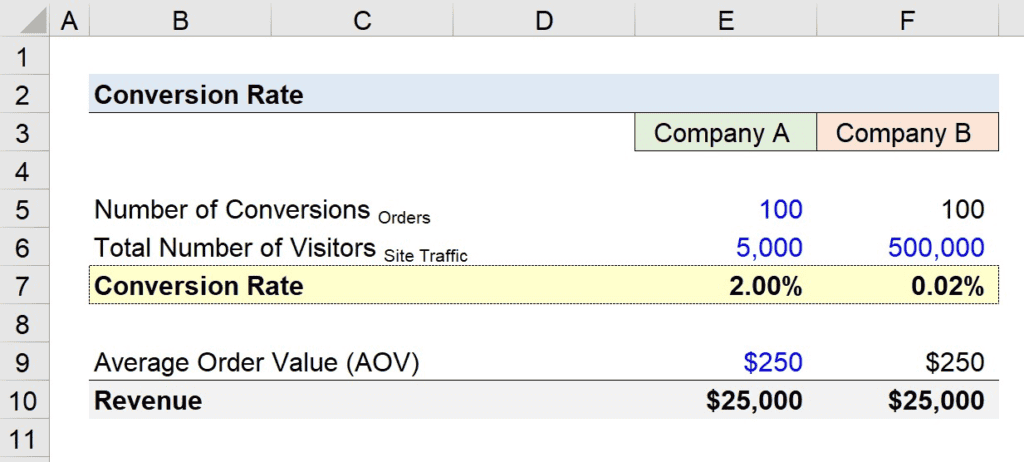
Image source: Wall Street Prep
Every test should inform the next one.
Eventually, you build a record of what works for your users. That reduces guesswork and makes future testing more efficient.
Conversion rate optimization services: The bottom line
Conversion rate optimization is a systematic process of understanding your users, forming hypotheses, testing changes, and iterating on what works.
If your business is serious about growth, CRO is one of the most effective levers available. Instead of spending more to acquire traffic, you’re squeezing more value out of the traffic you already have.
Find an agency that approaches it with the rigor it deserves: research first, disciplined testing, documented results, and relevant experience.
The same principle applies to content-led growth. Better content does not just attract traffic; it should also clarify the offer, answer objections, and move visitors toward the next step. If clearer messaging and stronger landing pages are part of your growth strategy, Codeless builds content programs for companies that take growth seriously.
If you’re ready to stop leaving conversions on the table, book an intro call, and let’s talk about what’s possible.