Most email platforms hold up fine at 10,000 sends a month. At 500,000 sends a month, the gaps show up as failed deliveries, missing 2FA codes, and a support queue full of users asking where their email went.
The best email delivery platforms for high volume sending in 2026 are Mailtrap, Twilio SendGrid, Amazon SES, Postmark, and Mailgun. We compared all five on email deliverability, analytics depth, and pricing at scale, so you can find the right email service for your team’s sending volume.
Highlights
- The five best email delivery platforms for high-volume sending in 2026 are Mailtrap, Twilio SendGrid, Amazon SES, Postmark, and Mailgun, each optimized for a different priority: deliverability, ecosystem consolidation, cost efficiency, speed, and routing control, respectively. The right choice depends on sending volume, technical resources, and whether stream separation and analytics need to be built or come included.
- Global inbox placement averages around 84%, meaning a 99% delivery rate can still leave roughly 1 in 6 emails out of the inbox. High-volume senders need per-mailbox-provider analytics — broken down by Gmail, Outlook, and Yahoo — not just aggregate delivery counts, to diagnose placement issues before they escalate.
- Stream separation — routing transactional and bulk email through isolated sending pools — is one of the most critical configurations for high-volume senders. Mailtrap and Postmark enforce this by default; other providers require manual setup, and skipping it means a spam flag from a marketing campaign can delay or block time-sensitive 2FA codes and password resets.
- At volumes above 100,000 emails per month, a dedicated IP is essential to isolate sender reputation from shared pool senders, with costs ranging from $24.95/month on Amazon SES to $59/month on Mailgun; Mailtrap includes a dedicated IP with automatic warm-up in its $85/month Business plan. Postmark only unlocks dedicated IPs at 300,000+ emails per month, making it a limiting factor for mid-volume senders who need that protection earlier.
- Amazon SES is the lowest-cost option at $0.10 per 1,000 emails, but requires engineering teams to build their own suppression management, delivery event handling, and analytics on top of AWS infrastructure. Mailtrap’s Business plan ($85/month for 100,000 emails) and Twilio SendGrid Pro ($89.95/month) include those capabilities by default, making them more cost-effective once engineering time is factored in.
Best email delivery platforms for high volume sending: at a glance
| Provider | Stream Separation | Free Tier | Starting Price | Best For |
| Mailtrap | Yes | 4,000/mo | $15/mo | High deliverability + native stream separation |
| Twilio SendGrid | No | 100/day (60-day trial) | $19.95/mo | Unified email, SMS, and voice via Twilio API |
| Amazon SES | No | 3,000/mo (first 12 months) | $0.10/1K emails | Low per-email cost + AWS-native integration |
| Postmark | Yes | 100-email trial | $15/mo | Delivery speed above all else |
| Mailgun | No | 100/day | $15/mo | API routing + pre-send address validation |
How to choose the right email delivery platform for high volume sending
Dedicated IPs and warm-up. With 100,000 or more emails per month, a dedicated IP protects your domain reputation from other senders in a shared pool. Automatic warm-up matters because manually ramping a new IP over two to four weeks is tedious and error-prone. Before warm-up begins, confirm the IP’s reverse DNS is set correctly — you can check this with a PTR lookup — since a missing or mismatched PTR record is a common reason mailbox providers reject mail from an otherwise properly authenticated dedicated IP.
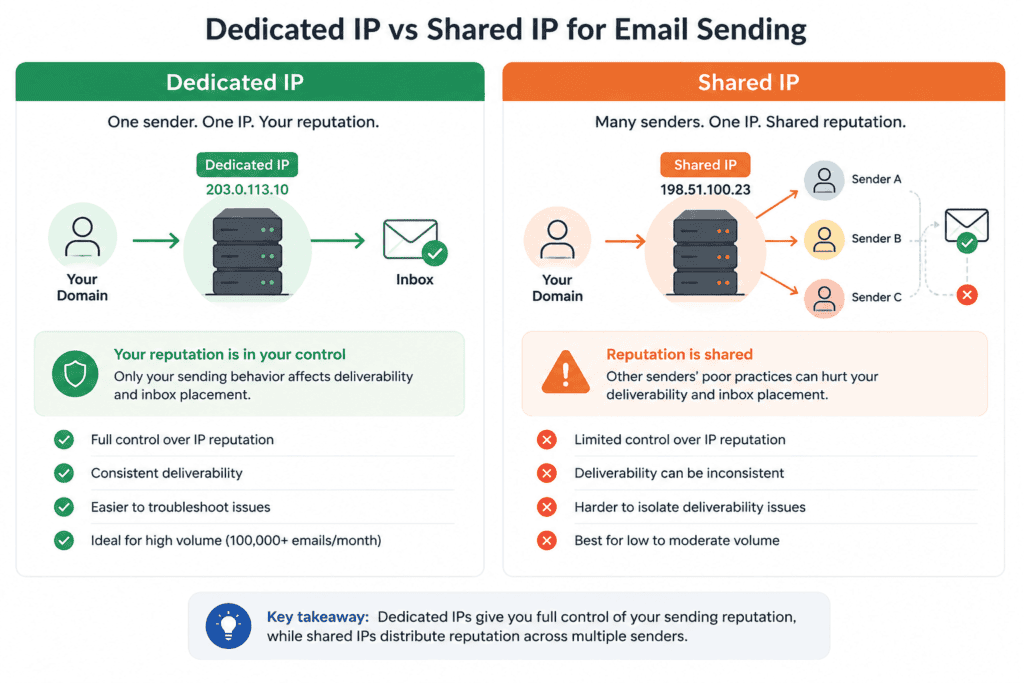
Image by author
Stream separation. Mixing transactional and bulk email on the same sending server is one of the most common deliverability problems at scale. Providers that enforce stream separation by default provide that protection without extra configuration.
Analytics and deliverability monitoring. A generic “delivered” count tells you almost nothing at volume. Deliverability research puts global inbox placement at around 84%, meaning a 99% delivery rate can coexist with one in six emails never reaching the inbox. You need per-mailbox-provider breakdowns, bounce categorization, and real-time webhooks to track email deliverability rates and diagnose issues before they become customer-facing.
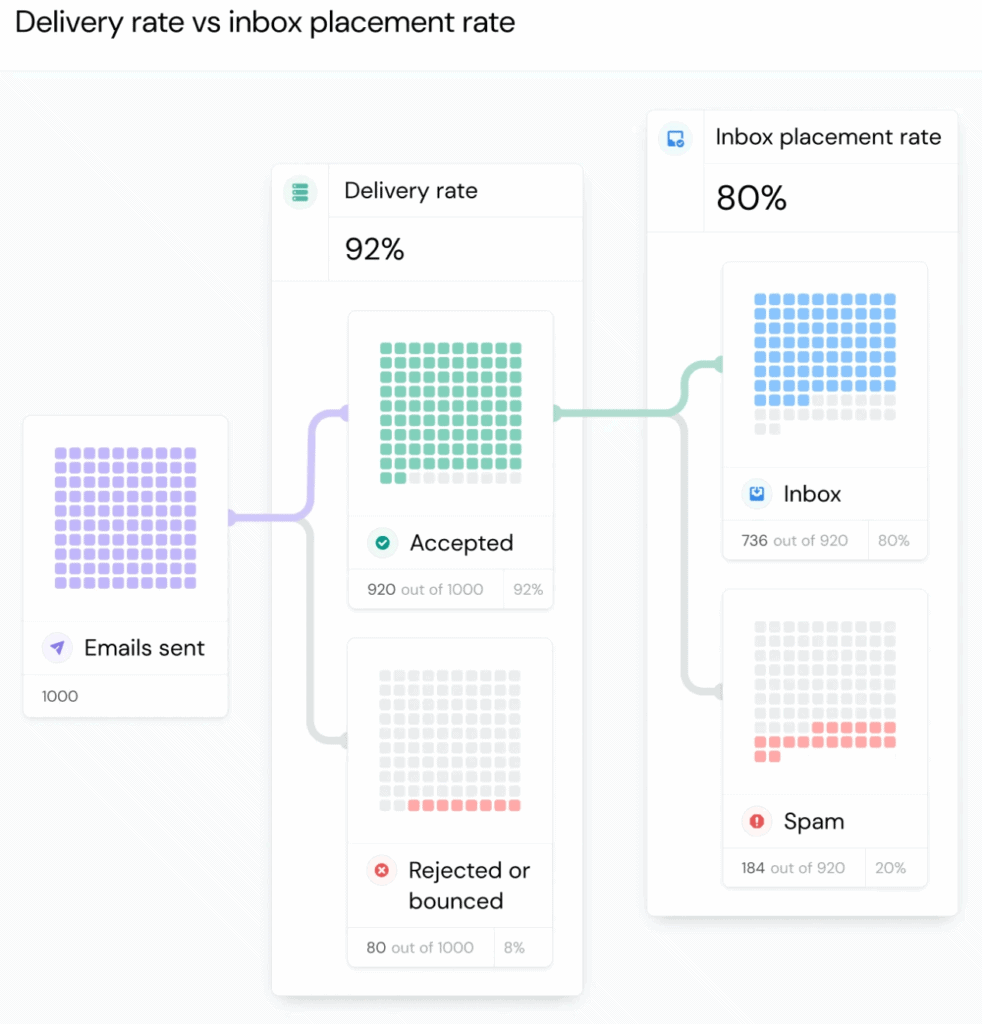
Illustrative example: A 92% delivery rate can still result in only 80% of accepted emails reaching the inbox.
Pricing at your actual volume. Entry-tier prices look similar across most providers. The real comparison happens at 50,000 or 100,000 emails monthly. Run the numbers at your expected volume before you commit.
Email content. Delivery infrastructure gets your email to the inbox, but the content determines whether it gets opened. Teams running SaaS newsletters alongside transactional sends should treat copy quality as seriously as configuration: getting SaaS email marketing right is its own discipline, separate from the delivery infrastructure.
Which email delivery platform to choose
Choose Mailtrap when you need stream separation handled automatically, dedicated IPs with built-in warm-up, and per-provider analytics included without add-ons.
Choose Twilio SendGrid when you’re already inside the Twilio ecosystem and want email, SMS, and voice on a single billing account.
Choose Amazon SES when per-email cost is the primary driver and your engineering team has the DevOps capacity to build the observability and suppression layer on top of AWS.
Choose Postmark when fast delivery is the top priority. Dedicated IPs are only available at 300,000+ emails.
Choose Mailgun when pre-send email validation and per-domain routing control are core to your workflow.
Whichever platform you land on, the email marketing strategies behind your campaigns are a parallel decision: infrastructure handles delivery, content drives whether anyone opens it.
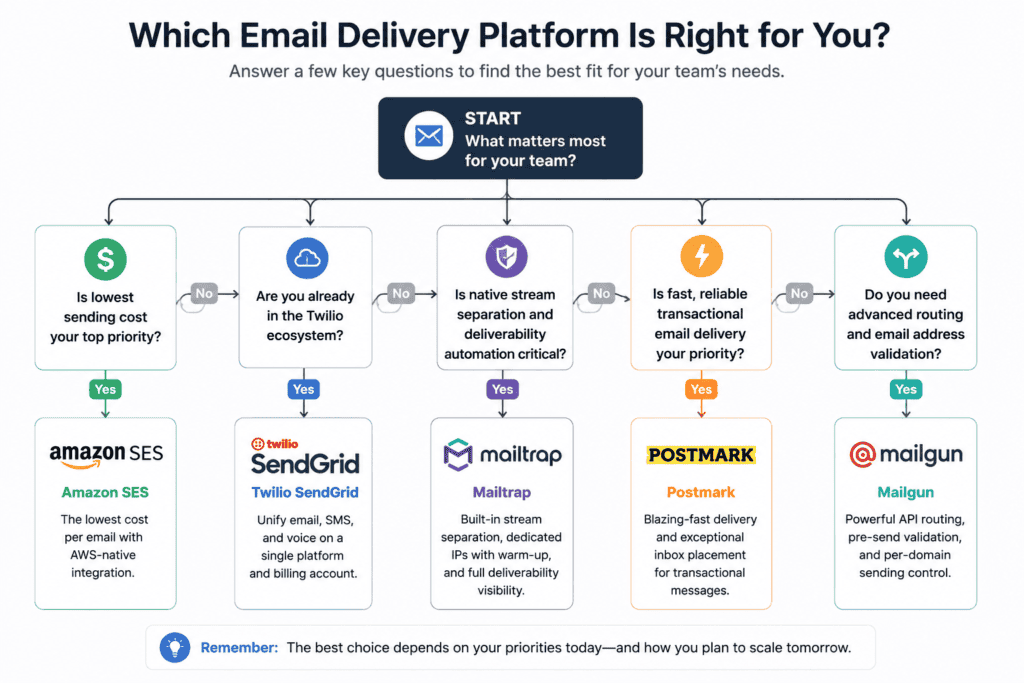
Image by author
Best email delivery platforms for high volume sending
1. Mailtrap: best for high deliverability and native stream separation
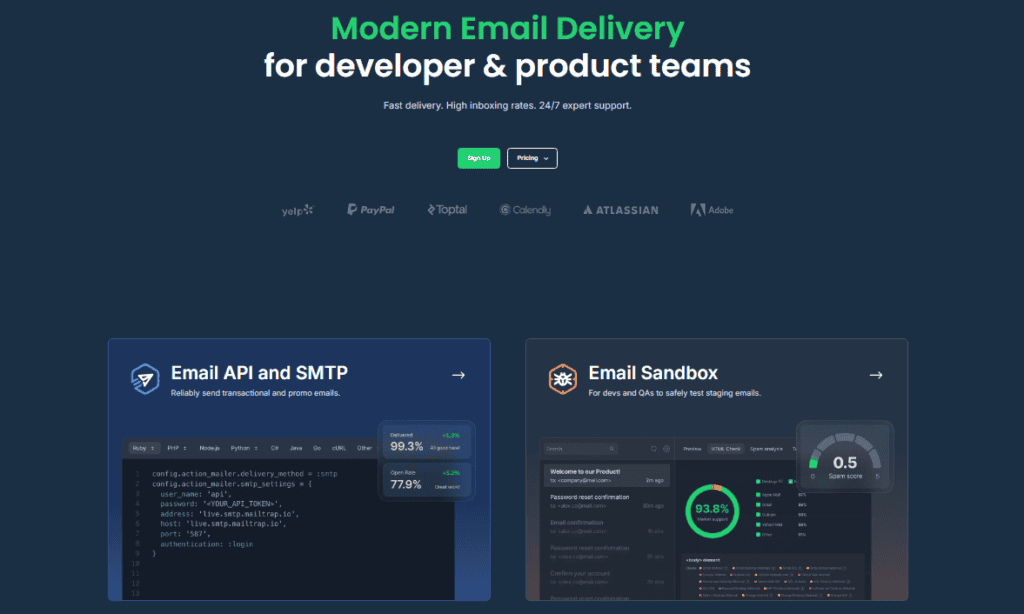
Mailtrap is an email delivery platform built for developers and SaaS teams that need high deliverability at scale. Its core feature is built-in stream separation that keeps transactional traffic isolated from bulk and marketing emails by default.
Sending infrastructure: Mailtrap handles both outbound sending and inbound email processing. Setup takes about five minutes from account creation to first send. Mailtrap sends emails via both a RESTful API and SMTP relay, with official SDKs for Node.js, Ruby, PHP, Python, .NET, Elixir, and Java, plus 25+ framework snippets covering Laravel, Symfony, Django, Rails, and Next.js. Native integrations with Vercel and Supabase make it easy to drop into modern stacks.
Email MCP servers have become standard in AI-assisted dev stacks; Mailtrap lets tools like Claude Code and Cursor trigger sends directly, without wrapper code.
Deliverability and authentication: Once you add the required DNS records, Mailtrap automatically verifies the SPF, DKIM, and DMARC configuration. You can test SPF records to confirm everything is aligned before you start sending at volume. DKIM keys rotate monthly without manual intervention, so stale keys don’t quietly damage your inbox placement. Dedicated IPs on the Business plan include automatic warm-up.
Mailtrap keeps email logs for 30 days. The Agent Inbox provides AI agents with a dedicated email address and delivers inbound messages as structured JSON over a webhook, ready to act on in a single API call.
Real-time webhooks cover all standard delivery events with 40 retries over five minutes. Drill-down analytics track inbox placement, opens, clicks, bounces, and spam complaints across Gmail, Outlook, and other mailbox providers, all included on every paid plan with no add-ons required. Mailtrap holds ISO/IEC 27001:2022, SOC 2 Type II, and GDPR certifications, with a 99% uptime SLA.
Pricing:
| Plan | Price | Emails/Month |
| Free | $0 | 4,000 |
| Basic | From $15 | 10,000 |
| Business | From $85 | 100,000 |
| Enterprise | From $750 | Up to 1,500,000 |
Best for: developers and SaaS product teams that need high email deliverability, native stream separation, automatic DKIM rotation, and built-in full analytics.
2. Twilio SendGrid: best for unified Twilio ecosystem sending
SendGrid launched in 2009, was acquired by Twilio in 2019, and fully merged into twilio.com in February 2026. Its strongest argument is ecosystem consolidation: if your team already uses Twilio for SMS, voice, or identity verification, adding SendGrid means a single billing account, a single contract, and one fewer vendor to manage.
Sending infrastructure: Twilio SendGrid supports SMTP and a RESTful API, with SDKs for Node.js, PHP, Python, Ruby, Java, Go, and C#. Server-side dynamic templates use Handlebars for personalized transactional content, with drag-and-drop and HTML editor options for teams that need a visual email builder. Teams that use SendGrid’s visual editor may still draft newsletter copy in Google Docs. Wordable can export those drafts directly to HubSpot without manual reformatting.
The platform keeps activity logs for 30 days on paid plans. Real-time event webhooks retry for 24 hours after a failure.
Deliverability and authentication: You configure SPF, DKIM, and DMARC manually through DNS. Twilio SendGrid runs continuous sender reputation monitoring. Suppression is automatic. The platform holds SOC 2 Type II certification and is GDPR compliant under Twilio’s data processing agreements. Support availability varies by plan, so teams that need rapid incident response should confirm the included support level before committing.
Pricing:
| Plan | Price | Emails/Month |
| Essentials | $19.95 | 50,000 |
| Pro | $89.95 | 100,000 |
| Premier | Custom | Enterprise volume |
No permanent free tier. A 60-day free trial includes 100 emails per day; after that, it expires.
Best for: enterprise teams already inside the Twilio ecosystem that want email, SMS, and voice under one account and can handle stream separation setup themselves.
3. Amazon SES: best for cost-efficient sending on AWS
Amazon SES is low-cost email infrastructure that requires more configuration than the managed platforms in this list. SES provides account-level suppression controls and event publishing through AWS services, but your team must still configure the surrounding monitoring, routing, and operational workflows.
Sending infrastructure: SES exposes a standard SMTP interface and a RESTful API via the full AWS SDK, available in JavaScript, Python, Java, Go, Ruby, PHP, and more. SMTP works with any standard mail library and is accessible from any developer stack. Native integrations connect directly to Lambda for event-driven workflows, S3 for log and attachment storage, and SNS for complaint and routing events.
Deliverability and authentication: SES supports SPF, Easy DKIM, and DMARC, but all three require manual configuration. Complaint notifications route through Amazon SNS, and you build suppression logic on top of the account-level list. The optional Virtual Deliverability Manager adds analytics dashboards and reputation monitoring at $0.07 per 1,000 emails.
Pricing:
| Usage | Cost |
| Per 1,000 emails | $0.10 |
| Free tier | 3,000/mo for first 12 months |
| Dedicated IP | $24.95/mo each |
| Virtual Deliverability Manager | $0.07/1K (add-on) |
Best for: engineering teams already on AWS where per-email cost is the primary constraint and the team has DevOps capacity to build suppression management, delivery event handling, and analytics themselves.
4. Postmark: best for transactional delivery speed

Postmark is an email service built to deliver email into inboxes fast. Every new account undergoes a manual review before live sending is enabled, which helps keep the shared IP pools clean across all senders on the platform. Fast delivery is the platform’s core value, not a feature among many, but the entire product strategy.
Sending and integration: Postmark supports SMTP and an API, with an SDK library covering Node.js, PHP, Python, Ruby, .NET, Java, and Go. Message Streams separate transactional, broadcast, and inbound email by default. Bounce processing, categorization, and suppression are all handled automatically. Postmark retains activity logs for 45 days. Webhooks track delivery, bounce, open, click, and spam complaint events.
Deliverability and authentication: Postmark supports SPF, DKIM, and DMARC. The strict account review process and transactional-only policies keep shared IP pools at a high standard for inbox placement. Dedicated IPs are only available to accounts sending 300,000+ emails, at $50 per month each. Below that threshold, you’re in the shared pool. Postmark is SOC 2 Type II certified.
Pricing:
| Plan | Price | Emails/Month |
| Starter | $15 | 10,000 |
| Growth | $55–$66 | 50,000 |
| Scale | $115–$138 | 100,000 |
No permanent free tier. The trial covers 100 emails. Dedicated IPs cost $50/mo and are available only for accounts with 300,000+ emails.
Best for: SaaS teams where fast delivery and inbox placement are the top priority and dedicated IPs at lower sending volumes aren’t a hard requirement.
5. Mailgun: best for API routing and pre-send validation
Mailgun is an API-first email delivery platform built for teams that need fine-grained routing control. The built-in email validation API checks addresses against DNS/MX records, disposable domain lists, and syntax rules before any message goes out.
Sending and integration: Setup takes 10 to 15 minutes to complete, including DNS records, domain verification, and API key configuration. Mailgun provides SMTP and a transactional email API, with SDKs covering Node.js, Python, PHP, Ruby, Java, Go, and C#. Batch sends accept up to 1,000 recipients per API call, with per-recipient variables for personalization. Domain-specific API keys give per-domain permission control, which is useful for multi-tenant setups.
Deliverability and authentication: Mailgun supports SPF, DKIM, and DMARC, but hands the configuration to you. Dedicated IPs cost $59 per month each, the highest of the five providers here. The base plan retains email logs for only 5 days, which can be problematic if you rely on them to quickly debug delivery issues. Webhooks retry for eight hours on failure. The Scale plan includes a 99.99% uptime SLA.
Pricing:
| Plan | Price | Emails/Month |
| Free | $0 | 100/day |
| Basic | $15 | 10,000 |
| Foundation | $35 | 50,000 |
| Scale | $90 | 100,000+ |
Dedicated IPs cost $59/mo each. Overage runs $1.80 per 1,000 emails.
Best for: developer teams that need pre-send address validation, inbound email routing, and per-domain API key control as core tooling.
Choosing the right high volume email delivery platform for your team
The best email delivery platform for high volume sending depends on what you’re optimizing for.
If you need email deliverability and visibility with minimal DIY configuration, Mailtrap’s native stream separation, automatic DKIM rotation, auto IP warm-up, and per-provider analytics give you everything set up from the start.
The Business plan at $85 per month covers 100,000 emails, a dedicated IP, and automatic warm-up. It’s the strongest option for SaaS teams and developers who need to deliver email reliably without building their own monitoring stack. SaaS brands scaling through content-driven growth and working with link building and digital PR agencies to build organic traffic need that delivery stack solid before those channels can activate and retain the audience they bring in.
If cost at extreme scale is the primary constraint and your team lives on AWS, Amazon SES at $0.10 per 1,000 emails is hard to beat. Just account for the engineering time you’ll spend building what other providers include by default.
If you’re already on Twilio, adding Twilio SendGrid for email is the simplest path. Postmark is built for speed above all else, and it’s the right choice for SaaS teams where a delayed password reset or 2FA code directly hurts the user experience. And if pre-send validation and routing control are core to your email sending strategy, Mailgun is the right fit.
One rule applies regardless of which email service provider you choose: get DNS authentication configured before your first production send. Set up suppression and start tracking delivery logs before you scale. And where possible, choose the provider that handles warm-up, suppression, and DKIM rotation for you by default.
Once delivery is stable, teams can connect email to a broader SaaS content marketing program that turns acquired traffic into retained subscribers. uSERP’s link-building services can help high-growth SaaS brands expand organic visibility and drive more qualified users into their owned channels.
Frequently asked questions
What is a high volume email delivery platform?
A high-volume email delivery platform is an email service designed for large-scale sending, typically 100,000 or more emails per month, with infrastructure to maintain email deliverability and inbox placement at that volume. This includes SMTP relay and API access, dedicated IPs, IP warm-up support, authentication enforcement, and per-mailbox-provider analytics to track performance across Gmail, Outlook, and Yahoo.
Do I need a dedicated IP for high volume email sending?
At volumes above 100,000 emails per month, a dedicated IP isolates your sender reputation from other senders in a shared pool. Availability and cost vary: Mailtrap includes it on the Business plan ($85/month), Amazon SES offers it as an add-on ($24.95/month), Mailgun charges $59 per month per IP, and Postmark only makes dedicated IPs available for accounts with 300,000+ emails.
What is IP warm-up, and why does it matter for high-volume sending?
IP warm-up is the process of gradually increasing email sending volume from a new IP address to build trust with mailbox providers. Skip it, and your emails land in spam filters instead of inboxes. For high-volume senders, the standard warm-up period runs four to six weeks. Mailtrap handles this automatically on the Business plan. Amazon SES and Mailgun leave the schedule to you.
What’s the difference between transactional and bulk email, and why does separation matter at scale?
Transactional email is triggered by user action, such as password resets, purchase confirmations, and 2FA codes. Bulk email covers newsletters, promotional campaigns, and email marketing to subscriber lists. Content teams that write newsletter copy in Google Docs often publish it directly to WordPress or HubSpot before the email platform takes over, keeping the content workflow separate from the delivery workflow. When they share the same sending pool, a spam filter flag from email campaigns can delay or block your transactional email. Mailtrap and Postmark enforce separation at the sending level by default.
Which high-volume email delivery platform offers the best pricing at scale?
Amazon SES is the cheapest at $0.10 per 1,000 emails, but you have to build your own analytics and suppression. Mailtrap’s Business plan ($85/month) includes 100,000 emails, a dedicated IP, stream separation, and analytics. Twilio SendGrid Pro runs $89.95 per month, and Mailgun Scale runs $90 monthly for the same volume, with dedicated IPs charged separately on both. Postmark is the most expensive at $115–$138 per month for 100,000 emails.