




Affiliate marketing generates huge revenue for content creators such as bloggers and influencers. Some entrepreneurs even create entire businesses based on it.
Whether you’re a creator or an entrepreneur, if you do affiliate marketing, one thing remains true: you should leverage search engine optimization (SEO) to boost your organic traffic and sales. Several tips and techniques can help you create SEO-friendly affiliate marketing content.
This article will discuss the ins and outs of optimizing affiliate marketing for search engines. It will also include tips for affiliate marketing SEO, such as finding a niche and choosing the right domain.
Before diving into affiliate marketing SEO, we will quickly review the basics of affiliate marketing.
What is affiliate marketing?
Affiliate marketing is a sales technique in which an affiliate sells items from another retailer in exchange for a commission. Affiliate marketers receive unique links that allow the retailer to track their sales and pay them accordingly.
Commission rates vary according to the product type and industry, and the affiliate program sets the amount. According to Influencer Marketing Hub’s 2023 Affiliate Benchmark Report, retail generates the most affiliate revenue of any industry (44%), followed by telecom and media (25%), and finally, travel and leisure (16%).
Who can be an affiliate marketer?
Anybody can be an affiliate marketer if they can drive traffic to sell a product. Some affiliate marketers start with an audience from previous content creation initiatives, and some begin with no following.
If you are starting from scratch, do not fret. You can build an audience to funnel through several different affiliate sales channels. We’ll cover these channels shortly.
What can you sell with affiliate marketing?
You can sell just about anything as an affiliate marketer. However, some specific types of things you can sell include:
- Consumer goods (clothes, household goods, seasonal items, etc.)
- Professional services (to businesses or consumers)
- Digital products (ebooks, art, video games, etc.)
- Educational services
- Memberships
As an affiliate marketer, it’s up to you to determine what products resonate best with your target audience. If you try to push irrelevant products to your audience, they will likely lose trust and interest in your content. For example, if your brand focuses on fashion or lifestyle, promoting custom clothes or unique products like personalized gift boxes can be a natural and highly effective choice that aligns with your audience’s interests.
Many creators also choose to use custom boxes for packaging or product presentation, which can make the product more memorable and shareable on social media.
How to become an affiliate marketer
If you haven’t already started your affiliate marketing business, do not fret. It’s relatively easy to get started. Several popular affiliate programs give you access to millions of products to sell, including the Nike Affiliate program, Amazon Affiliate program, and CJ.com.
You can also work directly with all sorts of retailers to become an affiliate for their brand. Some businesses have large affiliate programs you can apply for on their website. Smaller companies may not have a well-established affiliate program, but if there’s a brand you love, reach out to see if they’d be interested in a partnership.
Once you have affiliate links for products you want to sell, you can promote them just about anywhere.
Affiliate marketing channels
Before we dive into our tips for optimizing affiliate marketing content for search engines, it’s important to understand possible sales channels for affiliate marketing. You can use a mix of several channels, such as your website or specific social media platforms, to reach your target audience wherever they are. In some cases, sellers also rely on affiliate marketing proxies to manage multiple accounts or campaigns more securely, ensuring a wider reach without risking platform restrictions.
With that said, here are some of the top sales channels to leverage for affiliate marketing.
Your website
A website is a great sales channel for affiliate marketing, especially if you plan to use SEO to drive your growth. The most common way to use a website for affiliate marketing is through a blog.
With blog content, it’s really easy to plug affiliate links in a way that flows naturally. Some great types of blog posts for making affiliate sales include:
- Product comparison posts
- Product reviews
- Travel guides
- Gift guides
- Tutorials
- Recipes
Some of these article types are more product-focused than others, but they all offer opportunities for sales.
For example, you can create a product comparison post that looks at the top bread-proofing baskets and provides links to the baskets you’re discussing. Alternatively, you can write an article with an artisan bread recipe and add a link to your favorite proofing basket within the recipe.
NerdWallet is a great example of an affiliate site that leverages product comparisons.

The best part of using your website as your primary affiliate sales channel is that you own it. With social media and other channels we will cover, you’re at the mercy of the platform. If you’re shadowbanned on social media or your account is hacked, you may risk losing everything you’ve worked to build.
Social media
Social media is one of the largest channels for affiliate marketing. Influencers who use this channel regularly connect with their audience, making it an excellent source of income.
Many social media content creators use an affiliate platform called LTK to link to their outfits, household goods, and other favorite items. They can then direct their social media followers to this app and earn a commission on any item they post.

Some social media platforms, like Pinterest, are also search engines. SEO is important in these situations. Later in this article, we will examine this specific example.
Email marketing
Email marketing is another excellent way to make affiliate sales. Experts in SEO understand the combined sales and SEO benefits of email marketing.
Affiliate marketing emails are a great way to distribute or repurpose the SEO blog you create. Include affiliate links directly in your email newsletter, product guide, etc.
If you’re interested in email affiliate marketing, ensuring you’re organically sourcing your contacts is vital. Contacts you gain from lead capture forms or past buyers are more valuable than those you purchase from a generic list.
Paid ads
Like email affiliate marketing, paid ads aren’t directly related to SEO or organic traffic, but they are worth mentioning on this list. Some affiliate marketers run paid ads to drive traffic to their affiliate links.
What’s nice about paid ads is that you can get very specific on who you’re targeting. Plus, some advertising technology is very intuitive, so it automatically pivots and iterates based on the results of previous campaigns.
Some of the most popular advertising platforms are Google Ads (which includes YouTube), Meta Ads (which includes Facebook and Instagram), LinkedIn, and TikTok ads.

11 Tips for affiliate marketing SEO
Now that you’re more familiar with some of the basics of affiliate marketing, let’s look at some of the top tips for optimizing your affiliate marketing initiatives for search. This is more commonly known as affiliate marketing SEO.
1. Establish a niche
Establishing a niche is valuable for affiliate marketing and SEO, both separately and together. It’s essential for affiliate marketing since it enables you to focus on a specific audience and grow in that space. On the other hand, it’s important for SEO since it allows you to build domain authority, and search engines recognize the consistent effort of publishing within that niche.
If you’ve started to build a following on a blog or social media platform, your affiliate marketing niche should align with whatever content you’ve already created.
However, if you’re starting fresh, the options are endless. Think about which industries interest you most, and assess the demand within that industry. An excellent way to evaluate demand is by looking at Amazon and checking out which items have the most reviews. If a product has thousands of reviews across several different listings, that’s a good indicator that people are into it.
You can also use keyword research tools to assess the demand for a product. Look up some keywords related to the industry or product you want to sell to determine how many people are searching for it each month. Leveraging AI development services can further streamline keyword analysis and market research, helping businesses identify profitable opportunities more efficiently. Again, thousands of people searching for something indicate it’s in demand.
Pro tip: When researching different industries, consider using recommended mobile proxy solutions to gather accurate data on market trends and consumer behavior.
2. Create people-first content
No matter what you use SEO for, creating people-first content is crucial. This provides the best user experience and appeals to Google’s preference for people-first content.
If you’re unfamiliar with this concept, “people-first” means that you write content for readers and not exclusively to rank. Your content must offer value to your audience. There is no room for fluff, keyword stuffing, or anything else.
Google’s E-E-A-T technique is an excellent path for creating people-first content. Every piece of content should demonstrate experience, expertise, authoritativeness, and trustworthiness. By focusing on topics that enable you to check all those boxes, you’ll be on track to create high-quality content.
For example, if you’re a tech guru focusing on remote meeting software, creating a Christmas shopping guide for toddlers makes no sense. In this example, your content should stay within the realm of live conferencing, webcams, technical integrations, and similar topics.
3. Choose an optimal domain
Another part of implementing a successful affiliate marketing campaign on your website is choosing an optimal domain name. You should choose a domain name relevant to your niche or brand.
If you don’t choose a branded domain, focus on the primary keyword you want associated with your business. Keep it short, simple, and direct. It’s also essential to use a reliable domain root, such as .com, .io, or .org.

5. Scope out the competition
Staying on top of the competition is crucial for securing high search engine rankings. You should keep tabs on what your competitors are doing to know how to improve your content. The goal should be to fill in the gaps in your competitors’ content or
Depending on the nature of your business, competitors could include other affiliate companies or retailers that sell similar products.
6. Tap into Pinterest
As we briefly mentioned, Pinterest is a search engine. While it has a social aspect, people most commonly use it for its search functionality. People use Pinterest to make vision boards, find outfit inspiration, browse recipes, and more.
If Pinterest is part of your target audience’s buying experience, you should publish and optimize content there. This requires graphic design resources since the platform uses a visually focused interface to drive traffic to links attached to “pins.” Getting results with Pinterest affiliate marketing is pretty easy as you can directly link to an affiliate URL from Pinterest instead of sending them to your website. This can get you a lot more conversions.
7. Target long-tail keywords
Long-tail keywords are low-hanging fruit that you should include in your affiliate SEO strategy. This type of keyword typically ensures high search intent since they are more specific than one- or two-word queries.
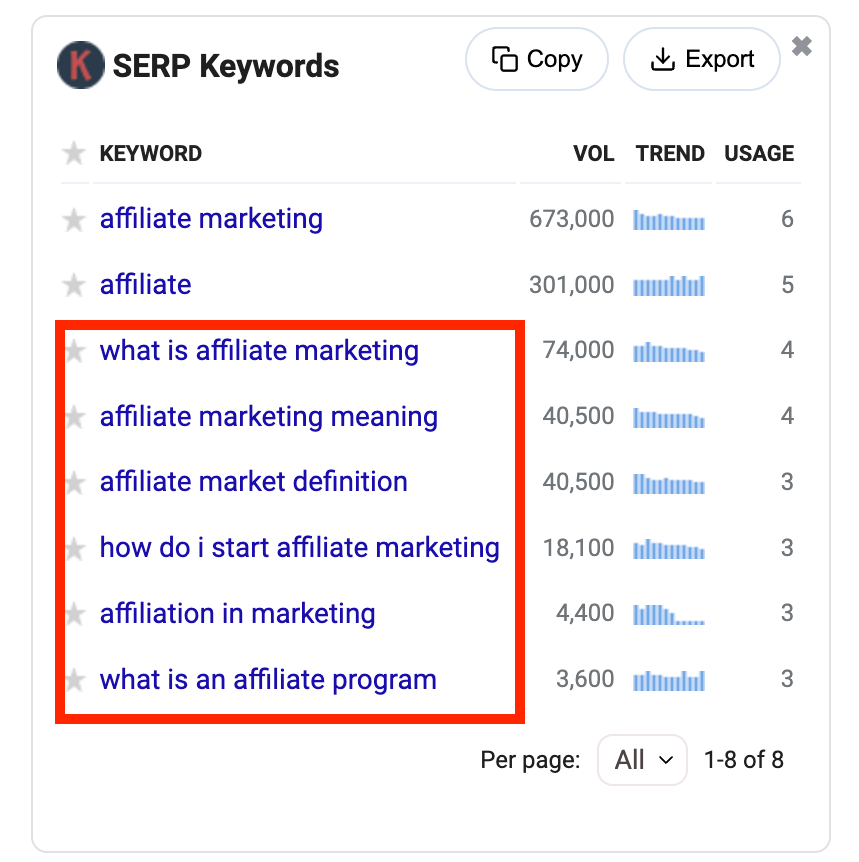
Since long-tail keywords are usually less competitive than broader search queries, they are also low-hanging fruit. You can target them as the primary keyword of a dedicated post or as secondary keywords in other articles.
8. Leverage SEO technology
You can use many tools to optimize the affiliate marketing content on your website. Some of the top tools for SEO include:
- Keyword research: Keywords Everywhere, SEMrush, Google Trends
- Analytics: Google Search Console and Google Analytics
- Content graders: Frase, Content Harmony, Ahrefs
- Site crawlers: Moz and SpyFu
These tools include paid and free options, so affiliate marketers have various accessible choices.
9. Get clever with long-form content
Long-form content is the backbone of many affiliate marketing SEO strategies. They allow you to go in-depth on a topic, which is excellent for helping your content rank. Plus, longer articles create many natural opportunities to place affiliate links.
Some types of long-form blog posts you can create include:
- Product comparisons
- How-tos/tutorials
- Product reviews
- Buying guides
- Gift guides
Different types of long-form articles make sense for different buyers, so consider this when crafting your content strategy.
10. Invest in professional SEO support
It’s very possible to optimize your affiliate marketing content for search engines on your own. However, if you want to jump-start your initiatives or you’re ready to scale your affiliate marketing SEO, it’s wise to lean on the support of a professional SEO service.
Some SEO efforts you can hire a specialist for include:
- Backend/techncial SEO
- Content creation
- SEO strategy
- Link building
- UX design
Outsourcing to these professionals saves you time and resources since these SEO initiatives take time to learn and implement. Not to mention, outsourcing allows you to focus on your strengths within the business.
11. Pivot as necessary
Like any digital marketing technique, there is trial and error in SEO. As you publish more blog posts, you’ll get an idea of what your audience views as valuable content based on page traffic, click-through rates (CTR), conversion rates, and so forth.
Use this information to adjust your content. When you understand what your audience responds to, you can prune and refresh existing content and plan content more strategically going forward.
If affiliate marketing SEO isn’t working for you, another option is to launch your own affiliate program. This way, instead of relying solely on promoting other brands’ products, you can incentivize affiliates to promote your business. Tools like ReferralCandy make it easy to set up and manage an affiliate or referral program, helping you drive sales through word-of-mouth marketing.
Level up your affiliate marketing SEO and reap the rewards
Enhancing your affiliate marketing SEO is an excellent way to drive more traffic to your site and boost your earnings. You can use the tips and tricks we’ve covered in this guide to supercharge your affiliate marketing site’s SEO in no time.
Ready to boost your SEO and grow your affiliate marketing endeavors? uSERP is here to help. Book a call to learn how we can help you with link building, content creation, and other SEO initiatives.