




If you’re considering hiring a link insertion service but not sure how it compares to guest posting, you’ve come to the right spot.
This is a common question in the B2B and SaaS space, and for good reason. But most importantly (and spoilers) they both are helpful at delivering ROI!
Let’s take a closer look at the differences between link insertion services versus guest posts. I’ll walk you through some scenarios where one may be better than the other, and the real ROI equation to pay attention to. 👇
Highlights
- Link insertions prioritize speed and efficiency but limit strategic control.
- Guest posts take more effort but often align better with B2B buyer intent.
- SaaS companies benefit more from contextual authority than isolated links.
- ROI depends on whether you optimize for rankings or conversions.
- The strongest strategy often combines both … intentionally.
What is a link insertion service?
A link insertion service places your backlink into existing, already-published content on relevant websites. Instead of creating new articles, they insert your link into content that already ranks, has traffic, and carries domain authority.
Here’s how it works. 👇
You (or your provider) identify articles that:
- Rank for relevant keywords
- Have authority (DR 60+)
- Fit your niche
Then you negotiate placement and insert your link naturally into the content.
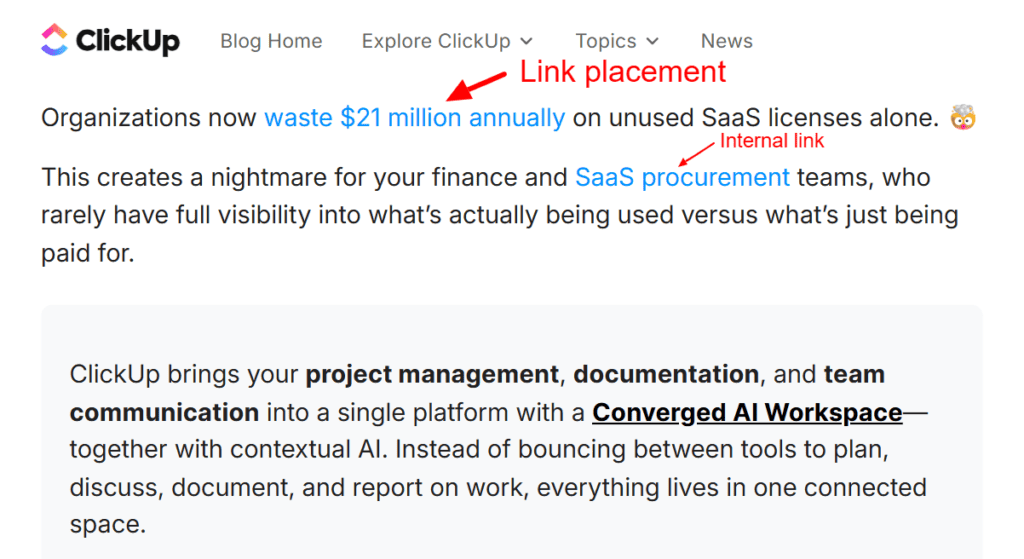
Here’s an example of a backlink insertion and an internal link that are embedded in a ClickUp blog post:
Why marketers use link insertions
Link insertions give you:
- Less production overhead. You don’t manage briefs, guest posting, or revisions.
- Faster placement. A link can go live in days, not weeks.
- A lower cost per link. (Usually.)
Where link insertions fall short
The problem with link insertions is WHO you’re getting them from. Unless you’re a pro at outreach and link speak, you’ll likely need to invest in link insertion instead of DIY-ing it.
And if you buy from a cheap provider … Well, you get what you pay for. They typically have a non-existent evaluation process. Meaning you’ll get a list featuring the same overused sites, pick where to place your links, and hope it’ll result in long-term ROI. (Spoilers: Cheap links don’t!)
- You don’t control the surrounding content. If the article is outdated or loosely relevant, your link inherits that weakness.
- You inherit existing context. If the article targets a different audience or intent, your link may feel forced. Or get ignored.
- You can’t shape topical depth. You’re adding a signal, not building authority. This limits your long-term SEO impact.
So yes, link insertions are efficient. But they’re structurally constrained.
What are guest posts?
Guest posts are original articles you create and publish on external websites, with backlinks pointing to your site.
Unlike link insertions, you control the entire piece, from topic selection to messaging to internal linking.
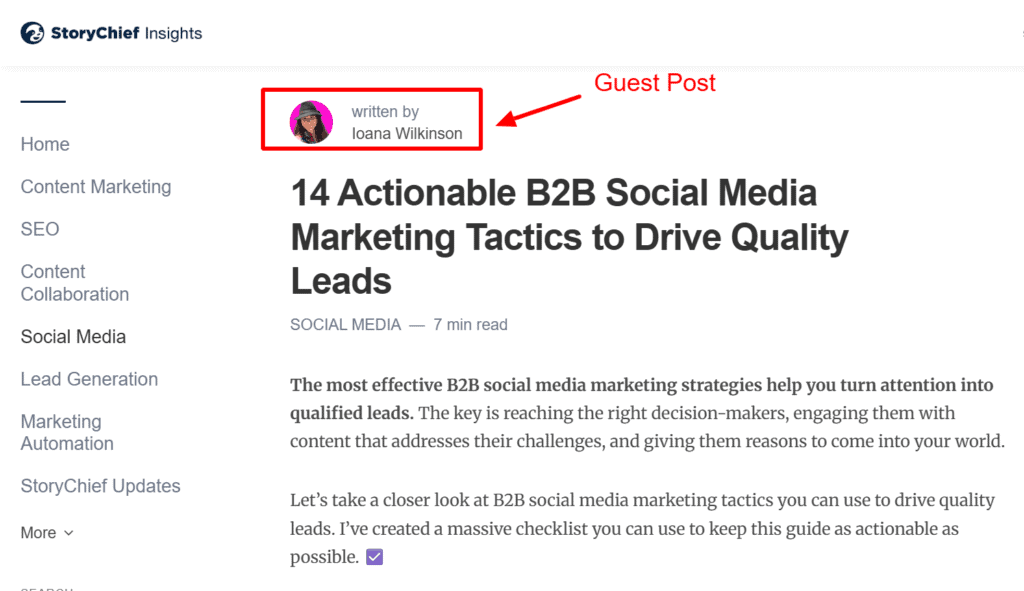
Here’s a guest post I wrote for StoryChief, for example:
What makes guest posts highly effective for B2B and SaaS
Guest posts allow:
- Intent targeting. You can align content with specific buyer stages (e.g., awareness, consideration, or decision).
- Semantic coverage. You can build depth around your core topics, which strengthens topical authority.
- Internal linking to money pages. You can guide readers toward high-conversion pages with context.
- Full content shaping. You can decide the angle, structure, and narrative.
Why this matters for B2B SaaS
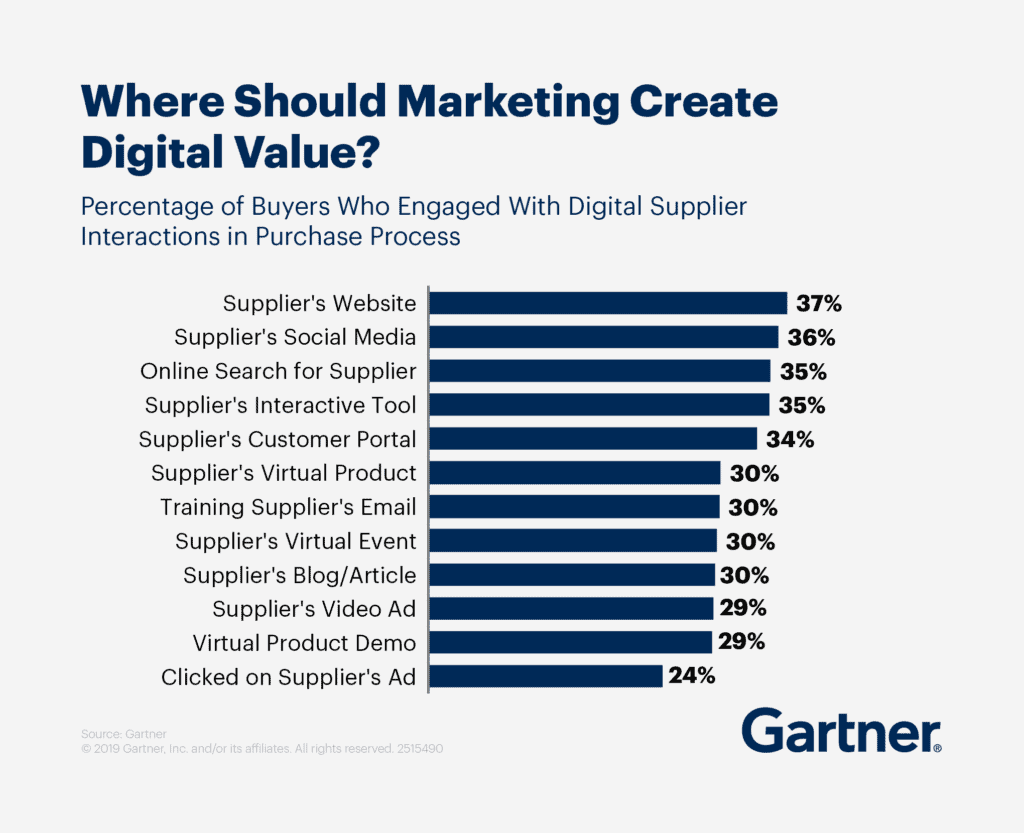
B2B buyers at big companies are doing a lot more homework on their own before ever speaking to sales. In fact, Gartner research says that 75% of B2B buyers prefer a rep-free sales experience. This means marketing now shapes a bigger part of the journey, and that journey tends to take longer overall.
Guest posts fit directly into that journey.
They often improve:
- Topical authority coherence. You reinforce your expertise across multiple touchpoints. (Especially important for domain authority, rankings, and AI SEO.)
- Conversion quality. You attract visitors who feel more inspired to buy.
- Lead qualification. Your messaging filters out low-fit prospects.
And if you have solid relationships with sites that allow guest posting (cough cough …) you can also score brand mentions along with links.
With so many B2B buyers turning to online search content, you can’t afford to ignore the channels that shape how they discover, evaluate, and trust your brand before they ever reach out.
Which delivers more ROI for B2B and SaaS: A link insertion service or guest posts?
Here’s the honest answer: It depends on what you define as ROI.
If ROI means faster rankings at a lower cost, a link insertion service often wins. If ROI means pipeline impact, conversion quality, and long-term authority, guest posts outperform.
Scenario 1: You need quick SEO wins
If you’re launching a new page and want to boost rankings as soon as possible, you don’t have time for long editorial cycles.
A link insertion service makes sense here.
You can use it to tap into:
- Established traffic
- Existing authority
- Indexed content
But remember … You’re renting relevance, not building it.
Scenario 2: You’re building topical authority
If you want to dominate a niche or need Google to associate your brand with specific themes, guest posts are the better play.
You can usually control:
- Narrative consistency
- Keyword clusters
- Content depth
This compounds over time. Each article reinforces the next.
Scenario 3: You care about conversions
This is where most SaaS companies struggle. They invest in links and traffic increases … But conversions don’t.
Why? Because the traffic isn’t aligned with buyer intent.
Guest posts can help fix this. You can create guest posts that:
- Speak to real pain points your audience has
- Lead naturally into your solution
- Educate your ideal customer
A link insertion service can’t do that. (Remember, it doesn’t shape the message.)
Scenario 4: You’re scaling link building operations
If you need volume and want predictable output, a link insertion service may scale better.
You can:
- Reduce operational complexity
- Maintain consistent output
- Place links faster
But scaling inefficiency is still inefficiency. If the links don’t support your broader strategy, volume will never save you. Watch out for this, especially if you’re link building with a small budget.
The real ROI equation to pay attention to
Most teams compare tactics in isolation. That’s the mistake.
Instead, you should evaluate ROI based on these three layers:
1. Acquisition efficiency.
Consider the:
- Operational effort
- Time to publish
- Cost per link
➜ Link insertions usually win here.
2. SEO impact.
Consider:
- Ranking improvements
- Keyword coverage
- Authority signals
➜ This is often a tie, depending on execution.
3. Revenue influence.
Look at:
- Pipeline contribution
- Conversion rates
- Lead quality
➜ Guest posts dominate this layer.
And for B2B SaaS, this is the layer that matters most.
The smarter strategy: Combine both.
You don’t need to choose one. You need to use each where it performs best.
For instance, I recommend using a link insertion service for:
- Filling gaps in your backlink profile
- Supporting existing pages
- Boosting rankings quickly
And guest posts for:
- Targeting high-intent keywords
- Building authority in key topics
- Driving qualified traffic
You can also use HARO link building strategies. HARO (Help A Reporter Out) connects journalists with expert sources to help them create credible content. From a link building perspective, it’s one of the most straightforward ways to earn genuine editorial backlinks that impact rankings.

This hybrid approach gives you: Faster ranking gains, stronger authority, and higher-quality pipeline.
This is where real ROI comes from. 💪
Common mistakes to avoid when building links
Here’s where most teams go wrong.
- Measuring success too early. Link building compounds over time. If you expect immediate pipeline impact from a few placements, you’ll misjudge what’s actually working. Give it three to six months, ideally longer.
- Treating link insertions like a shortcut. If you rely on them without a clear content direction, you’ll end up with scattered links that don’t build real authority. (Remember to stay away from spammy networks!)
- Skipping intent alignment. Getting traffic is relatively easy. Getting the right traffic is harder. If your links don’t connect to what your buyer actually cares about, conversions won’t follow.
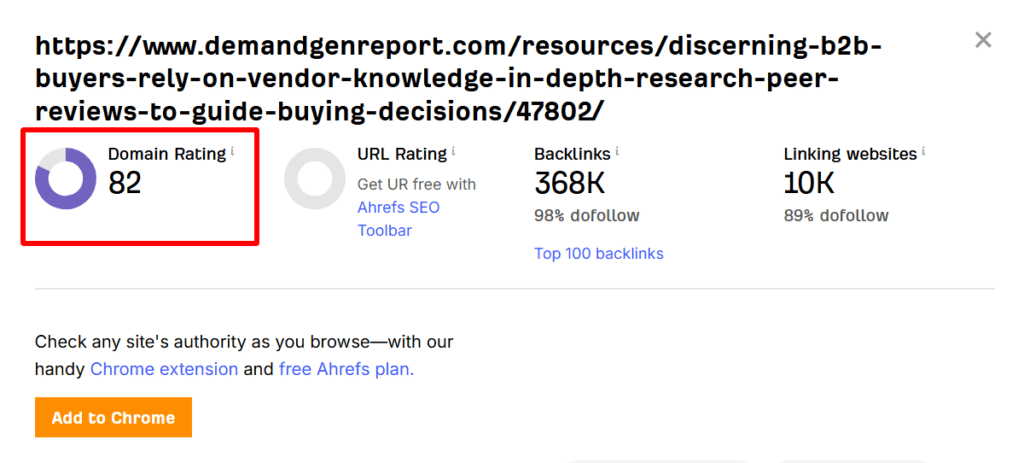
- Buying based on DR alone. High DR looks good on paper. But if the page has no traffic, weak relevance, or exists just to sell links, it won’t move the needle.
- Neglecting relationship building. The best placements don’t come from marketplaces. They come from real partnerships with sites that trust your content.
- Forcing links into irrelevant content. If your links feel out of place, readers will ignore them. So will Google. Context always wins.
- Running link building in a silo. If your SEO, content, and sales teams aren’t aligned, your links likely won’t support revenue.
How to find the right provider for link insertion and guest posting
I want to be straight up with you … In this space, the gap between “good” and “waste of budget” is huge.
I highly recommend using this checklist to evaluate providers before committing to a link building strategy. 👇
Link building provider checklist for B2B and SaaS
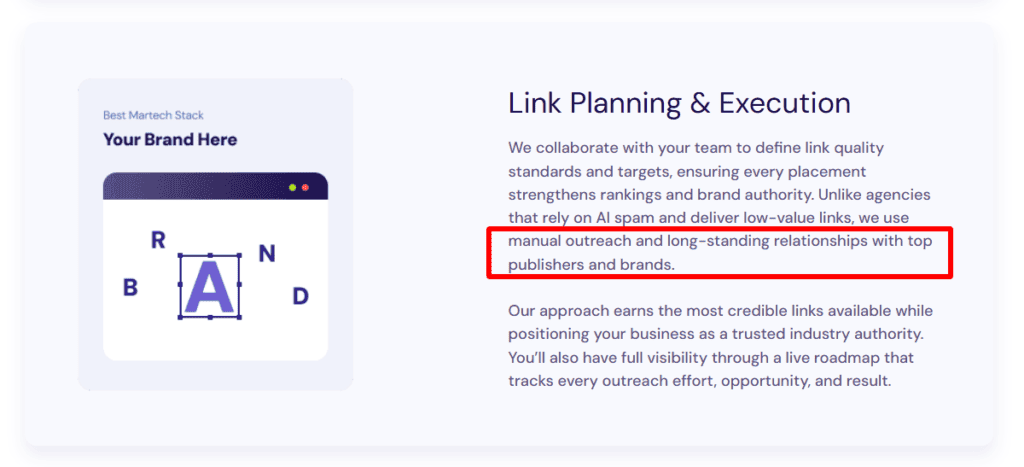
 They explain their outreach process. Is the provider building real relationships or just tapping into a recycled network? Note: You want it to be the first one!
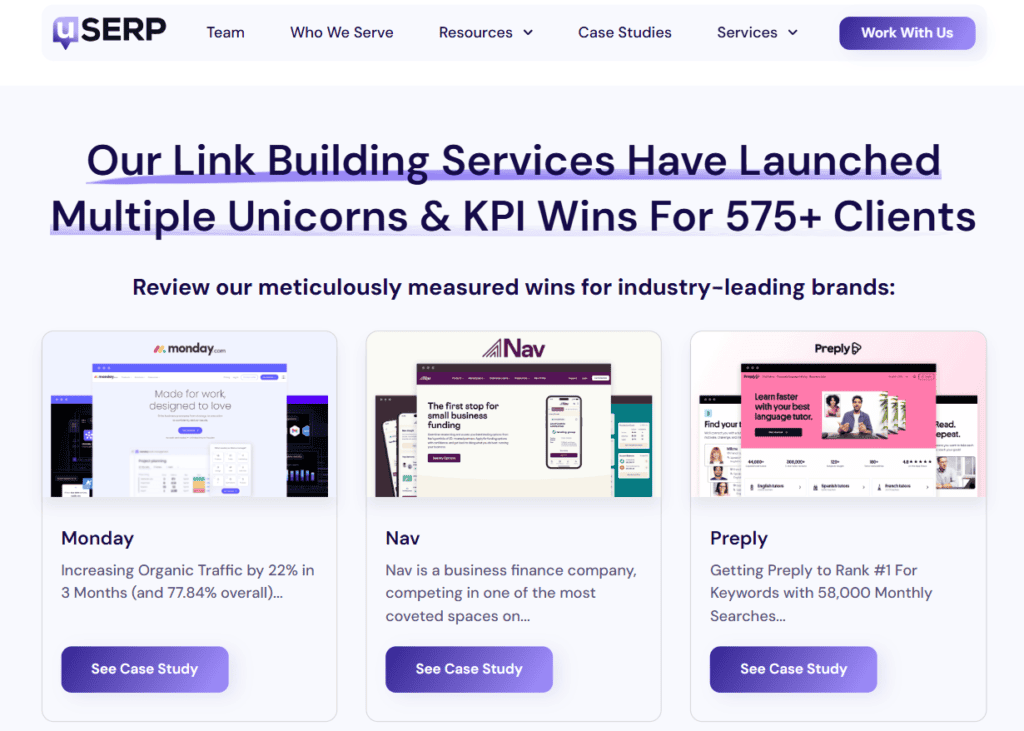
- They show real site examples. (Not vague metrics or sample lists.) You should see actual domains, live links, and recent placements.
- They give you anchor text guidance. They don’t ask “what do you want?” They give you recommendations based on SEO and natural usage.
- They align with your strategy. A good provider asks you about your goals, pages, and audience before suggesting placements.
- They’re transparent about pricing. You should know what you’re paying for. (The site, the placement, the content, or all three.)
- They have plenty of case studies. You should be able to read through several case studies that align with your niche.
- They prioritize niche relevance over DR. If every pitch starts with “DR 70+” but ignores niche fit, that’s a red flag.
- They vet traffic quality. Ask where the traffic comes from. Organic, steady growth beats spikes or random referral noise.
- They offer contextual placements. Your link should sit naturally within content that matches your topic and intent.
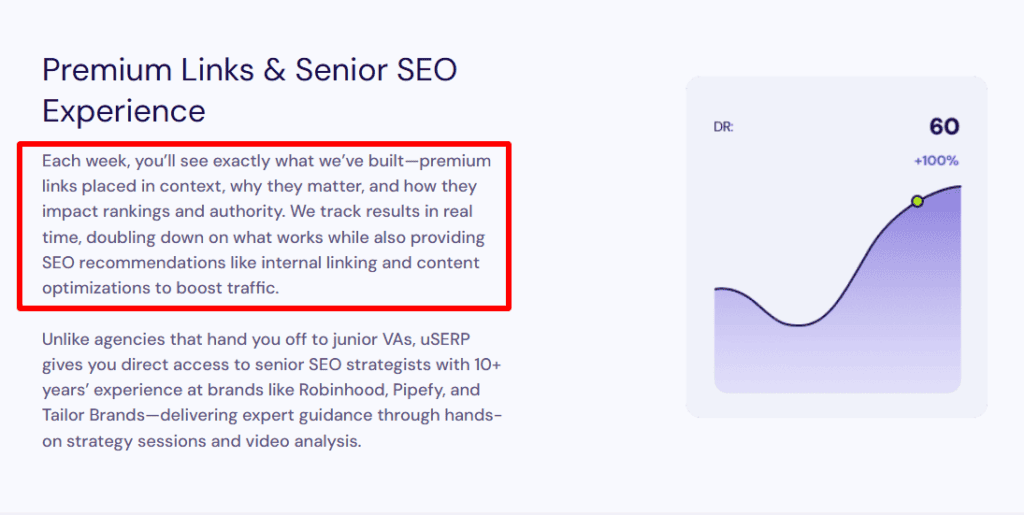
- They track performance beyond links. Look for reporting on rankings, traffic, and impact, not just a list of URLs.
- They don’t overpromise volume. If it sounds too easy to get dozens of links fast, quality is likely on the line.
If a provider can’t check all of these boxes, keep looking. The right partner isn’t interested in merely building links. They’re interested in supporting your growth and proving the ROI via routine reports and check-ins.
Wrap up
A link insertion service gives you speed, efficiency, and quick ranking momentum. Guest posts give you control, context, and a direct path to influencing buyer decisions. If you’re in B2B SaaS, you can’t afford to optimize for rankings alone.
My advice?
- Use guest posts to shape perception. Build authority in the topics that matter. Attract the right audience and move them closer to a decision.
- Use a link insertion service to strengthen what already exists. Close gaps. Support key pages. And accelerate visibility where it counts.
This is how you turn link building into a real growth channel. 💰
P.S. Ready to build a backlink strategy that drives rankings, authority, and real pipeline? Book a free intro call with uSERP now.
FAQs about link insertion services
Are link insertions safe for SEO?
Yes, link insertions are safe for SEO if you’re selective. The real risk is poor link placements, not the tactic itself.
Focus on pages with real traffic, strong relevance, and editorial integrity. Be sure to also keep your anchors natural and aligned with the surrounding content.
How much does a link insertion service cost?
Link insertion pricing depends on the site, niche, and placement quality.
High-authority, relevant sites with real traffic will cost more, and they should. Cheap links usually come from recycled lists and weak domains.
Instead of chasing volume, look at cost per outcome: Rankings, traffic, and pipeline influence. Reading case studies can be super helpful here.
Do link insertions help rankings?
Yes, link insertions can help rankings. Especially in the short term. You’re tapping into existing authority and indexed content, which helps pages move faster in search. But the impact depends on context.
A well-placed link on a relevant, ranking page will outperform a random high-DR placement every time.
Are guest posts better than link insertions?
Guest posts and link insertions serve different roles.
Guest posts give you control over the message, targeting, and internal linking, which makes them stronger for authority and conversions.
Link insertions are faster.
The best results come from using both with a clear link building strategy behind them.