




Publishing more content won’t raise your domain rating on its own. Content matters, but authority mostly comes from who links to you and how much they trust your pages.
Sites with strong authority tend to rank higher. You can see where yours stands in a minute with a free DR checker, then work on the signals behind the number.
Below, we cover what the DR score measures, how to check it, and six practical ways to strengthen your website authority for better rankings and visibility.
Highlights
- Domain Rating (DR) is an Ahrefs SEO metric that scores a site’s backlink profile on a scale from 0 to 100.
- DR and Moz’s Domain Authority (DA) are third-party scores. Google doesn’t use either one.
- A free DR checker lets you check your domain and your competitors’ in seconds.
- Backlinks are what move DR. Content, internal links, technical health and brand presence help you earn them.
What a DR checker measures
Domain Rating is a metric developed by Ahrefs. It measures the strength of a website’s backlink profile on a logarithmic scale from 0 to 100, compared with every other site in the Ahrefs index.
Ahrefs calculates DR from how many unique domains link to a site with at least one followed link, and how strong those linking domains are themselves. Because the scale is logarithmic, going from DR 20 to DR 30 is far easier than going from DR 70 to DR 80.
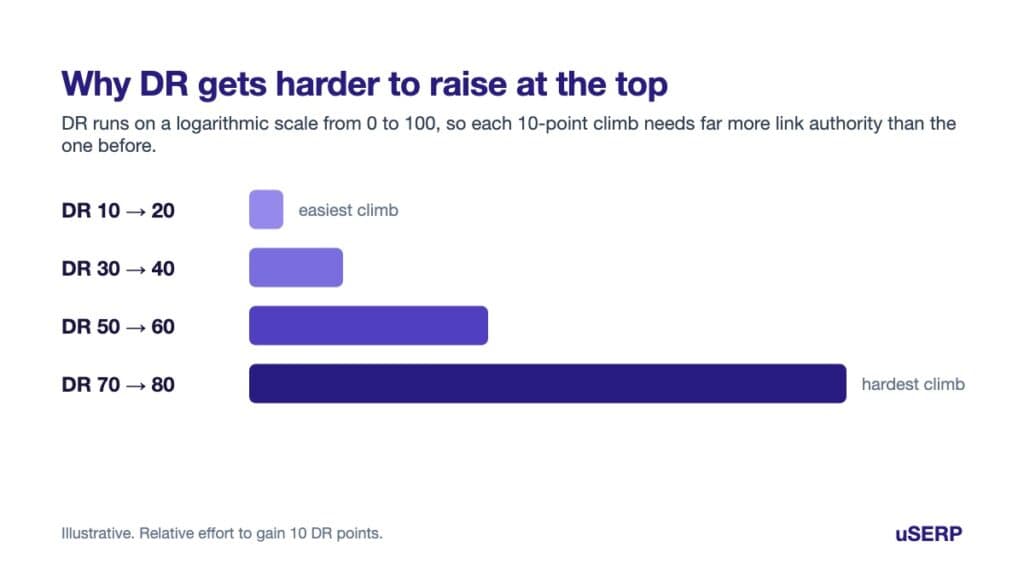
Image created by uSERP
Domain Authority is a different score, developed by Moz, that predicts how likely a website is to rank. The two metrics are correlated but not interchangeable, since they use different data and different math. We break down the details in our Moz DA vs Ahrefs DR comparison.
DR is not a Google ranking factor, and neither is DA or Semrush’s Authority Score. All three are third-party estimates of backlink authority, useful for comparing sites but invisible to Google.
How to use a free DR checker
You don’t need an Ahrefs subscription to check domain rating. Ahrefs offers a free Website Authority Checker for a quick look at any site.
A free DR checker like this one shows DR, URL rating and estimated traffic side by side. Enter any domain to see where it stands, then run your main competitors through the same tool. Paid plans on some tools add a bulk check, which helps when you’re vetting a long list of link prospects.
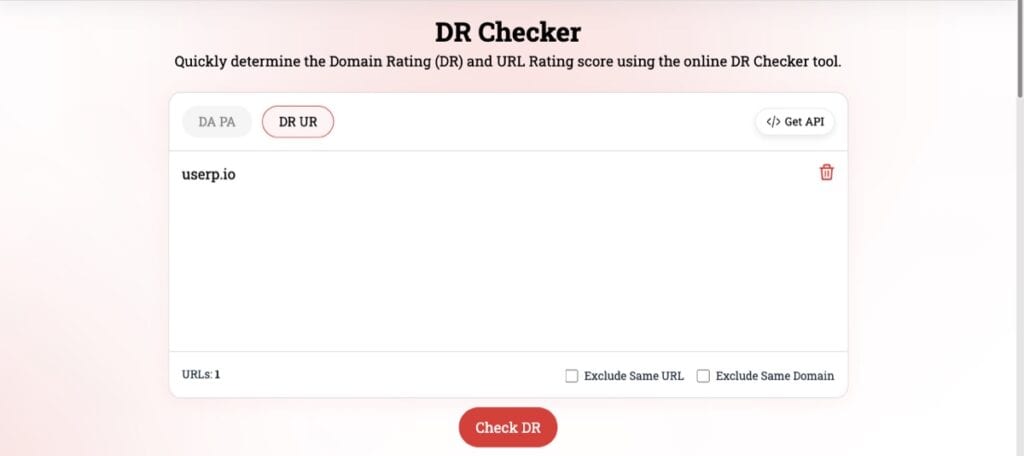
Screenshot provided by author
DR scores the whole domain, so a subdomain like blog.example.com reflects the root domain’s backlink profile. To judge one specific page, look at its URL Rating (UR) instead.
What is a good DR score?
A good domain rating is relative. A DR 35 site can be the strongest player in a local niche, while DR 60 might be average for B2B SaaS. Compare your score with the sites you compete against in the SERPs.
When we vet link prospects at uSERP, we treat DR 60+ as high authority and DR 20-59 as niche sites that are still worth a link when the topic is a close match. If your DR is 0, it usually means no other site links to yours with a followed link yet.
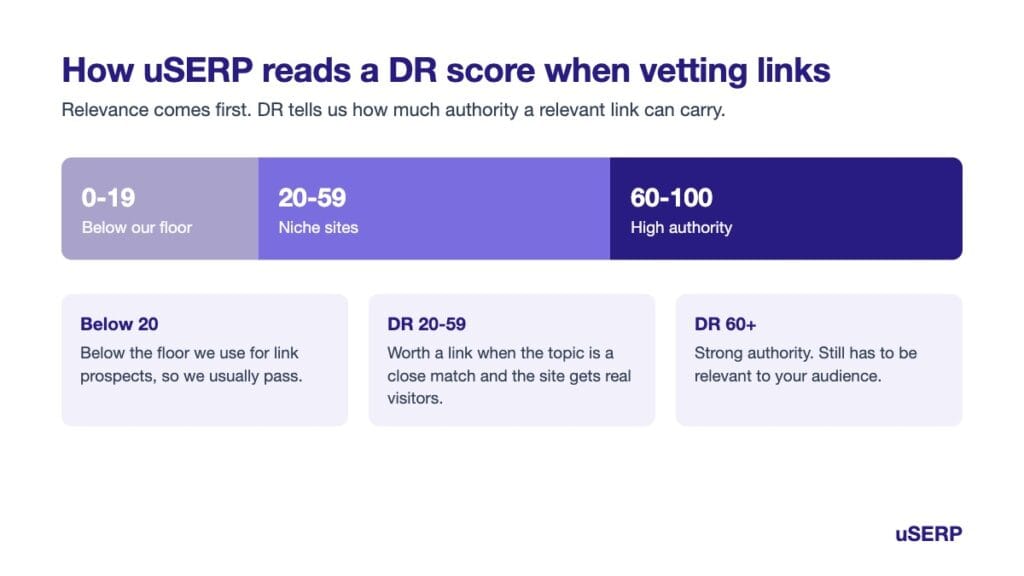
Image created by uSERP
6 ways to strengthen your website authority
Backlinks are what move DR. The other five areas build the kind of site that earns those links and keeps them.
1. Earn quality backlinks
Backlinks are the strongest authority signal, and they’re what DR measures directly. Search engines treat a link from a trusted, relevant site as a vote of confidence, while links from spammy sites add little or nothing.
Before you pursue a link, check the domain’s authority score. A quick DR check gives you a baseline, but relevance matters just as much. A backlink analysis of the site shows whether its own link profile looks natural or bought.
Contribute useful articles to relevant publications and write for their readers. Add a link only when it helps them, and use the right link attributes when a placement is sponsored.
2. Publish content worth citing
Thin content rarely earns links. Other writers link to pages that give them something to cite.
Build outlines from the questions your audience actually searches for. Review what competitors have published, find the gaps, and group related posts into topic clusters. Google’s guidance on creating helpful, people-first content is a good checklist for this.
Original research works best. A survey or a study of your own client results gives other sites a reason to link to you as the primary source.
3. Tighten your internal linking
Internal links help search engines understand how your content fits together. They also pass authority from your strongest pages to the ones that need it.
Start with your money pages, like services and core guides. Then find related blog posts and add contextual links from them. Begin with the pages that have the most backlinks, since those carry the most authority to share.
4. Fix your technical trust signals
Strong content and backlinks underperform on a site that’s slow or hard to crawl. The basics include:
- A secure HTTPS connection
- Fast loading speed
- Mobile-friendly pages
- A clean site architecture
Trim heavy scripts and compress images. Keep your XML sitemap and robots.txt file correct so search engines can reach every page you want indexed.
5. Show strong E-E-A-T signals
Google’s quality guidelines describe Experience, Expertise, Authoritativeness and Trustworthiness (E-E-A-T). These signals help readers and search engines judge whether your website is trustworthy.
Add author bios to important pages, with relevant experience and links to professional profiles. Keep your contact details and policies current, and disclose affiliations where they apply.
6. Build your brand beyond your own site
Other sites’ mentions of you build authority too, linked or not. They help people and search engines connect your brand with your topic.
Pitch relevant publishers on topics you know well, and join industry discussions where your audience already spends time. If you serve a local market, keep an accurate Google Business Profile.
Keep an eye on what points back to you. A pattern of paid or manipulative links can draw a manual action from Google, and avoiding unnatural links is far cheaper than cleaning them up.
How to use DR going forward
Check your domain rating every month or so to track progress and compare yourself with competitors. A rising DR is a sign the work above is paying off.
When you pick link prospects, weigh relevance first. A site with a real audience in your space is often a better link than a higher-DR site with nothing in common with yours.
For a step-by-step plan, see our guide on how to increase domain authority, or review the link building metrics worth tracking alongside DR.