




Anyone can publish an article and call themselves an expert.
But Google has to decide which sources are worth trusting. That matters most when bad information could affect someone’s health, finances, safety, or major life decisions.
So, what is EEAT in SEO? It’s the set of standards (written E-E-A-T) that helps Google make exactly that call.
Does your site show real experience, expertise, authority, and trust? If not, you give Google fewer reasons to see your content as credible.
In this article, you’ll learn what E-E-A-T means for SEO and how Google judges each part of it. You’ll also get practical ways to improve E-E-A-T on and off your site. That sets your content up for better rankings, traffic, and more.
Highlights
- E-E-A-T stands for Experience, Expertise, Authoritativeness, and Trustworthiness. Google’s Search Quality Raters use these principles to assess whether content is helpful, credible, and trustworthy.
- E-E-A-T is not a direct Google ranking factor or ranking signal. Instead, it helps Google check if its search systems show high-quality content from sources people can trust.
- Strong E-E-A-T extends beyond your website. Strong backlinks and mentions help build your brand’s authority and trust. So do good third-party reviews, community sentiment, and praise from respected sources.
- Show first-hand experience with original screenshots, hands-on tests, case studies, and real results. Add insights that someone without direct experience couldn’t easily give.
- Improve E-E-A-T by building topical authority and by publishing and updating accurate content often. Create detailed author, About, and credibility pages that show your expertise and reputation.
What is E-E-A-T in SEO
Google’s E-E-A-T framework stands for Experience, Expertise, Authoritativeness, and Trustworthiness.
It’s a system that Google’s search quality raters use to understand content quality. When raters measure content against E-E-A-T, they learn whether Google’s algorithms give good results.
But E-E-A-T isn’t a Google ranking factor.
In Google’s own words: “Search raters have no control over how pages rank. Rater data is not used directly in our ranking algorithms. Rather, we use them as a restaurant might get feedback cards from diners. The feedback helps us know if our systems seem to be working.”
TL;DR: the E-E-A-T framework is NOT:
❌ A ranking factor
❌ A ranking signal
E-E-A-T IS:
✅ A standard Google uses to judge your content and your public brand. It also weighs your trust and your authority to speak on your topic. When your content aligns with E-E-A-T principles, raters see your site as authoritative. Authoritative websites tend to get more backlinks, traffic, and qualified leads than other sites.
Real world applications:
- Writing about medical advice? You should have the certifications, degrees, and consensus from other reputable experts backing your information as credible.
- Writing about the best trading journals? Put numbers on your data and use charts to explain what you found. Mention your finance expertise too.
- Writing about the best ways to learn guitar? You should have deep knowledge of how to play the guitar.
The idea is to filter out the noise online. Searchers should see true, accurate content they can trust.
What is EEAT in SEO, according to Google?
Google wants a helpful search experience. People should find trustworthy information that answers their questions and solves their problems.
Google describes their own goals as:
“At Google, we’re always working on ways we can improve your Search experience.
We constantly experiment with ideas to improve the results you see. One of the ways we evaluate those experiments is by getting feedback from third-party Search Quality Raters. Quality Raters are spread out all over the world and are highly trained using our extensive guidelines.
Their feedback helps us understand which changes make Search more useful.”
You can see the full search quality raters guidelines PDF here if you want to deep dive.
Google’s Quality Rater Guidelines mention E-E-A-T again and again.
Google asks its outside raters to weigh E-E-A-T when they judge content, sites, and brands.
Here are the exact words Google includes in their guide:
Simply put, Google cares about four things:
- Experience of the person/brand/entity publishing the content
- Expertise of the person/brand/entity publishing the content
- Authority of the person/brand/entity publishing the content
- Trustworthiness of the person/brand/entity publishing the content
Google also tells its raters that low-quality content and pages lack E-E-A-T:
Case in point: E-E-A-T is very important if you want your content to rank organically.
The question now becomes: what can you do to showcase your real-world experience, expertise, authority, and trust?
8 ways to improve E-E-A-T for your website
Now you know (or recall) what E-E-A-T is. Here are some ways to improve it on your website.
1. Authoritative mentions and backlinks
The “Authority” in E-E-A-T almost surely points to high-authority mentions and backlinks pointing back to your brand, articles, website, and more.
Why does this off-site signal matter? Anyone can spin up a $10 website and claim to be an expert.
But only a few get named as experts by trusted publications and brands.
The key here is consensus from third parties.
Say big, trusted websites call you an authority on a subject. That’s a good sign it’s true. It counts for far more than someone claiming authority with zero third-party sources.
This is directly referenced by Google’s Search Quality Rater guidelines:
“Use reputation research to find out what real users, as well as experts, think about a website. Look for….news articles.”
Take my own case. I write as a featured expert for Search Engine Journal. It’s a trusted SEO site, and its editors are famously picky about what they run.
This kind of backing from a trusted expert source likely sends positive signals about the content I publish.
If you’re credible in your own right in a niche, get other real authorities to back you up.
- Publish original research and case studies that big websites will reference and share
- Share expert quotes and opinions on platforms like HARO or Twitter’s #journorequest hashtag
- Apply to be an expert contributor at highly selective media outlets (not the ones you can buy placements in for $50 please…)
Build your off-site authority. It’s critical to E-E-A-T. And if you don’t have time, hire an agency to do it.
Track your Domain Authority or Domain Rating as you update pages and add strong content. Check out our guide on Moz DA vs Ahrefs DR to learn more.
2. Get Great Third-Party Reviews
Google cares about the overall sentiment of your business in the public domain.
Say your business has 10,000 bad reviews and a 1-star rating. BBB reviews call you a scammer. That’s probably not by chance.
It also means your content shouldn’t get the same trust as a brand with glowing reviews and praise from experts.
Google specifically looks at reviews across many platforms to take into account the overall sentiment of your brand:

Reviews are a trust signal, likely playing into the “trustworthiness” component of E-E-A-T.
Hence Google’s language of: “trustworthy positive user reviews as evidence of positive reputation.”
Do your best to get reviews on platforms like:
- Local: Google, Yelp, OpenTable
- National: Better Business Bureau
- Online: G2, Clutch, Capterra
Garner as many real reviews as you can by surveying current and past customers. A good reputation can play a big role in how well your content ranks.
3. Become a Topic Expert
Becoming a topic expert takes more than an “about us” page that says you’re an expert.
Just because YOU claim to be an authority does not make you one.
Here’s an example:
I recently ran across an incredible finance blogger on social media who was drafting articles on his blog.
They were all optimized and ready to rank in search results. And the information was accurate. I sent it to several CPAs, and all of them confirmed it was accurate.
But I noticed his site got almost no visits per month from organic search, despite optimization.
Why is that? By most standards, the blogger was an expert. The content was accurate and subjectively good.
But the problem?
He wasn’t widely known as a topic expert. His content was good, but his authority stayed inside his own blog. Others didn’t recognize him as a topical expert.
So, how do you become a topical authority in your niche?
Start here:
What displays when you Google your name? It should show:
Quotes, interviews, awards, bylines, podcasts, and conferences on your topic.
If your name doesn’t show up around the topics you’re publishing on, it’s hard to call you a trusted expert.
Why listen to your advice when others have dozens if not hundreds of authorities citing their work?
You can get there, too, though. For example:
- Create content for publishers that earn you backlinks and brand mentions
- Publish original research: create useful data that people want to cite
- Get quotes in publications: share your expertise with journalists
- Podcast: share your story and background
Your goal is to answer this question in the eyes of Quality Raters:
Is there a consensus from others that your content is good and that you’re the reputable topic authority?
4. Have a Wikipedia Mention or Page
Wikipedia? Wait, isn’t that the site teachers told us not to cite?
Well, they were dead wrong. Wikipedia is highly trusted as a fair source of information on topics, businesses, and people.
Here’s what Google says in their detailed guidelines about rating websites:
“See if there is a Wikipedia article or news article from a well-known news site”
Wikipedia requires facts about your company to be verifiable. Your business also needs coverage from many reliable sources.
Don’t get me wrong: Wikipedia isn’t a ranking factor.
Look at the ROOT CAUSE of why Google cares. If Wikipedia covers you, you likely have plenty of proven experience, expertise, trust, and authority.
It means that multiple sources are mentioning you in the public sphere, and can give key hints at your reputation.
Google’s guidelines show this in action. Here, a rater checks Wikipedia to learn about a site’s reputation:
“Positive reputation information: According to Wikipedia, the Cleveland Clinic “is currently
regarded as one of the top 4 hospitals in the United States” which can be confirmed by reputable news articles cited in the references section. Users can trust medical information on this website.”
Interesting, right?!
Google sees reputation as a trusted source. If your business is known for ripping people off, showing your articles to searchers is a risk for Google.
Wikipedia happens to be an accurate, checked, and verified source of information about the reputation of a business.
Don’t try to game the system for a Wikipedia article, though. Build a brand that earns positive coverage there. Stick to white-hat techniques.
5. Community and forum mentions
Yes, Google Quality Raters look at the sentiment and nature of brand mentions within forums.
But please don’t spam links in a forum. We’re talking natural mentions of your brand in real forums. (Plus forums WILL block you if you spam threads.)
Why does this matter?
Because it shows what real people are saying about your brand.
Brand is what people say about your business (or you) when you are not around.
Reviews, testimonials, and quotes on your site only show the positives. Forums and communities tell the truth as they see it.
That makes this information very useful for judging a brand’s reputation and trust without bias.
With this advice, don’t go after short-term solutions where you pay people off to write good things about you. Seriously. Please, don’t do that.
This consistent trend of positive reputation and trust should lead you to assess your entire business and brand strategy:
Ask: How can we have a better product, a better marketing plan, better community, and better customer service in our niche to build long-term trust and respect?
This is how you win in search: by building a trusted brand that people see in search results and click time and time again to find great content that genuinely helps them succeed.
6. Publish and update content very often
It’s no secret that Google wants you to publish content often, and update even more often.
Fresh (as fresh as needed based on the topic), relevant, accurate content is the lifeblood of Google.
Google’s John Mueller recently said:
“It’s really hard to call a site authoritative after 30 articles, and especially if you’ve stopped publishing for a while, I can see how Google might be a bit more conservative with regards to indexing more.”
The 30-article mark isn’t a hard-and-fast rule. But Mueller’s general point is this:
Say you have only a little content on a topic. You rarely update it, and you rarely publish anything new on it. Then you’re probably not a deep authority on that topic.
If you want to become more of an expert on the topic, be sure you’re publishing and updating content more often.
And don’t allow massive gaps in your publishing calendar. Always go back to old content and update it as facts, figures, situations, and trends change or emerge.
Make sure to also track your Google position for keywords so you can see if your pages are ranking.
7. Create detailed about / author / credibility pages
Detailed author, about, and review pages on your site always help E-E-A-T.
These pages should show news about you or your company and awards others gave you. They should also explain how you create content and check that it’s accurate.
These pages help readers trust you more. They also show Google’s raters how much authority you have.
A great example of a detailed About Page is Wirecutter. Within their about page, they internally link to relevant pages detailing their rigorous editorial standards and review process:
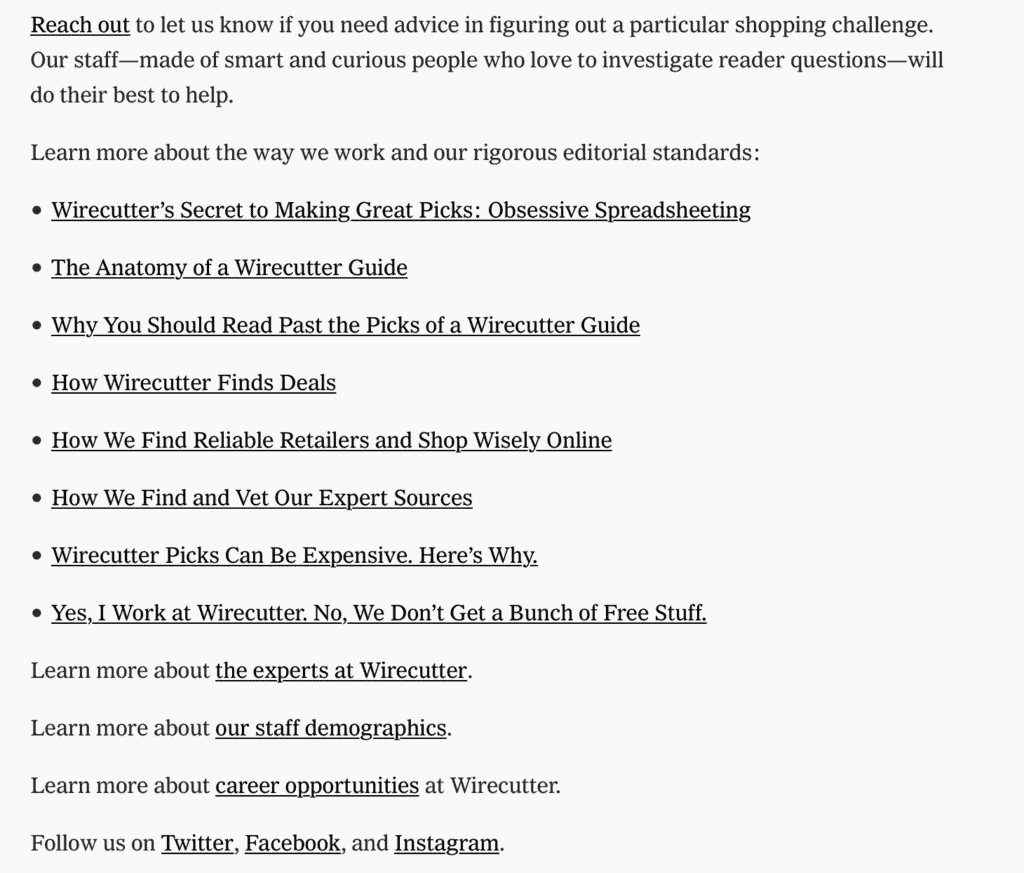
This builds trust with readers and Google. It shows openly how they pick and review products, so users aren’t just spoon-fed a list of high-paying affiliate links that only benefit Wirecutter.
Wirecutter makes it clear that they often recommend products that aren’t giving them commission, have mediocre reviews, and more.
For Author Pages, take Search Engine Journal as an example:
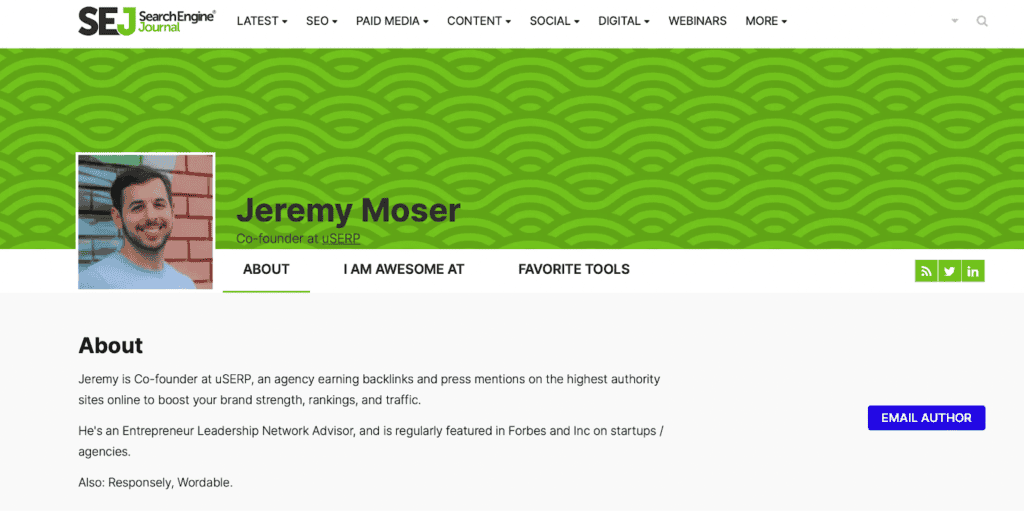
This author page lists not only a detailed biography, but also unique sections like “I AM AWESOME AT” and “FAVORITE TOOLS” to increase credibility.
Consider creating an Awards page too. At uSERP, we showcase that we have countless awards from third parties recognizing us as a top SEO and link building consultancy:
Create detailed pages that reference your accomplishments, openly share your review process, and more.
These will all serve to build trust and credibility.
8. Demonstrate First-hand Experience
The extra “E” in E-E-A-T stands for experience. That means first-hand, real-world experience with the topic you write about.
Google’s Quality Rater Guidelines ask raters to check whether the creator has actually done what they write about. Did they use the product? Visit the location? Perform the task? Work in the industry?
This is especially important when first-hand experience can make the content more useful and trustworthy.
Some ways to demonstrate real-world experience include:
- Adding insights that someone without first-hand experience would be unlikely to know
- Explaining your testing methodology and how you reached your conclusions
- Publishing original photos, screenshots, or videos from hands-on testing
- Sharing case studies with actual results and lessons learned
- Including specific examples from projects you’ve completed
For example, say you’re writing an SEO software review.
Don’t just sum up features from the company’s website. Actually use the tool. Add original screenshots and explain how you used key features. Share what worked, what didn’t, and the results you got.
E-E-A-T matters even more now that AI content is easy to create. AI can sum up what’s already out there. But original evidence and first-hand notes show readers and Quality Raters that real experience shaped your content.
You don’t need first-hand experience for every topic. But when experience affects whether people should trust you, show it. Don’t just claim it.
That’s how you create content that demonstrates the newest pillar of E-E-A-T while giving readers something they can’t get from another generic summary of the same topic.
Wrapping Up
E-E-A-T remains a set of criteria that Google’s Search Quality Raters use. It helps them spot high-quality content that deserves to rank.
It’s not a ranking factor or signal. It’s a system for judging content and other ranking factors.
Improving E-E-A-T can be done both on your site and off your site. It’s not as simple as adding an author bio or publishing new content though (these are table stakes).
Implement the tips in this post to improve your E-E-A-T. Or reach out to uSERP for a tailored E-E-A-T strategy.
FAQs: What is EEAT in SEO?
What exactly is E-E-A-T?
E-E-A-T stands for experience, expertise, authoritativeness, and trustworthiness. Google uses these principles to assess whether content is helpful content users can trust. Trust is the most important component of E-E-A-T.
Is E-E-A-T still relevant?
Yes, E-E-A-T is an ongoing part of Google’s Search Quality Rater Guidelines.
What’s the difference between E-E-A-T and E-A-T?
The difference between E-E-A-T and E-A-T is the addition of “Experience.” Google added experience to account for whether content demonstrates first-hand, real-world experience with the topic.
What are low E-E-A-T and strong E-E-A-T signals?
Low E-E-A-T signals include a lack of first-hand experience, expertise, authority, or trust.
Strong E-E-A-T signals help Search Quality Raters assess whether content is trustworthy content that aligns with Google’s quality guidelines.
Is E-E-A-T a ranking factor?
No, E-E-A-T is not a direct Google ranking factor. Instead, Google’s Quality Raters use it to assess content quality. For content creators, creating quality content that meets E-E-A-T principles can help build the experience, expertise, authority, and trust users expect.
What does YMYL mean in E-E-A-T?
YMYL stands for “Your Money or Your Life.” YMYL topics can affect a person’s health, money, safety, or well-being. That’s why strong E-E-A-T matters most for YMYL content.