





In SEO, schema markup helps search engines understand and display your site’s content.
So, what is schema markup?
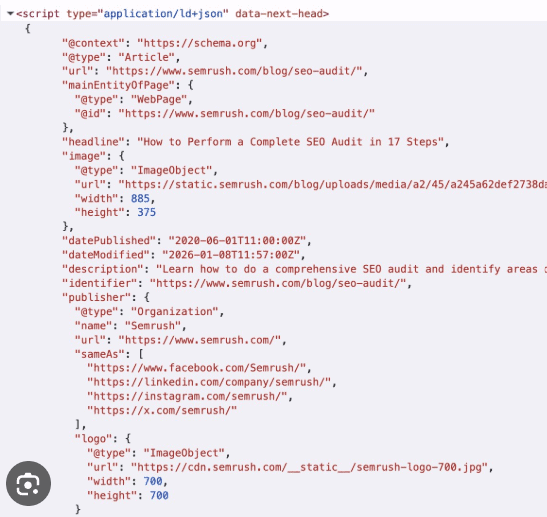
Schema markup is a structured data vocabulary (not a language itself) that you add to HTML using formats like JSON-LD, Microdata, or RDFa.
It helps search engines understand your content’s semantics by connecting content to context.
In a nutshell, it can improve how search engines understand and present your content in the SERPs.
Recent testing suggests schema markup may support AI visibility; we’ll look at the available evidence later in the post.
Our guide explains what schema markup is, why it’s important, the different types, what they do, and how to implement it on your website.
Highlights
- Schema markup helps search engines understand the context and relationships within your content.
- Schema markup enhances search visibility and enables rich results.
- You can install it using tools, plugins, and markup generators.
- Validation helps ensure your markup is technically valid and eligible for supported search features.
- SEO and GEO use the same Schema.org vocabulary.
What is schema markup?
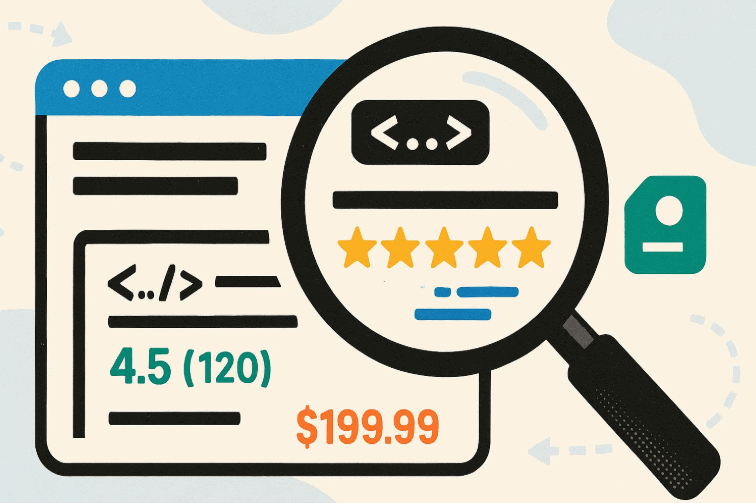
Schema.org was developed as a shared structured-data vocabulary supported by major search engines.
Schema.org provides a shared structured-data vocabulary that search engines use to interpret and categorize web content.
It uses a standardized markup hierarchy (a common search engine language) to define entities (such as people, products, places, organizations, or events).
Its purpose is to help search engines understand your content, display it correctly, and list it where people look for it.
Here’s what it looks like:
Is schema markup the same for SEO and GEO?
Schema markup uses the same structured language for GEO and SEO, but the broader GEO vs SEO distinction comes down to where and how that content is surfaced.
SEO uses schema to help search engines understand your content, enabling organic rich results (rich snippets) such as stars, images, and pricing.
GEO uses it to provide structured, semantic content to help AI tools (LLMs like ChatGPT and Gemini) understand and verify citations.
Schema.org vocabulary does not change between SEO and GEO, and Google does not require special structured data for AI Overviews or AI Mode.
For Google’s AI features, the same SEO fundamentals apply: make the page indexable, ensure structured data accurately reflects the visible content, and use supported schema types where they genuinely describe the page.
Why schema markup is important for SEO
Source: Author
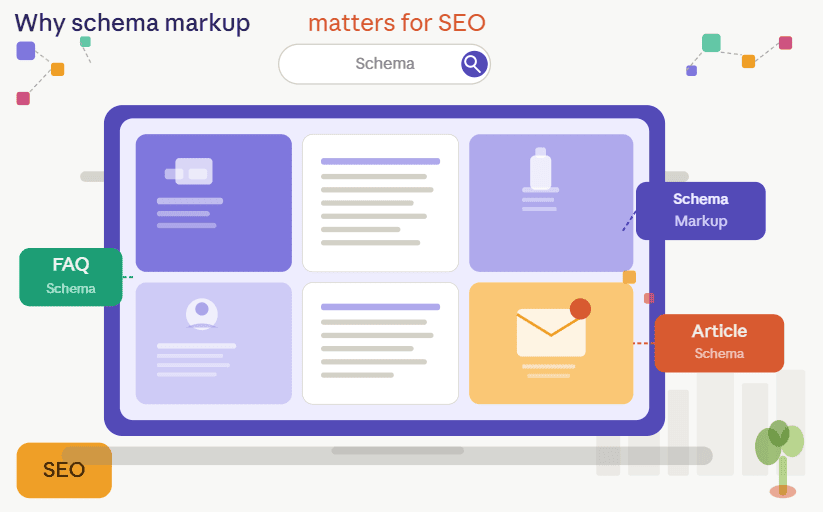
Schema markup acts as a content/context translator between your webpages and search engines. Kind of like the camera function on your translator app when you’re reading a foreign menu!
When search engines understand your content, they can display your pages in relevant organic search results.
Organic results can include rich snippets, such as your reviews, product details, or ratings. This helps improve your brand’s search visibility.
Benefits of schema markup for SEO

- Local business SEO: Helps local businesses display information, such as opening hours and location, in the SERPs.
- Explains context: It enables search engines to understand a webpage’s meaning and categorize content.
- Rich Results: Schema markup can make eligible pages available for supported rich results.
Common schema markup for SEO
- Local Business Schema: Provides relevant and helpful information, like address and contact details.
- Product Schema: Highlights e-commerce product price, availability, and reviews.
- FAQPage markup can identify question-and-answer content in structured data, but Google no longer shows FAQ rich results in Search. Use it only when it accurately represents visible FAQ content rather than as a rich-result or CTR tactic.
Is schema markup important for AI visibility?
Although there’s no official confirmation that schema markup increases AI visibility, studies suggest it may help with LLM optimization.
AI search systems retrieve and summarize web information in different ways, so the effect of structured data varies by platform. Schema may help clarify page context and entities, but current evidence does not establish it as a direct AI visibility factor.
Schema markup and AI search test
Search Engine Land ran a test to see whether content with schema markup performed better in Google AI Overviews than content without structured data.
The test used three single-page websites for direct schema comparison.
Besides the schema, every detail (including keywords) was identical.
Their results:
- Only the page with high-quality schema markup showed in an AI Overview.
- The same page ranked for six keywords and third in traditional search.
Search Engine Land reported:
- “Rank 3 was the highest conventional search rank achieved by any page in our experiment, and it was also the query that triggered the AI Overview appearance.”
While the results aren’t definitive, the experiment suggests that high-quality schema may support AI Overview visibility under some conditions.
Google’s current guidance still recommends using supported structured data where it accurately reflects visible page content, but no special schema markup is required for AI Overviews or AI Mode.
Google explains how Search can ground LLM responses
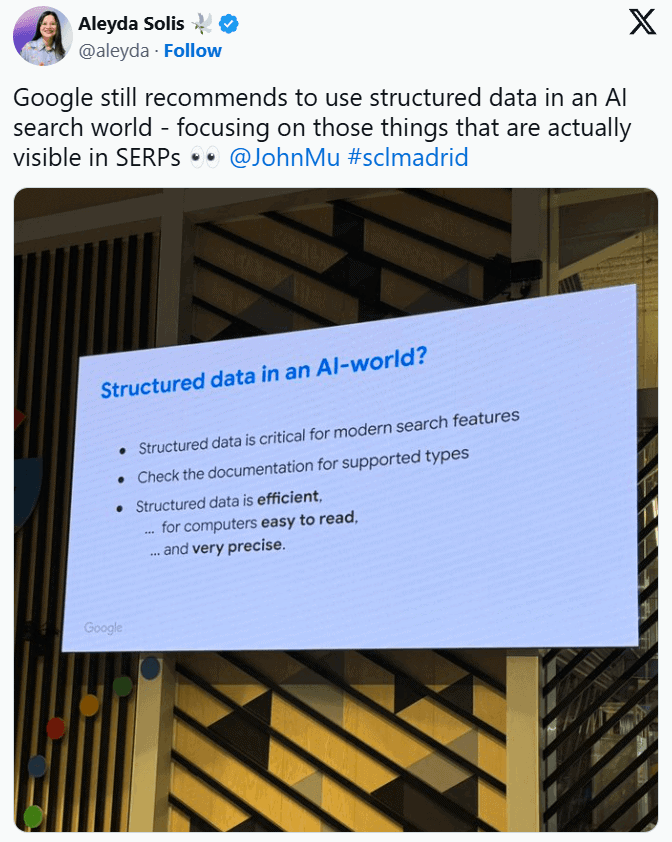
At Search Central Live Madrid in 2025, Google’s John Mueller presented a simplified example of how an LLM can use Search to ground responses.
Current Google guidance emphasizes that standard SEO practices still apply to AI Overviews and AI Mode, with no special schema markup required.
Mueller said Google uses Retrieval-Augmented Generation (RAG) to build its AI-powered search answers.
Aleyda Solis provides images of Mueller’s slides showing the four-step process.
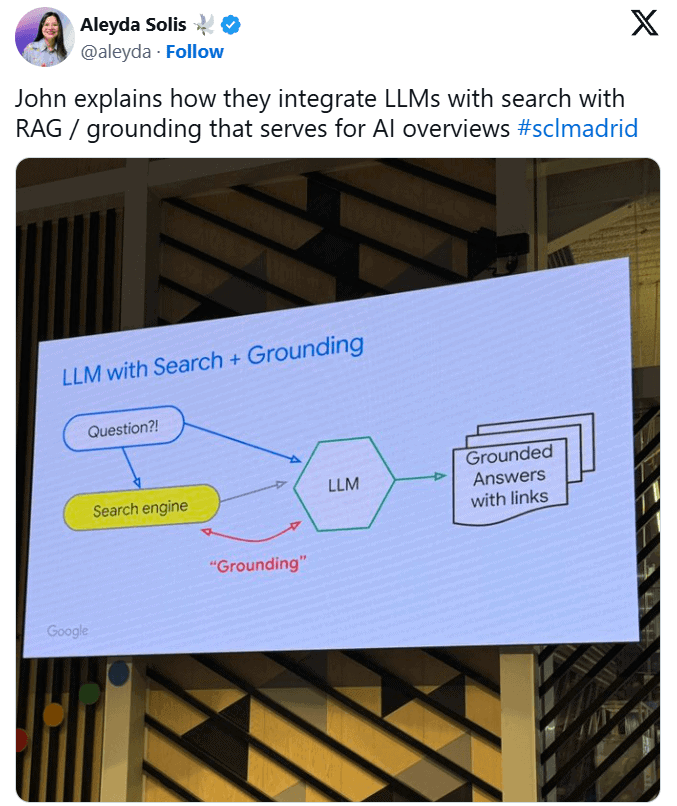
During the Madrid conference, Google advised continuing to use structured data (schema) because it makes it easier for LLMs to read, understand, and index your content.
Mueller’s graph on structured data in an AI world:
Benefits of schema markup for AI visibility
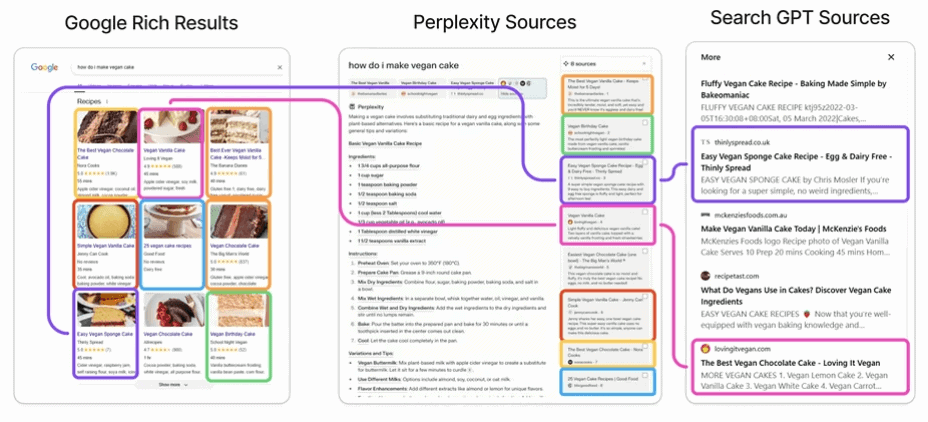
While schema primarily helps search engines contextualize web content, emerging evidence suggests structured data may also support how AI systems interpret entities.
Teams can use generative engine optimization tools to monitor citations and AI visibility alongside traditional search performance.
Benefits for AI visibility:
- Entity clarity: Structured data can help machines interpret page information and relationships, which may support AI visibility depending on the platform.
- Increased SERP and rich results presence: Structured data can make eligible content available for supported rich results, such as star ratings and product pricing.
- Potential AI visibility: Preliminary testing suggests that well-implemented schema may support AI Overview visibility, but current evidence does not establish that adding schema directly increases citations.
Types of schema markup
Source: Author
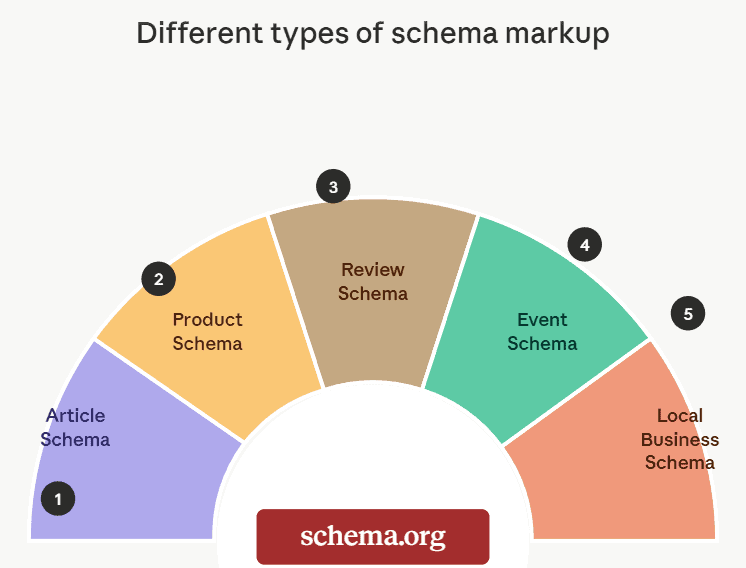
Schema.org includes hundreds of structured-data types covering entities such as organizations, products, events, articles, and local businesses.
Whether you focus on content production, run an e-commerce store, offer physical services, or host local events, there’s a schema markup for it.
Some common schema types include:
Organization schema
Tells search engines your organization type, name, contact details, website URL, and logo.
Organization schema can help search engines connect details such as your organization name, website, logo, and official profiles to the same entity.
Local business schema

Optimizes local businesses by providing Google with details like opening hours, address, phone number, and location.
Structured data can support local search understanding, but it works best alongside broader tactics such as link building for local SEO.
Article schema
Article structured data helps search engines understand details such as the headline, author, publication date, and images associated with written content.
Recipe schema
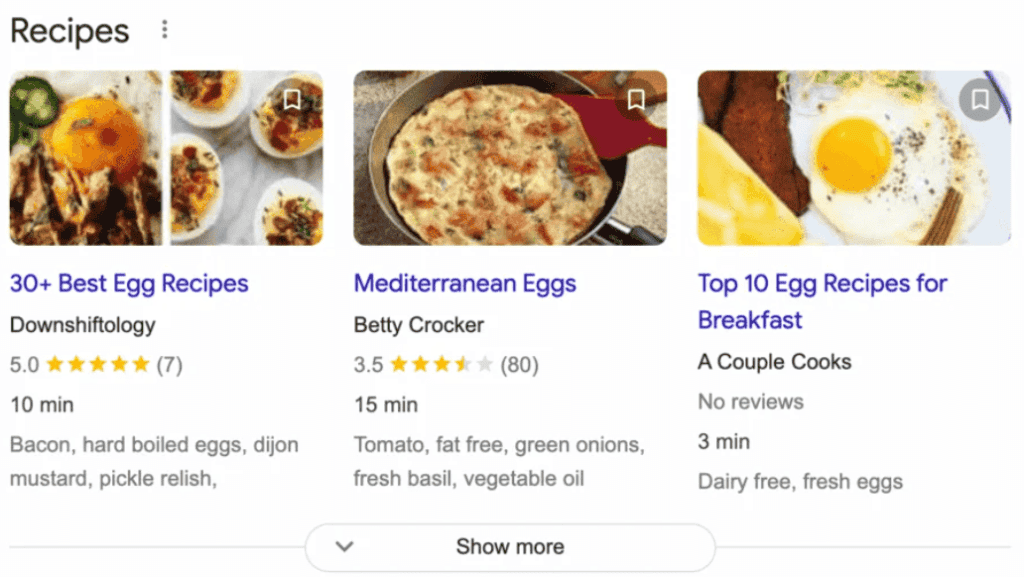
Search engines use this to define specific recipe details. This includes recipe instructions, ingredients, prep time, images, and ratings.
Recipe structured data can make eligible recipe pages available for supported recipe rich results and carousel experiences.
Review schema
Enables search engines to display your site’s customer review count, star ratings, and feedback details in rich snippets.
Essential for providing social proof, increasing trust, and click-through rates.
Product schema

Product schema helps search engines understand and display details from e-commerce product pages. Include information like product availability, prices, star ratings, and customer reviews.
Helps power “rich results” and increase CTR by enhancing listing details in Google Search, Lens, and Images. Also increases the chances of appearing on Google Shopping lists.
FAQPage schema
FAQPage markup identifies question-and-answer content in structured data, but Google no longer displays FAQ rich results in Search. Use it only when it accurately represents visible FAQ content rather than as a rich-result or CTR tactic.
How to add schema markup to your website
While schema markup is code, you don’t need a coding degree to generate it.
Platforms like WordPress offer plugins such as Yoast SEO, Schema Pro, and All in One Schema Rich Snippets.
How to add schema markup:
- Identify the right markup: Review your webpages to see which schemas you need, then search Schema.org to find them.
- Choose a format: Schema formats include RDFa, Microdata, and JSON-LD. Google recommends using JSON-LD; you embed it on your website with a <script> tag in your HTML.
- Generate your schema markup: You have a few options here:
- Use plugins like Schema Pro or Yoast SEO, which have built-in schema generation tools.
- Generate the code using Google’s Structured Data Markup Helper.
- Use the Schema.org guide and write the code manually.
- Integrate schema markup: Create a custom HTML tag using Google Tag Manager (GTM), paste your script, and select the pages where you want to apply it.
Testing and validating your schema markup
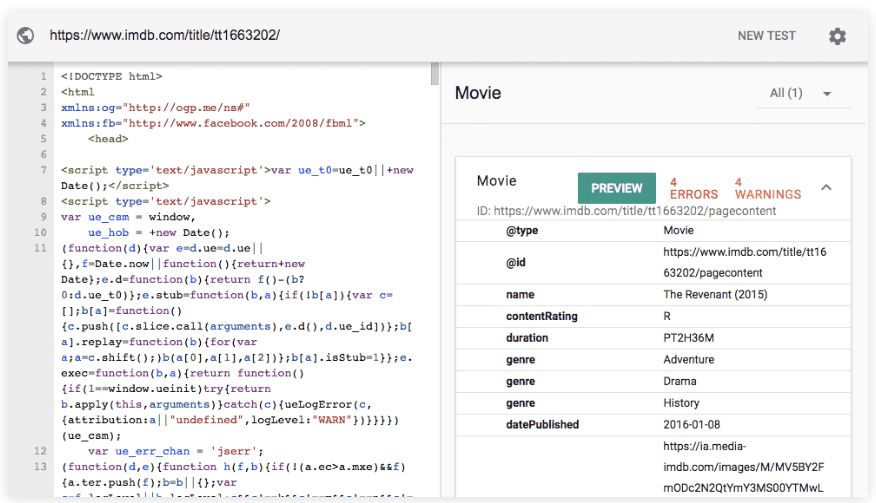
Always test your schema markup to ensure it’s working so search engines can understand your data.
You can do it using the following validating tools:
Schema Markup Validator
Run your code snippet or your page’s URL through the Schema.org Markup Validator to check that it conforms to schema guidelines.
Google’s Rich Results Test
Paste your URL into Google’s Rich Results Test to confirm that your structured data is valid and eligible for supported rich results.
After deployment, use the URL Inspection tool and structured data reports in Google Search Console to confirm that Google can access the page and read the markup.
Treat these checks as part of your ongoing technical SEO process, not a one-time setup.
A passing Rich Results Test does not guarantee that Google will display a rich result; it only confirms technical eligibility for supported features. Recheck the markup whenever visible page details change, including prices, availability, business hours, publication dates, or author information.
If the markup no longer matches the page content, update it before requesting a recrawl.
Schema markup best practices
- Choose the right pages: Select pages where schema markup can help, such as blog articles, product pages, local business listings, and events.
- Use the right schema: Use the appropriate schema markup and add it to the relevant content/page.
- Ensure schema matches all listings: Brands with social media, other websites, or a Google Business Profile should ensure their schema details are consistent across all listings.
- Keep your markup fresh: Regularly check and, if needed, update your schema—especially for changes to details such as business hours or product prices.
- Test and validate your markup: Use tools like Google’s Rich Results Test and Schema Markup Validator before publishing to ensure it doesn’t contain any errors, as that can cause Google to issue a “structured data manual action.”
Bottom line
Schema markup isn’t something your content might need. It’s essential for helping search engines and AI find, understand, and display it.
While schema markup is not a direct ranking factor, it can help search engines interpret content and make eligible pages available for supported search features.
And it should be on your SEO checklist for 2026.
If you need support turning technical SEO guidance into scalable content, explore uSERP’s content production services.
FAQs: What is schema markup?
1. What does schema markup mean?
Schema markup is structured data that you add to your website’s HTML to help search engines understand what your content means.
2. Why is schema markup important?
Schema markup can increase your website’s visibility in the SERPs. It can enable rich snippets (or rich results) that display images, star ratings, or prices, boosting click-through rates.
3. How does schema markup improve SEO?
It helps improve your content’s visibility in the SERPs and its presence in rich snippets.
Schema can also improve your organic search visibility and may help AI systems such as Perplexity, Gemini, and Google AI Overviews interpret your content.
4. Does schema markup directly boost SEO rankings?
No. Schema markup is not a direct Google ranking factor. It helps search engines understand page content and can make eligible pages available for supported rich results.
5. What are the types of schema markup for businesses?
Business schema types include Local Business, Organization, Product, Article, FAQ, and Review.
6. What is the easiest way to add schema markup to your website?
Use WordPress plugins such as Schema Pro, Yoast SEO, All-in-One SEO, or Google’s Structured Data Markup Helper.
7. What are common mistakes in implementing schema markup?
Using the wrong schema types for your content, missing essential data, marking up content that’s not visible to users, and failing to validate your structured data before publishing.