

A blog post doesn’t magically attract backlinks because it exists. Someone has to discover it first. Usually, that means multiple people.
And that discovery is happening more often on social platforms.
That’s the real SEO value behind social media backlinks.
Not necessarily the links themselves, but the visibility behind them.
In fact, (as I’ll cover soon), social links pass little direct ranking value.
Still, social platforms help distribute content, reinforce topical associations, and keep your brand in front of people who influence conversations online.
And that has a bigger impact on SEO than many marketers realize.
Let’s take a closer look at which social platforms Google can crawl, how social profiles reinforce entity understanding, and how to turn social media backlinks and visibility into stronger SEO signals over time.
*Note: In this guide, I’m using “social media backlinks” as a shorthand for links/mentions/distribution from social platforms, not as a traditional link-equity asset.
Highlights
- Social media backlinks usually don’t improve rankings directly. But they can increase visibility, leading to branded searches, mentions, and editorial backlinks.
- Platforms like LinkedIn, YouTube, Reddit, and X regularly appear in Google search results. (Their content is public and crawlable.)
- Consistent branding, topic focus, and industry mentions across social platforms can help search engines better understand a brand and its expertise.
- Repurposing blog content into social posts and participating in industry conversations can strengthen your online visibility over time.
- The strongest social SEO strategies focus on discoverability, topical consistency, and getting your content in front of people who influence online conversations.
Can I get social media backlinks, and do they help with ranking signals?
Yes. You can get backlinks from social media platforms such as LinkedIn, X, and YouTube.
But most social media links affect rankings indirectly.
Many social platforms apply nofollow or similar link attributes to outbound links, which tells search engines not to pass much ranking value through them. So a link from a social post typically won’t influence organic rankings the same way a traditional backlink from a website does.
(Image by Ioana)
But that doesn’t mean social media has zero SEO value.
Maybe a founder sees your research on LinkedIn. Or a creator references your framework on YouTube. Or someone shares your comparison article in a Reddit thread. Over time, their interactions could lead to branded searches, citations, or mentions in newsletters.
Search engines can also use broader web context to better understand a brand’s authority.
They use recurring associations and entity authority signals to better understand:
- How authoritative or recognizable you appear within a niche
- Which topics relate to your company
- What your brand specializes in
- Who talks about you
This broader context can influence your visibility over time, especially for topical and branded searches. (More on entity authority in a bit.)
Social platforms can also drive qualified traffic and put your content in front of people who may later reference and link to it from their own websites. For example, someone might discover your content on LinkedIn and then cite it in a blog post that passes SEO value.
I reference LinkedIn posts in B2B articles all the time.
Which social platforms are more likely to be indexed and surface in Google?
Public content from platforms like YouTube, LinkedIn, X, Pinterest, Reddit, and Quora often shows up in Google results.
(Reddit SEO strategies have become very important. More on Reddit tactics to use in a bit.)
TikTok public videos and profiles can rank, but not as consistently as YouTube or LinkedIn.
Instagram and Facebook are less reliable for SEO visibility. Google can index some public pages and profiles, but crawling and ranking are less consistent due to privacy controls, login walls, and platform restrictions.
How social profiles help reinforce entity (brand) understanding
Social profiles provide search engines with additional context about your business.
If Google consistently connects your brand to certain topics, industries, products, or experts, it becomes easier for the search engine to determine when your content is relevant to a search.
Here’s how social profiles can help reinforce entity understanding:
- Brand-name consistency: Using the same business name, logo, website, and messaging across platforms helps search engines connect your profiles to the same brand entity.
- Topic association: Posting regularly about certain subjects helps search engines understand what your company is known for and which topics it should be associated with.
- Geographic alignment: Consistent location details across profiles help reinforce where your company operates and which audiences or regions it serves.
- Expertise validation: Industry mentions, collaborations, and engagement can strengthen your online authority and credibility.
- Founder attribution: Consistent mentions of the founder and team help validate who’s behind the company.
I’ll touch more on these social backlinking details below. 👇
How to turn social profiles into discovery and entity signals
Once your social profiles are consistent and aligned with the right topics, focus on increasing your visibility among trusted people, conversations, and industry communities.
Here’s how:
Get your brand mentioned in the right circles
Start building visibility in places where your audience already pays attention.
Great ways to encourage mentions include:
- Appearing on niche podcasts (hosts will share the episodes across their social profiles)
- Getting featured in LinkedIn newsletters that your audience reads
- Commenting on respected industry accounts on X
- Participating in expert LinkedIn article roundups
- Collaborating with creators on YouTube
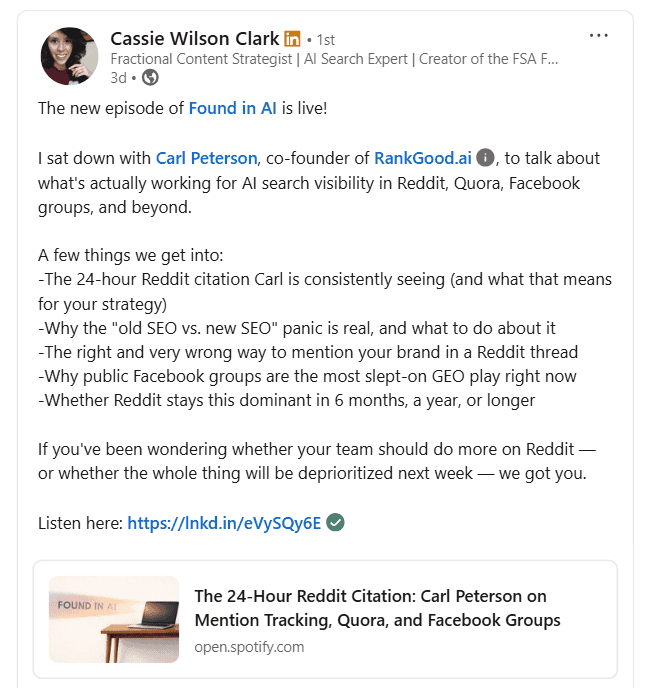
The goal isn’t to force backlinks into every interaction. It’s to repeatedly place your brand near relevant experts, topics, and communities.
Those recurring mentions can help reinforce understanding of the entity and brand building over time.
If your company consistently appears in conversations about technical SEO, AI infrastructure, RevOps, or cybersecurity, search engines begin to associate your brand with those topics. The same thing happens when trusted creators, founders, or publications repeatedly mention your company alongside certain industries or areas of expertise.
That broader web context helps reinforce what your brand is known for online.
(Don’t stress too much about getting an actual link. Mentions alone can still drive traffic and increase brand awareness.)
Reinforce SEO topics across blog and social content
Make sure your blog content and social content are based on the same topical content map.
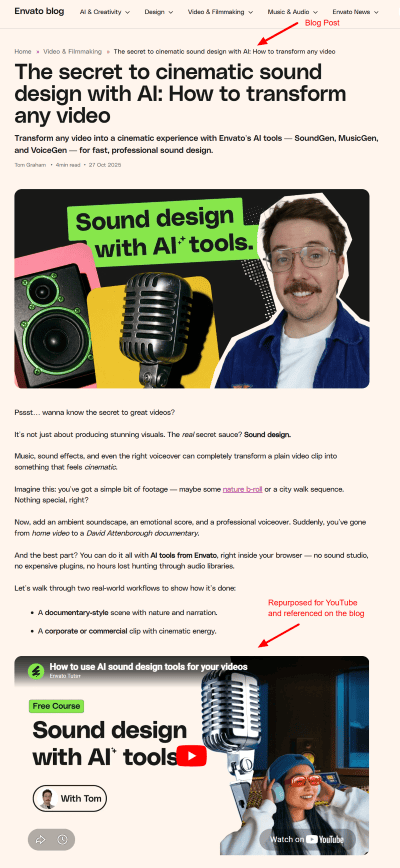
One of the best ways to do that is by repurposing high-performing topic cluster content into platform-specific social posts. E.g., turn a detailed blog post into a LinkedIn carousel, an X thread, a YouTube video, a Reddit discussion, or a newsletter takeaway.
Here’s a blog post Envato repurposed into a YouTube video and also referenced on the blog:
The key here is topical consistency.
If your company wants to build authority in project and resource management, those subjects should keep showing up throughout your content ecosystem. Not once every few months, but repeatedly and from different angles.
Content depth is also vital.
A brand posting surface-level content about unrelated topics sends weaker signals than one that consistently explores connected subtopics in detail. (Again, search engines pay attention to these recurring patterns and associations over time.)
At the same time, the content still needs to feel native to each platform.
Don’t copy a post directly from your blog and paste it on social. The format, pacing, and audience expectations are different. Make sure to adapt the content to match the platform you’re repurposing it for.
Create highly shareable social media content
Post share-worthy content often. These are fantastic linkable assets.
For instance, people love sharing:
- Controversial industry analysis
- Tactical breakdowns
- Benchmark reports
- Data visualizations
- Original research
- Frameworks
- Statistics
Tailor these to audience segments who are more likely to share it. (E.g., marketers like sharing reports, strategies, and data findings. Sales reps like sharing lead scoring and closing strategies.)
The content most likely to get shared gives people something worth referencing publicly. A benchmark report backs up an argument. A framework makes a complex process easier to explain.
A strong data visualization helps someone make a point in a presentation, newsletter, or social post. That’s why the best content keeps picking up backlinks and mentions long after it’s published.
Remember, shares themselves aren’t a ranking signal. It’s what those shares produce (backlinks, visibility, traffic) that affects SEO.
Engage in relevant conversations consistently
Never post content and disappear. Stay active in the conversations already happening around your industry.
How to engage on Reddit
On Reddit, focus on threads where people are actively discussing problems, frustrations, comparisons, workflows, or tool recommendations.
These discussions often rank well in Google because they contain real opinions and natural language.
Reddit’s search visibility has also surged recently. According to Semrush data, Reddit became one of Google’s fastest-growing domains after Google increased visibility for forum-style and user-generated discussions in search results.
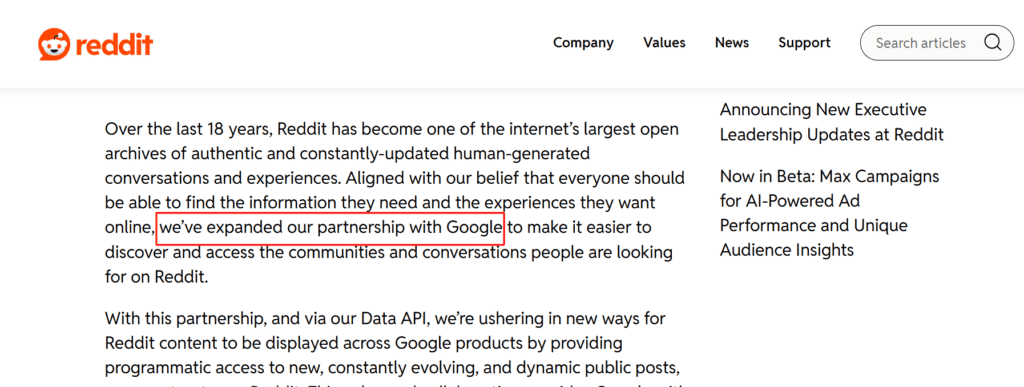
(In case you haven’t read the Reddit announcement, Reddit expanded its partnership with Google to improve how Reddit discussions and communities appear in search results and discovery experiences.)
On Reddit, answer questions directly. (Don’t post promotional links.)
Share solutions, explain tradeoffs, recommend better workflows, or add firsthand experience. Helpful responses tend to get upvoted, referenced later, and resurfaced in search results for a long time.
Reddit is also one of the best places to find content ideas. If the same questions keep appearing across multiple threads, that’s a sign the topic deserves its own SEO page or blog post.
Reddit isn’t the only platform where user-generated discussions can strengthen visibility in search.
How to engage on Quora
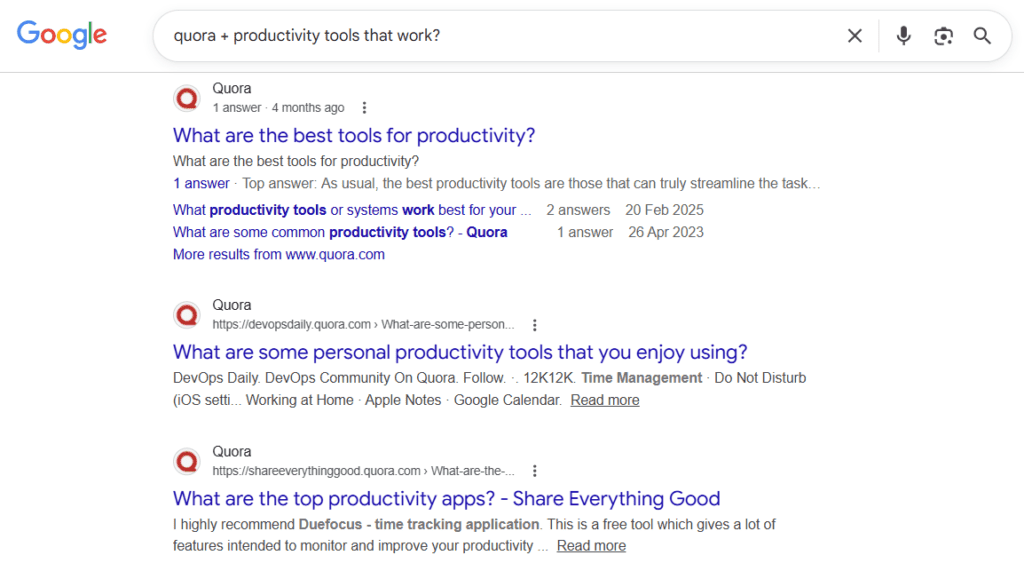
On Quora, prioritize detailed answers for specific long-tail questions related to your niche. A strong answer should define the problem, give a clear recommendation, and include one practical example before linking only when the source genuinely helps the reader.
(Screenshot by Ioana)
Don’t give surface-level advice that people could get anywhere else. Add examples, mini case studies, step-by-step processes, or insights from your own experience.
Helpful Quora answers can continue to generate visibility for months because many of them rank consistently in Google for informational searches.
How to engage on LinkedIn
On LinkedIn, comment strategically on posts by respected founders, creators, journalists, and operators in your space.
Strong LinkedIn comments can generate impressive visibility on their own. The best comments usually add missing context, summarize a lesson from direct experience, or clarify how the advice varies by company size. (Especially if you contribute early and add a useful perspective instead of repeating what everyone else is saying.)
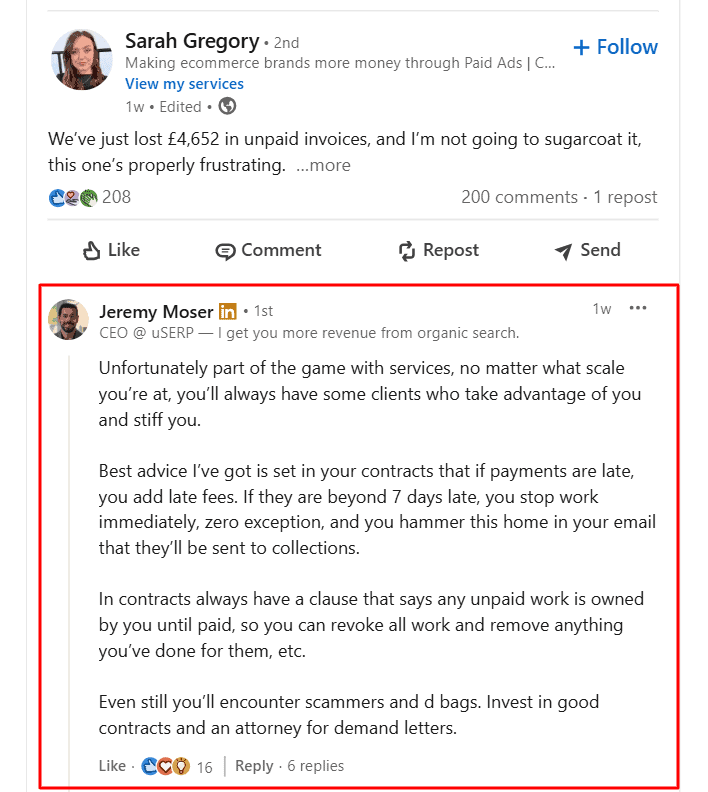
For example:
- Share a quick example from your own campaigns
- Add missing context to a trending discussion
- Explain why a tactic works differently at scale
- Challenge an oversimplified SEO take
- Share a relevant story
To get more topical traction and shares, get your entire team in on your LinkedIn posting strategy. (Have them reshare and comment on posts, and also share valuable info.)
Create consistent bios and branding across channels
Keep your branding consistent across every social platform. Use the same company description, address, founder names, positioning language, website link, and branded imagery everywhere your business appears online.
For example, if your LinkedIn page describes your company as an “AI sales enablement platform,” don’t call it a “revenue workflow tool” on X and “sales productivity software” on YouTube.
Pick one clear positioning and repeat it consistently across channels.
Use social to accelerate discovery
Share important pages on social media shortly after publishing them.
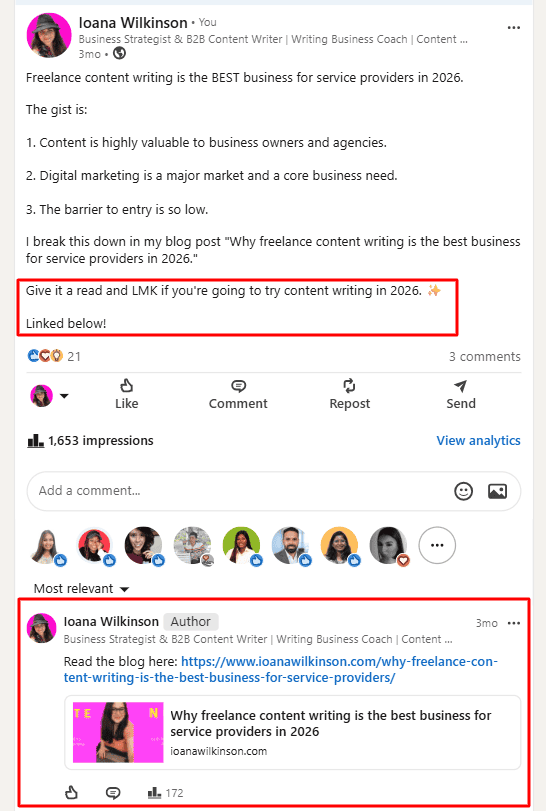
That early visibility matters because content discovery increasingly starts on social platforms. HubSpot’s 2025 State of Marketing report found that 31% of consumers now discover brands through social media searches more often than through traditional search engines.
This helps put your content in front of people faster. (Especially journalists, creators, newsletter writers, and industry peers who may later reference or link to it.)
It can also increase early traffic and visibility for new content, helping search engines discover those pages sooner.
Focus especially on distributing:
- Thought leadership content
- Comparison pages
- High-value guides
- Original research
- Statistics
Expand your share of voice with social media backlinks
Social media backlinks rarely improve rankings directly, but they can increase visibility, leading to stronger SEO outcomes over time.
➜ The brands gaining traction in search today are active across multiple channels. They publish useful content, participate in industry conversations, consistently reinforce the same topical themes, and stay visible in the spaces where people discover and share ideas.
This visibility leads to branded searches, mentions, and stronger recognition across the web.
If you want your content to reach more decision-makers and generate stronger SEO signals over time, start treating social distribution as part of your search strategy … instead of a separate marketing channel.
If your team already publishes strong content but struggles to make it visible, social distribution can help close that gap.
Need help building a backlink strategy? Reach out to uSERP for tailored support. ✨
FAQs about social media backlinks
Are social media backlinks dofollow or nofollow?
Many social media backlinks are nofollow or similarly qualified (sponsored/UGC). That means they usually don’t pass the same direct ranking authority as traditional editorial backlinks.
Can social media profiles rank on Google?
Yes. Public content from platforms like YouTube, LinkedIn, X, Pinterest, Reddit, and Quora often appears in Google search results.
For branded searches, social profiles often rank on page one alongside company websites.
Why are my social media posts not showing up on Google?
Some social platforms restrict crawling or place content behind login walls. Privacy settings, low engagement, limited indexing, or newer accounts can also affect whether posts appear in search results.
Public content on YouTube, LinkedIn, Reddit, and X tends to get indexed more consistently.
Does posting on social media help Google index pages faster?
It can help indirectly. Sharing new pages on social media increases visibility and traffic around the content, which can help search engines discover new URLs sooner.
Which social platform drives the most traffic to websites?
It depends on the industry and content format, but LinkedIn performs especially well for B2B traffic, while Pinterest can drive strong long-term traffic for visual and educational content. YouTube also drives significant discovery through search visibility and video recommendations.