



If you own a business in 2026, your website is no longer just an online brochure. It is your storefront, sales team, customer support channel, and marketing engine all rolled into one. And at the center of that engine sits one of the most valuable digital assets any business can build: organic traffic.
That is why understanding what organic traffic is matters more than ever.
For years, marketers have debated whether SEO is “dead.” Yet every year, search engines continue to send billions of visits to websites across nearly every imaginable industry. Businesses still rely on Google visibility to generate leads, sales, phone calls, newsletter signups, demo bookings, and long-term brand awareness.
Organic traffic is not just about getting random visitors. It is about attracting the right people at the right moment without paying for every click. And despite the rise of AI-generated search summaries and changing user behavior, organic search remains the largest source of internet traffic.
At the same time, AI-powered search experiences are changing how users discover information online. Businesses now have to think beyond traditional rankings and focus on authority, trust, search intent, and user experience.
Let’s jump in!
Highlights
- Organic traffic refers to unpaid visitors who find your website through search engines like Google, making it one of the most sustainable and cost-effective ways to generate leads and long-term business growth.
- Despite AI-powered search experiences growing rapidly, traditional organic search still drives most website traffic, underscoring SEO’s continued importance for online visibility in 2026.
- Successful SEO strategies focus on attracting high-intent traffic through helpful content, topical authority, technical SEO, strong user experience, and search intent optimization rather than simply chasing traffic volume.
- Businesses should measure organic traffic using tools like Google Analytics 4, Google Search Console, Ahrefs, and Semrush to track conversions, keyword visibility, click-through rates, and user engagement.
- Protecting organic traffic requires ongoing effort, including updating older content, maintaining technical SEO health, diversifying traffic sources, and building a recognizable brand that users and search engines trust.
What is organic traffic?
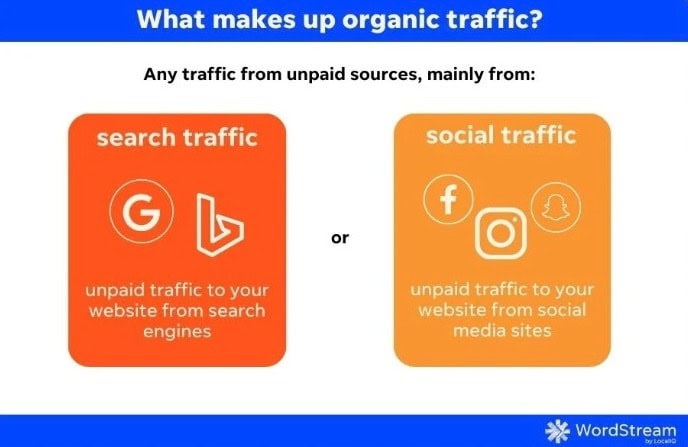
Organic traffic refers to website visitors who arrive through unpaid search results rather than advertisements.
When someone types a search query into Google or another search engine and clicks a regular listing rather than a sponsored ad, it’s organic SEO, and that particular visit counts as organic traffic.
For example, imagine a person searches for:
- “best accounting software for freelancers”
- “best CRM for small businesses”
- “how to fix a slow website”
If they click your website naturally in the search results, that is organic traffic.
Now compare that with paid traffic.
If your business runs Google Ads and someone clicks a sponsored result at the top of the page, that visitor is categorized as paid traffic.
The difference matters because organic traffic is earned, not bought.
Businesses gain organic visibility through:
- Technical website performance
- Search intent alignment
- Strong user experience
- High-quality content
- Relevant backlinks
- SEO optimization
- Website authority
That is why organic traffic is often considered more sustainable and cost-effective over the long term.
Organic traffic can continue generating leads long after a team completes the original work.
This is one of the biggest reasons businesses invest heavily in SEO today.
According to HubSpot’s 2026 marketing research, 41% of marketers say updating their SEO strategy for search changes is a top trend they’re exploring.
Organic traffic also tends to bring highly targeted users. People who search online usually already have a need, a problem, or buying intent. They are not passively browsing. They are actively looking for information, products, or services.
That makes search traffic incredibly valuable.
Why organic traffic matters more than ever in 2026
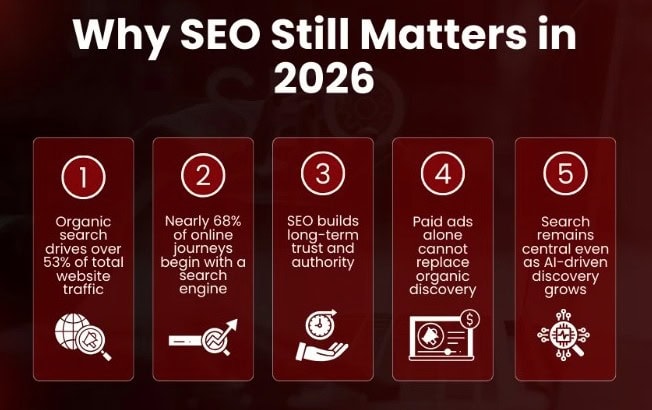
There’s a lot of noise in the 2026 online landscape. Much more than ever before.
Businesses compete for attention across search engines, AI assistants, newsletters, communities, podcasts, YouTube, and short-form video apps. Social platforms add another layer, especially for teams using social media for SEO rankings and content distribution. Consumers are overwhelmed with content from every direction.
Despite all of this, search remains one of the strongest sources of high-intent traffic.
Why?
Because search users are problem-aware.
When someone searches on Google, their query usually reflects one of four broad types of intent:
- Commercial investigation
- Informational
- Transactional
- Navigational
That creates a very different audience compared to many other marketing channels.
For example, someone casually scrolling social media may have no intention of buying anything. But someone searching “best project management software for remote teams” is already in research mode and likely much closer to deciding.
This is why organic traffic often converts better than many other traffic channels.
Organic traffic also builds long-term business resilience.
Many companies become dangerously dependent on paid advertising. When advertising costs rise, or budgets shrink, traffic disappears overnight.
Organic traffic works differently.
A strong SEO strategy creates a compounding effect. Every optimized page becomes another opportunity to attract future customers.
One high-performing article can generate:
- Thousands of visits
- Email subscribers
- Brand awareness
- Social shares
- Sales leads
- Backlinks
for years.
And even as AI reshapes search experiences, organic search still accounts for most of overall web traffic.
BrightEdge research found that AI search accounted for less than 1% of referral traffic in its January-August 2025 analysis, while organic search remained the primary traffic driver.
This means SEO is evolving, not disappearing.
Businesses that adapt early are better positioned to keep benefiting from organic traffic as search evolves.
The different types of organic traffic businesses should understand
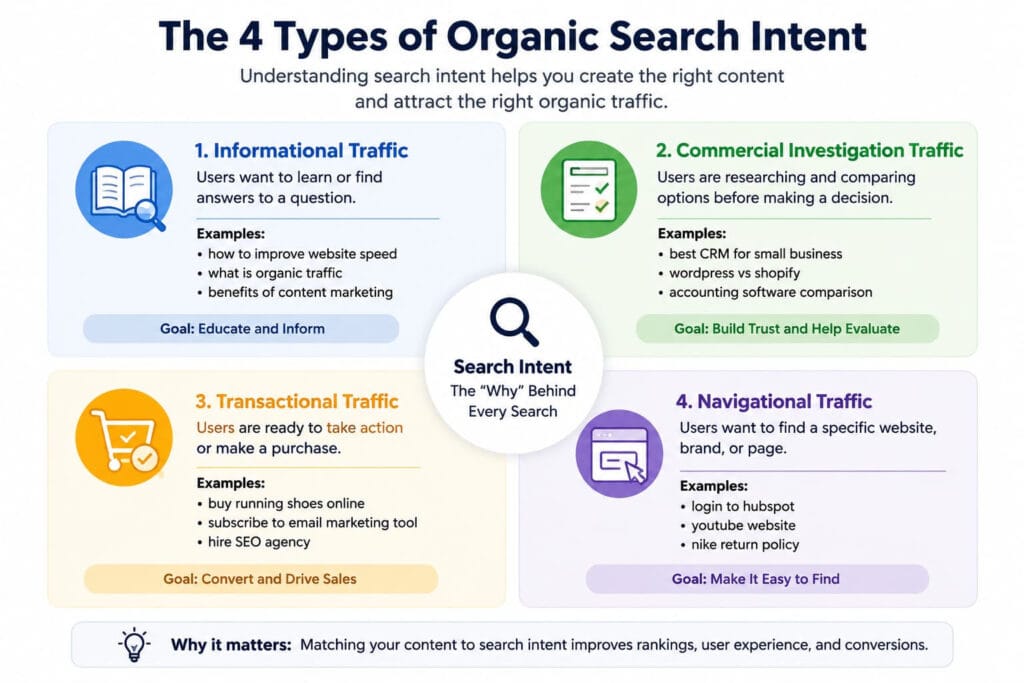
(Image created by the author)
One of the biggest mistakes businesses make is treating all organic traffic the same way. Not every visitor has the same level of intent or value.
In 2026, successful SEO strategies focus heavily on understanding traffic quality instead of just traffic quantity.
Different search queries signal different user intentions. Understanding those differences helps businesses create smarter content strategies and improve conversion rates.
Informational traffic
Informational traffic comes from users searching for answers, explanations, or educational content.
Examples include:
- “how to speed up a website”
- “what is domain authority”
- “what is organic traffic”
- “how SEO works”
These users are usually at the top of the buying journey. They may not be ready to purchase immediately, but they are building awareness and researching solutions. Informational content is important because it helps establish authority and trust.
Businesses that consistently educate their audience often become the brands users remember later when they are ready to buy. This is why blog content remains valuable in 2026.
Commercial investigation traffic
Commercial traffic comes from users comparing products or researching potential purchases.
Examples include:
- “top email marketing platforms”
- “Shopify vs WooCommerce”
- “best CRM software”
These visitors are much closer to making a buying decision.
Commercial-intent keywords often produce some of the highest conversion opportunities in SEO because users are actively evaluating options. Businesses that create strong comparison pages, review articles, and buying guides can capture highly valuable search traffic.
Transactional traffic
Transactional traffic represents users who are ready to take action immediately.
Examples include:
- “book dentist appointment”
- “hire SEO consultant”
- “buy gaming laptop”
This type of traffic often generates direct revenue quickly. Transactional keywords are usually highly competitive because businesses understand how valuable these searches are.
Navigational traffic
Navigational traffic happens when users search for a specific brand or company directly.
Examples include:
- “Canva templates”
- “HubSpot login”
- “Ahrefs pricing”
Navigational searches can also provide useful context when businesses measure SEO performance because they show how often users actively search for the brand.
How to measure organic traffic properly
Understanding what organic traffic is is only the first step. The next challenge is measuring it accurately.
Many businesses look only at total visitor numbers. That approach misses the bigger picture entirely. Modern SEO measurement focuses on traffic quality, user behavior, and business outcomes.
Use a three-layer measurement model: visibility metrics such as impressions and CTR, acquisition metrics such as organic sessions and landing-page traffic, and outcome metrics such as leads, sales, or other conversions.
This prevents teams from treating traffic growth as the end goal when the real objective is business impact.
Use Google Analytics 4
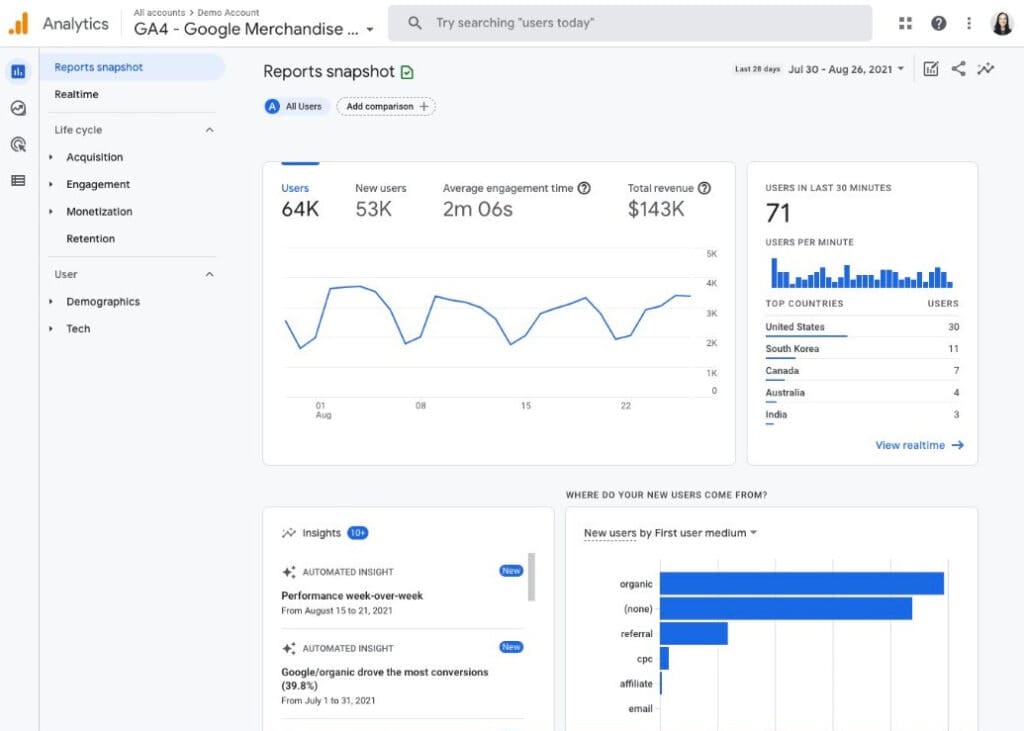
Google Analytics 4 remains one of the most important tools for tracking website traffic and user behavior.
GA4 allows businesses to measure:
- Landing page performance
- Geographic traffic data
- Revenue attribution
- User engagement
- Organic sessions
- Returning visitors
- Device usage
- Conversions
Inside GA4, businesses can view organic traffic under:
Reports → Acquisition → Traffic acquisition
Then filter by “Organic Search.”
One of GA4’s biggest improvements is its event-based tracking system, which allows more detailed measurement of user behavior.
Instead of focusing only on pageviews, businesses can track meaningful actions such as:
- Form submissions
- Scroll activity
- Button clicks
- Video plays
- Purchases
This creates a much clearer picture of SEO performance.
Use Google Search Console
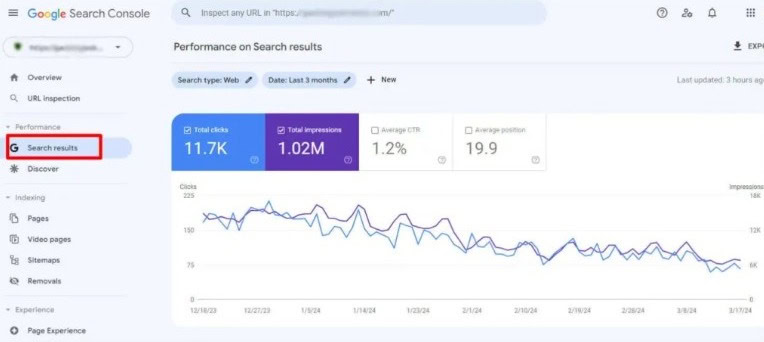
Google Search Console is equally important. This free tool shows how your website performs directly inside Google Search.
Businesses can monitor:
- Mobile usability issues
- Search impressions
- Click-through rates
- Indexing problems
- Keyword rankings
- Average positions
- Core Web Vitals
- Total clicks
Search Console is especially useful because it reveals which search queries actually drive visibility.
This helps businesses identify:
- Underperforming pages
- Ranking opportunities
- Technical SEO issues
- Content gaps
Without Search Console, businesses operate almost blindly in SEO.
Use advanced SEO tools
Professional SEO platforms provide deeper competitive insights. Popular options include Ahrefs, Semrush, and Moz.
These tools help businesses analyze:
- Keyword opportunities
- Content performance
- Competitor rankings
- Traffic estimates
- Search visibility
- Backlinks
Businesses using advanced SEO platforms often identify opportunities much faster than competitors who rely solely on free tools.
The most important organic traffic metrics today
Traffic volume alone no longer tells the full story. These days, businesses must focus on meaningful SEO metrics tied directly to performance and growth.
Organic conversions
This is the most important metric. Traffic without conversions has limited business value. Businesses should track how organic visitors contribute to:
- Newsletter signups
- Trial registrations
- Demo bookings
- Phone calls
- Purchases
- Leads
A page that attracts fewer visitors but converts at a higher rate may be far more valuable than a high-traffic article with poor engagement.
Click-through rate (CTR)
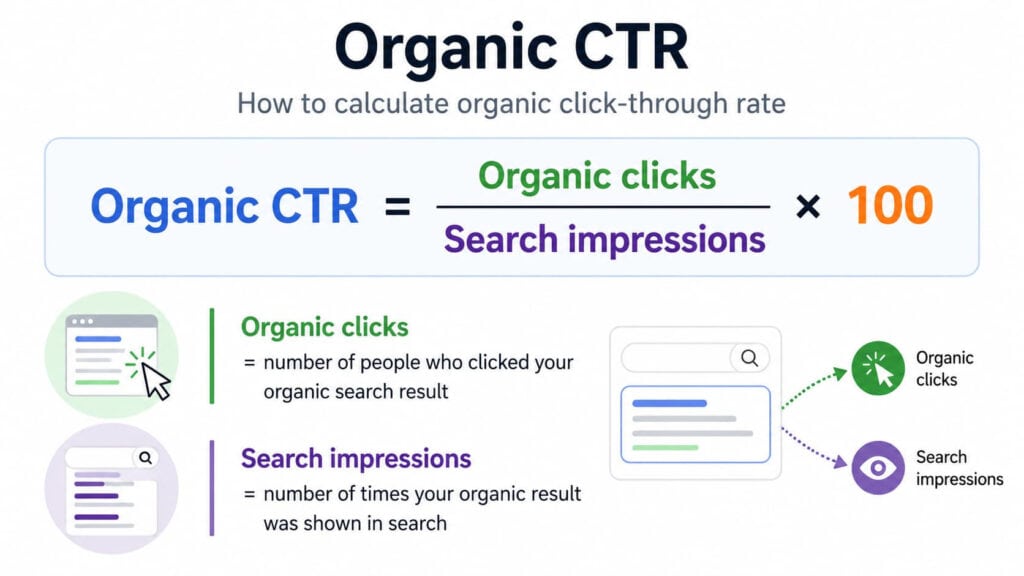
(Image created by the author)
CTR measures how often users click your result after seeing it in search results. Strong CTR often indicates several things, like:
- Strong search intent alignment
- Effective meta descriptions
- Good title optimization
- Brand trust
According to SearchLab’s 2026 SEO statistics, the first organic result averages a click-through rate of roughly 31%, showing how strongly search position can influence traffic.
Engagement metrics
Engagement metrics help businesses understand whether organic visitors find a page useful. If users consistently leave quickly, review the page’s search-intent alignment, usability, and content quality rather than relying on traffic volume alone.
Businesses should monitor:
- Pages per session
- Time on page
- Return visits
- Bounce rate
- Scroll depth
Keyword visibility
The latest SEO technologies are no longer just about ranking for a handful of keywords. The goal is broad search visibility across multiple search experiences. To achieve this, businesses need to check for:
- Top 3 keyword rankings
- Total ranking keywords
- Local search presence
- AI Overview visibility
- Featured snippets
How to grow organic traffic
Growing organic traffic today requires more sophistication than it did a few years ago. The internet is flooded with content. AI tools enable businesses to publish articles at scale.
Unfortunately, this has also created enormous amounts of low-quality content online. That means businesses must focus harder on quality, originality, and usefulness.
Create genuinely useful content
This is the foundation of modern SEO. Google increasingly rewards content that demonstrates expertise, original insights, helpful structure, clear explanations, and real experience.
Generic AI-generated articles without unique value struggle more than ever. Businesses need to put their focus on content that solves real problems.
Examples include:
- Actionable advice
- Industry research
- Detailed tutorials
- Original statistics
- Real examples
- Case studies
The goal is to create content users actually want to bookmark, share, and reference.
Build topical authority
Google wants to understand what your website specializes in. Random disconnected articles no longer work as effectively. Instead, businesses should create topic clusters around core subjects.
For example, a cybersecurity company might publish content about:
- Password management
- Compliance regulations
- Phishing attacks
- Network security
- Data protection
- Cloud security
Interconnected content helps search engines understand subject expertise. In turn, this improves rankings across entire topic areas.
Improve technical SEO
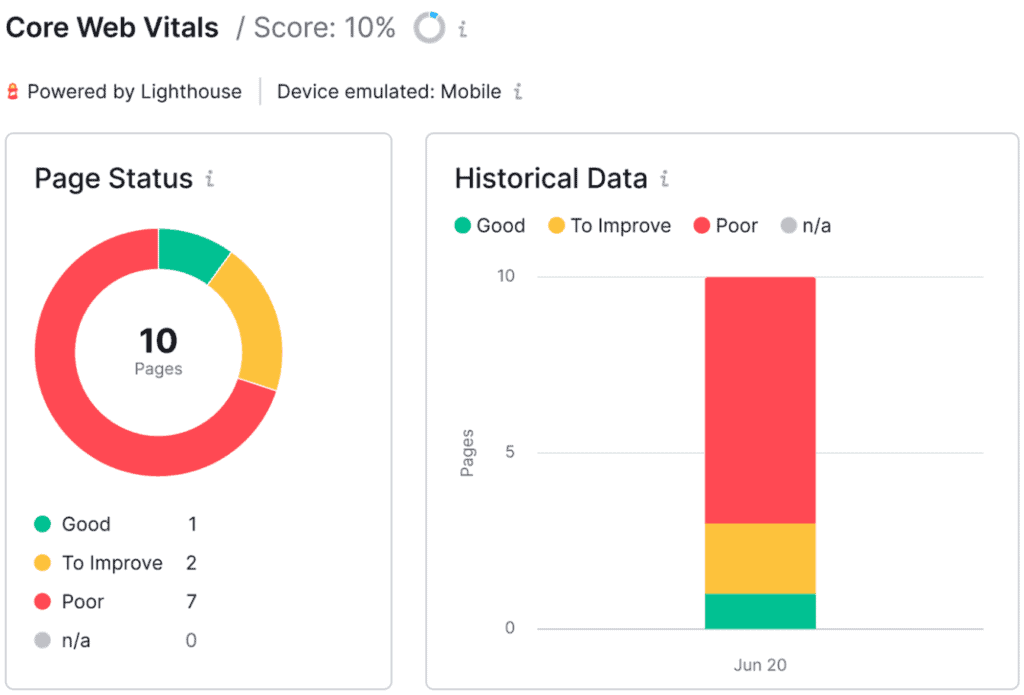
Technical SEO remains critical in 2026. Google continues to prioritize user experience heavily. A slow or broken website damages both rankings and conversions. Google’s Core Web Vitals remain important ranking considerations.
Ensure your website is:
- Properly indexed
- Mobile-friendly
- Easy to crawl
- Secure
- Fast
You can also use available test web tools like PageSpeed Insights to get a better look at what’s working on your site and what slows it down. The tool can check both the mobile and the desktop versions of your website.
Earn high-quality backlinks
Backlinks remain one of Google’s strongest authority signals. However, modern link building focuses much more on quality than quantity. The best backlinks usually come from:
- Valuable resources
- Original research
- Expert interviews
- Industry studies
- Unique insights
- Useful tools
Spammy link-building strategies are far riskier today because Google’s systems detect manipulation more effectively.
How to protect your organic traffic long term
Protecting organic traffic is just as important as growing it. Search algorithms change often, competitors improve their SEO, and user behavior keeps evolving. On top of that, AI-driven search is reshaping how people find information, which makes long-term SEO stability more challenging.
The first key step is diversification. Relying only on Google is risky, so businesses should also build email lists, social media communities, referral traffic, and direct brand visits. This creates stability even when search rankings fluctuate.
Brand strength also plays a major role in protecting traffic. Strong brands earn more trust, higher click-through rates, repeat visitors, and more direct searches.
Keeping content up to date is another important factor. Refreshing older pages with new data, improved formatting, better visuals, and updated examples helps maintain rankings and recover lost visibility without starting from scratch.
Finally, monitor your technical SEO health regularly. Issues like broken links, slow pages, crawl errors, duplicate content, and mobile usability problems can quietly reduce traffic over time. Ongoing maintenance ensures your site stays search-friendly.
Final thoughts
So, what is organic traffic? It remains one of the most powerful growth channels for businesses in 2026.
It drives long-term visibility, high-intent leads, lower acquisition costs, stronger authority, and sustainable business growth. Even as AI changes search, traditional organic search remains the main source of website traffic.
The businesses winning today don’t rely on shortcuts or low-quality AI content. Instead, they focus on helpful content, strong user experience, solid technical SEO, and building trust and authority.
In the end, SEO works because search engines and users want the same thing: the best possible answers.
Want to turn stronger organic visibility into measurable growth? Explore uSERP’s link building services to see how authority-focused campaigns can support rankings and qualified traffic.