




Running an SEO content strategy involves many moving parts, but AI SEO tools can cut down on manual work in research, planning, and optimization. In the past, content teams used spreadsheets, spent hours reviewing search results pages to understand what people wanted, and struggled to place keywords effectively.
Today, SEO strategies must also account for how search engines interpret context, meaning, and intent.
Integrating artificial intelligence into your content operations changes the equation. AI tools don’t replace human creativity; they transform a clunky, fragmented process into a streamlined engine.
Highlights
- AI tools speed up the repetitive parts of SEO content work: keyword clustering, SERP research, brief building, and on-page checks.
- Drafting gains are real but modest. Orbit Media found that bloggers who use AI write an article about 10% faster than those who don’t.
- AI-assisted content is now the norm. Ahrefs found that 74.2% of new web pages contain some AI-generated text, so originality is what sets your content apart.
- Google doesn’t penalize content just because AI helped create it. Its spam policies target low-value content produced at scale to manipulate rankings.
- The strongest workflow is human-in-the-loop: AI handles data and first drafts, while people own strategy, fact-checking, and firsthand experience.
Introduction to AI SEO tools
Challenges in managing SEO content workflows
Scaling content production without sacrificing quality is one of digital marketing’s hardest challenges. Traditional workflows suffer from persistent bottlenecks:
- Incomplete Topic Coverage: Missing critical subtopics or semantic terms can leave your content out of search recommendations.
- Time-Consuming Research: Manually checking top-ranking pages to understand target topics can take hours per article.
- Inconsistent Content Quality: Working with multiple writers often leads to inconsistent depth, tone, and alignment with search engines.
- Content Decay: Keeping legacy content updated as search intent shifts requires continuous manual monitoring.
Overview of AI tools for SEO
Modern AI SEO platforms act as intelligent research and workflow assistants. By utilizing machine learning algorithms and Large Language Models (LLMs), these tools process vast amounts of search data in seconds. They extract key semantic entities, generate structured outlines, analyze competitor strategies, and evaluate on-page optimization in real time.
What this article will cover
This guide provides a practical framework for integrating AI tools into your search strategy. You will learn:
- The technical differences between traditional and AI-driven SEO software.
- How AI accelerates every phase of content production—from research to analytics.
- A step-by-step blueprint for building a human-in-the-loop AI content workflow.
- How to navigate potential risks like hallucinated facts and generic output while maintaining Google’s E-E-A-T (Experience, Expertise, Authoritativeness, Trustworthiness) standards.
Understanding AI SEO tools
Definition of AI SEO tools
AI SEO tools are software applications that use machine learning, NLP, and deep learning algorithms to automate, optimize, and scale SEO tasks. Unlike static tools that rely solely on historical database queries, AI-powered systems dynamically process natural language, recognize patterns across thousands of web pages simultaneously, and generate context-aware suggestions.
Differences between AI tools and traditional SEO tools
| Feature | Traditional SEO Tools | AI-Powered SEO Tools |
| Data Analysis | Keyword, backlink, and SERP analysis | AI-assisted interpretation of SEO data |
| Content Recommendations | Keyword and content optimization suggestions | Contextual and AI-generated recommendations |
| Execution | Primarily analysis and reporting | Analysis combined with generative assistance |
| Intent Matching | Keyword grouping and intent classification | AI-assisted clustering and contextual analysis |
Common capabilities of AI SEO tools
- Real time Content Scoring: Checking how deeply your draft covers a topic compared to the pages currently ranking at the top.
- Semantic Analysis and Entity Extraction: Finding related ideas and terms that search engines expect to see with a given topic.
- Automated Internal Linking: Crawling domain architectures to suggest contextually relevant internal link anchors.
- Natural Language Generation: Drafting structured outlines, meta tags, section headings, and content variations.
How AI tools enhance your SEO content workflow
| Stage | Key Actions & AI Focus |
| 1. Research & Strategy | Keyword intent classification & AI-powered topic discovery |
| 2. Outline & Brief | SERP scraping & automated topic structuring |
| 3. AI-Assisted Draft | Fast draft generation & automated meta elements |
| 4. Human Refinement & E-E-A-T | Fact-checking, voice adjustment & expert insight injection |
Keyword and search-intent research
Traditional keyword research relies on search volume and keyword difficulty scores. AI elevates this process by evaluating user intent at scale. AI platforms group thousands of keywords into thematic clusters, revealing whether searchers seek a quick answer, a product comparison, or a step-by-step guide. These clusters can help teams choose the right content format, but editors should review representative SERP results before accepting AI-generated intent classifications.
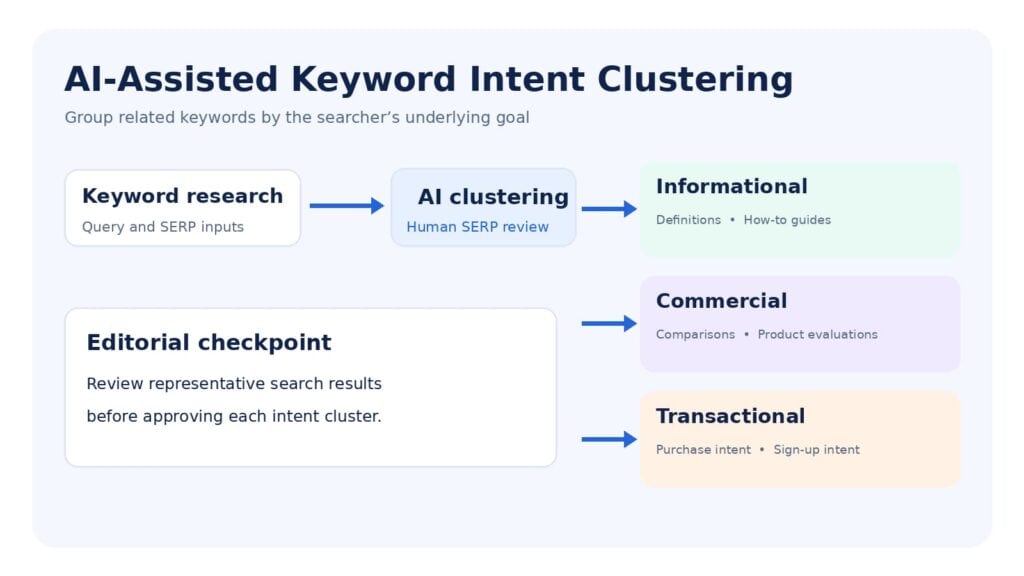
Image created by the author
Topic ideation and content briefs
Transforming raw keywords into a detailed brief used to take hours. AI tools scrape top-ranking results, aggregate common heading structures (H2s/H3s), extract frequently asked questions (such as Google’s People Also Ask), and consolidate them into a comprehensive content blueprint. If you’re planning a whole cluster rather than a single post, tying each brief to a topical content map keeps every article focused on one intent and makes internal linking far easier.
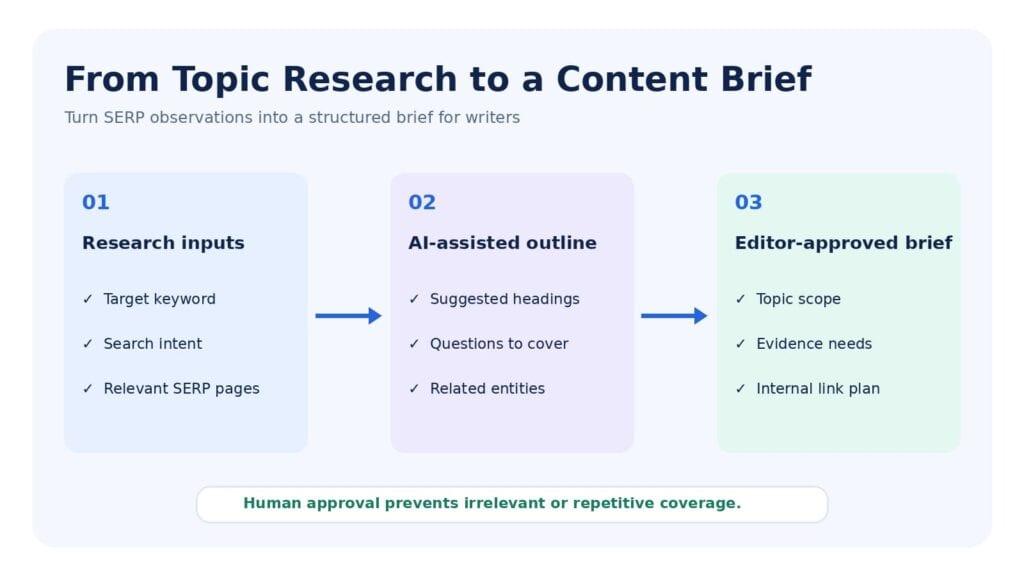
Image created by the author
Content creation and optimization
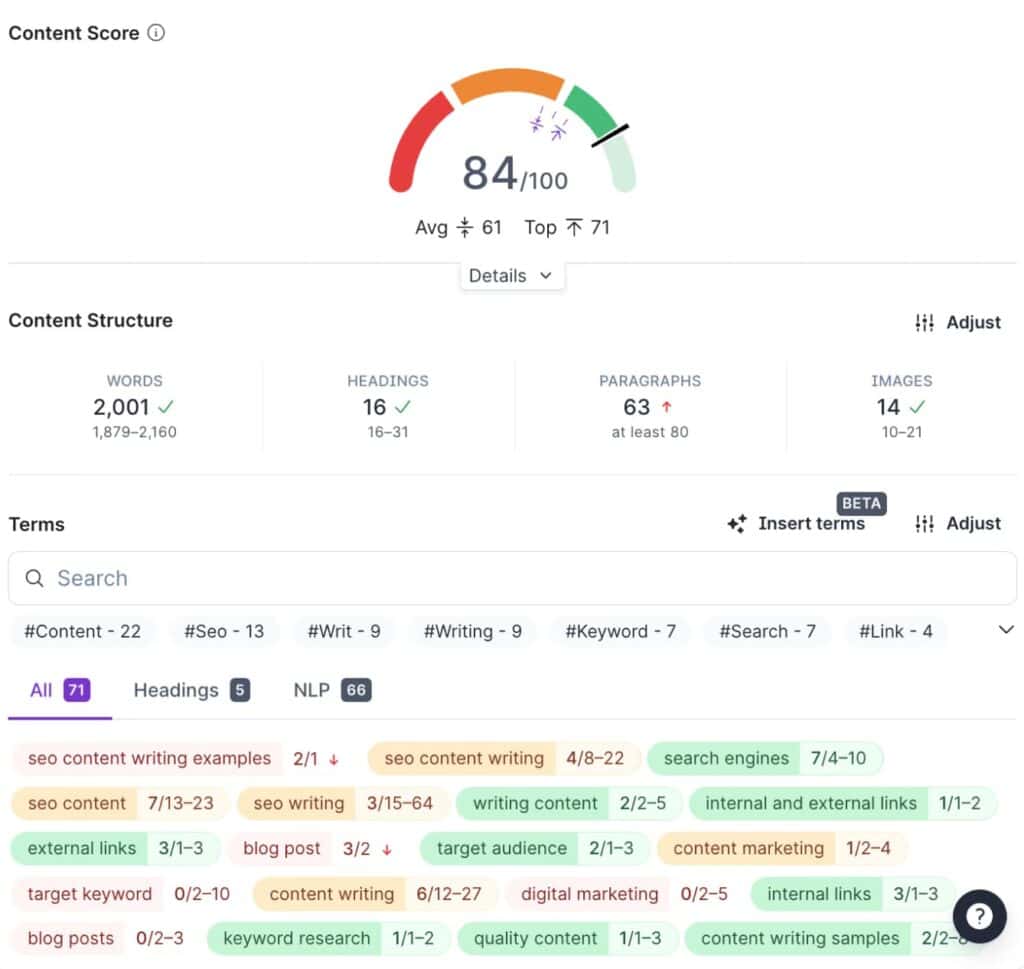
When drafting, generative AI tools act as a writing partner. A privacy-focused ChatGPT alternative (useful when briefs include unpublished client or product data) or assistants like Claude, Jasper, and Writesonic can help generate initial section drafts, introduce relevant analogies, or reframe complex ideas in your brand voice. At the same time, live optimization sidebars in tools like Frase, NeuronWriter, or Surfer SEO track term frequency and semantic coverage, helping writers cover the topic fully as they draft.
On-page SEO recommendations
AI tools handle the repetitive mechanics of on-page SEO quickly:
- Writing compelling, click-optimized title tags and meta descriptions within strict character limits.
- Generating descriptive, keyword-aware alt text for images.
- Structuring schema markup (e.g., Article, Organization, Product, or FAQ schema) so search engines can interpret the page and show eligible rich results.
Editing and quality control with AI
AI editing tools go beyond basic spellchecking. They assess readability, detect passive voice, identify awkward transitions, and flag unintentional plagiarism or repetitive language. This helps ensure drafts meet brand standards before they reach a senior editor.
Performance analysis and insights
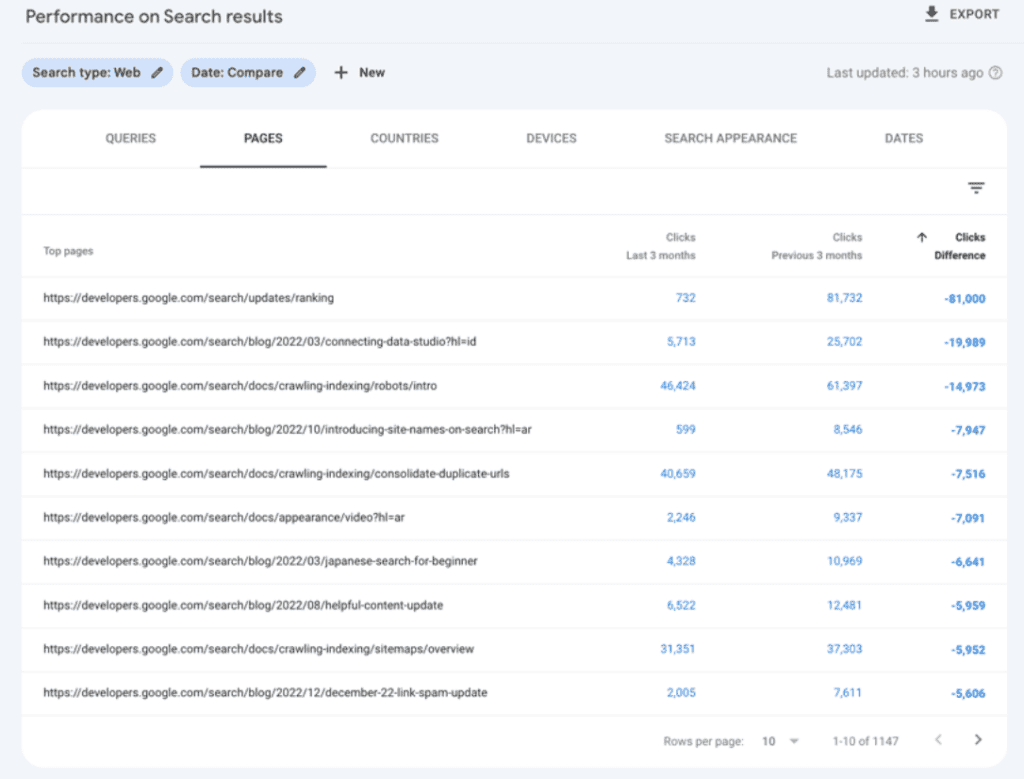
Post-publication monitoring is streamlined through AI integrations with tools like Google Search Console. AI engines identify decaying assets, track visibility in conversational search interfaces, and point out specific paragraphs that need updating to regain lost rankings.
A practical AI-powered SEO content workflow
The stages above explain where AI can help. The following sequence shows how to organize those tasks into a repeatable production process.
Step-by-step guide from research to publishing
- Discovery & Intent Analysis: Use LLMs or SEO platforms to group target terms into topic clusters.
- Automated Brief Generation: Run your target keywords through a tool to build an outline based on real data.
- Drafting the Core Framework: Use AI writing tools to draft early section ideas, summaries, or lists.
- On Page Semantic Tuning: Edit the text in an NLP editor to add related terms and ideas that help with SEO.
- Human Experience Injection: Add real insights, real examples, screenshots, or your own case study data.
- Publishing & Distribution: Generate social teasers, newsletter snippets, and schema code using AI prompts before pressing publish.
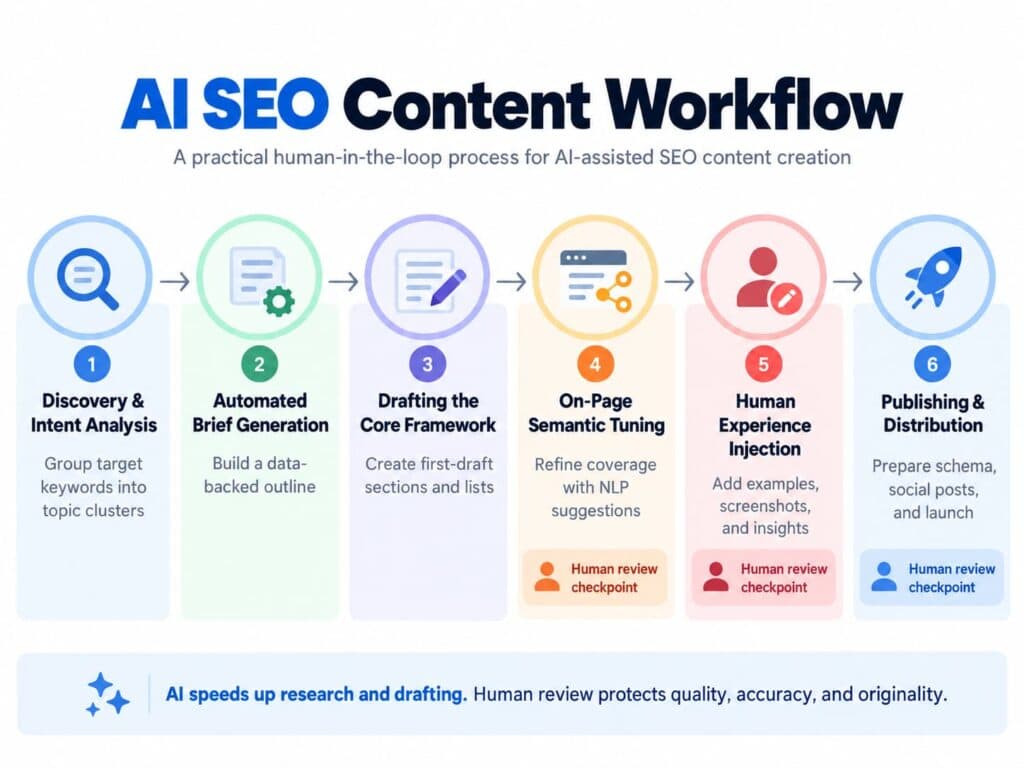
Image created by the author
Value addition through AI at each stage
AI can do your research, help you draft, improve your content, and handle distribution tasks.
The importance of human review
Raw AI output can lack brand nuance, stumble on precise factual details, or feel robotic. A human reviewer plays a key role. They check facts, adjust the brand voice, make sure the writing flows well, and confirm the piece actually answers the reader’s question.
Benefits of using AI SEO tools
Time savings in research and production
The time savings are real, but they’re more modest than many vendors suggest. In Orbit Media’s 2025 survey of content marketers, bloggers who use AI spent an average of 3 hours 24 minutes writing an article, compared with 3 hours 48 minutes for those who don’t — roughly a 10% efficiency gain. The bigger opportunity often sits upstream of the draft. By automating manual competitive analysis and outline generation, strategists spend less time collecting data and more time on positioning and creative storytelling.
Improving workflow consistency
Keeping a steady publishing schedule and quality level across big or spread out teams is hard. AI content briefs fix this by giving writers shared guidelines on topic depth, structure, and search intent.
Scaling content production effectively
For agencies and enterprise teams, scaling output traditionally meant increasing headcount linearly. AI workflows can help small teams manage larger content libraries with fewer repetitive tasks. However, higher production capacity also increases the need to check content quality before publication.
Limitations and risks of AI-generated SEO content
Potential for generic or repetitive content
Because LLMs predict text based on existing web patterns, unedited AI output often sounds generic. That matters more now that AI-assisted content is everywhere: an Ahrefs study of 900,000 new web pages found that 74.2% contained some AI-generated text. Over-relying on automated generation without adding novel insights leads to “me-too” content that fails to stand out in competitive search landscapes.
Factual inaccuracies and misinterpretations
Generative AI models can “hallucinate” — stating incorrect data, outdated metrics, or fabricated sources with full confidence. OpenAI’s own research links this partly to training and evaluation methods that reward guessing over admitting uncertainty. Publishing unverified AI text can damage brand credibility and undermine readers’ trust in the content.
Importance of human oversight
Google’s guidance on AI-generated content is clear that using AI isn’t against its guidelines; what matters is whether content is helpful, reliable, and made for people. However, its spam policies treat scaled content abuse — mass-producing pages mainly to manipulate rankings, with or without AI — as a violation. Maintaining a strict human-in-the-loop policy keeps your content aligned with E-E-A-T standards, blending automated research efficiency with genuine human authority.
Best practices for integrating AI tools in SEO
Using AI as a supportive workflow assistant
Treat AI as an executive assistant, not a ghostwriter. Use AI to crunch data, build briefs, draft templates, and optimize meta tags, while leaving strategy, voice, and opinions to human writers.
Providing context and detailed prompts
AI output quality depends directly on prompt clarity. Avoid generic prompts like “Write an article about SEO tools.” Instead, supply rich contextual parameters:
High-Performing Prompt Example:
“Act as a senior B2B SaaS content strategist. Draft a detailed 300-word section for an article titled ‘AI SEO Workflows.’ Target Audience: Content Marketing Managers. Focus on explaining how NLP tools streamline competitor analysis. Tone: Professional, practical, and authoritative. Do not use corporate buzzwords.”
Verifying facts and enhancing originality
- Cross-check all data: Verify every statistic, quote, and claim against a trusted primary source.
- Layer Firsthand Experience: Add personal observations, operational insights, or expert interviews to satisfy Google’s Experience signal.
- Include Original Visuals: Use your own screenshots, diagrams, or tables instead of generic stock images.
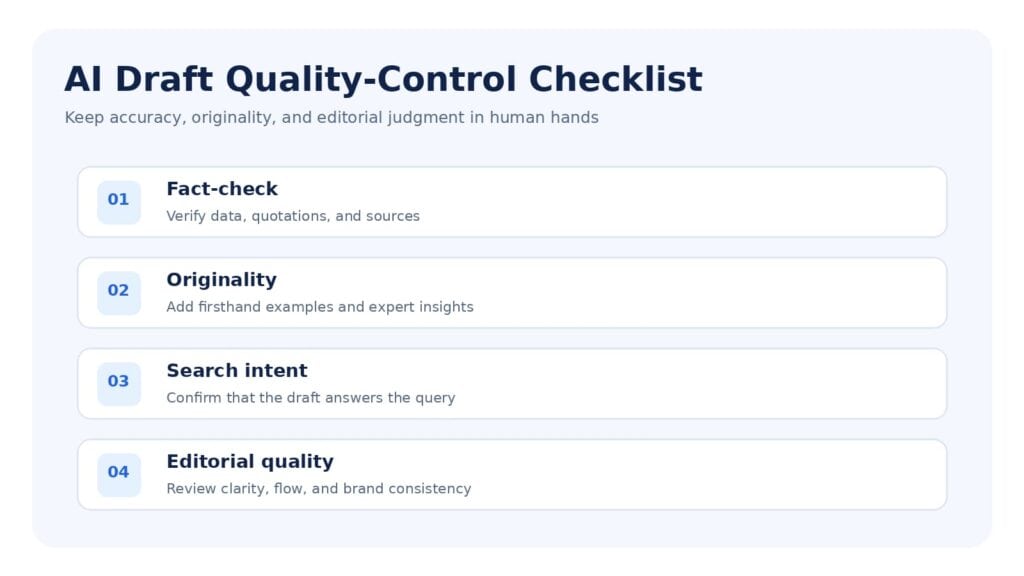
Image created by the author
Choosing the right AI tools for your stack
With hundreds of AI SEO tools on the market, picking the wrong one wastes budget and slows adoption. Use these criteria to narrow the field:
- Check data freshness: Ask how often the tool refreshes SERP and keyword data. Outdated data can lead to briefs based on search results that no longer reflect current intent.
- Test integrations: Confirm the tool connects to Google Docs, your CMS, and Google Search Console. Prioritize tools that fit your team’s workflow and can be used consistently.
- Match tools to bottlenecks: If research slows you down, prioritize clustering and brief tools. If quality varies between writers, prioritize content scoring and editorial checks.
- Review data privacy terms: Find out whether prompts and uploaded drafts are used to train models, especially if you handle client data.
- Run a pilot: Test two or three tools on the same brief and compare output quality, editing time, and ranking results over 60–90 days.
Measuring the impact of your AI workflow
Adding AI to your process is only worthwhile if it improves outcomes, not just output. Before rolling it out, record baseline metrics and compare results after one or two quarters. For a meaningful comparison, evaluate AI-assisted and manual content covering similar topics, keyword difficulty levels, and publication periods:
- Production time per article, from brief to publish.
- Editing rounds and time spent on revisions.
- Rankings, clicks, and impressions in Google Search Console for AI-assisted versus fully manual pieces.
- Engagement and conversions, such as time on page, scroll depth, and assisted sign-ups.
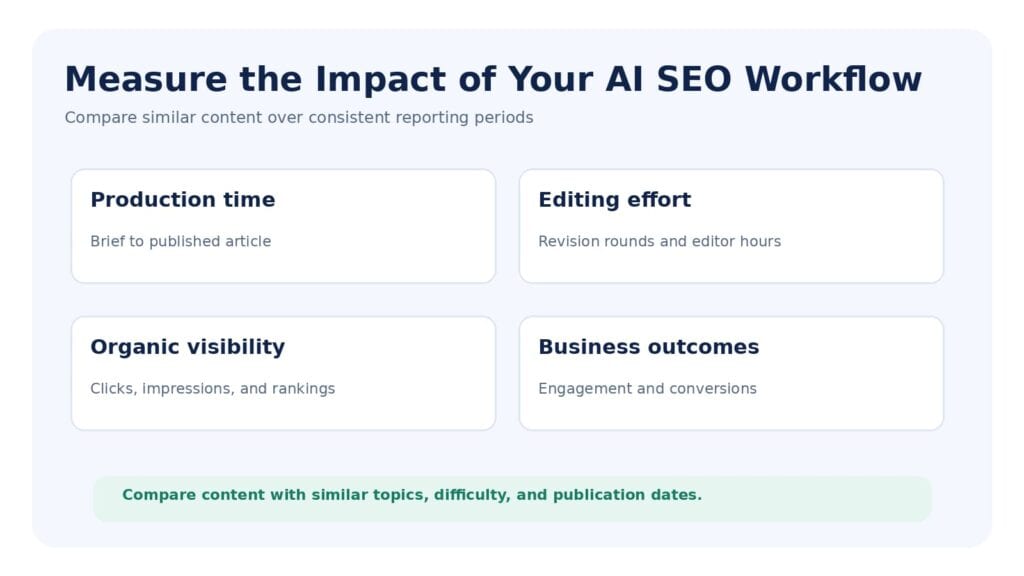
Image created by the author
If AI assisted content publishes faster but doesn’t perform well in search, that’s a sign to spend more time refining it rather than just making more.
Conclusion: the future of AI in SEO
AI tools can reduce repetitive work across keyword research, content planning, and optimization. However, effective SEO content still depends on human expertise to verify information, interpret search intent, and maintain editorial quality. Combining these strengths helps teams build more efficient workflows without losing sight of what readers need.
Putting this approach into practice requires the right tools, clear processes, and consistent editorial oversight. If you’d rather not build it from scratch, uSERP’s AI SEO agency team pairs AI-driven research with experienced strategists and writers to create content designed for visibility in traditional search results and AI-powered answer engines.
Talk to uSERP to see where AI can speed up your content workflow without sacrificing quality.