





Fixing broken links is an essential step in maintaining a healthy backlink profile. But you’ll need to do more than that to succeed in SEO.
Backlinks monitoring shows how your rivals win organic traffic. Instead of guessing, you can study the exact links behind their rankings.
A backlink monitor also tracks your links and shows what competitors are doing.
Highlights
- Choose the right tooling stack: Pair comprehensive suites like Ahrefs or Semrush with real-time link monitoring and backlink management software to sustain search growth.
- Segment links by editorial authority: Filter backlink data by Domain Rating, contextual topical relevance, and real organic traffic rather than gross backlink volume.
- Capitalize on competitor link gaps: Use dedicated backlink gap tools to target referring domains that link to multiple competitors but not yet to your site.
- Monitor velocity and lost link movements: Set automated alerts for new and lost backlinks to reclaim broken placements and replicate competitor PR wins.
- Track SEO competitors, not just business rivals: Your primary organic search competitors frequently differ from direct industry brand rivals.
What is backlinks monitoring (and why it matters for competitor analysis)?
Backlinks are incoming or inbound links from one website to another. When a website links to yours, that’s a backlink for your site. Backlink monitoring is the process of continuously tracking, indexing, and evaluating these backlinks. It means actively watching the link ecosystem to identify:
- Newly acquired or earned links
- Currently active links
- Lost backlinks
- Broken links
A backlink monitor is a tool that tracks all the links pointing to a website (yours or a competitor’s). It provides a wealth of data on:
- Each link’s rel attribute (whether it’s dofollow, nofollow, sponsored, or UGC)
- The domain and page each backlink comes from
- Whether a link is active or lost
- The anchor text used
- Each link’s quality
- Link toxicity
Backlinks remain a core ranking factor
The importance of monitoring backlinks boils down to link-building’s relevance to SEO.
Search engines evaluate these inbound links to determine three critical signals:
- Credibility: Whether independent editorial platforms validate your brand as a trustworthy source.
- Topical relevance: How closely the linking page’s subject matter aligns with your content.
- Niche authority: How strongly established industry voices endorse your site.
Despite constant core updates, Google still uses backlinks as a fundamental ranking signal. Comprehensive industry studies confirm it. According to a recent Backlinko study spanning 11.8 million SERPs, the average page in position #1 has 3.8 times as many backlinks as those in positions #2–10.
Semrush research also found that a web page’s DA score (calculated from the number of backlinks) has the fifth-highest correlation with SERP position.
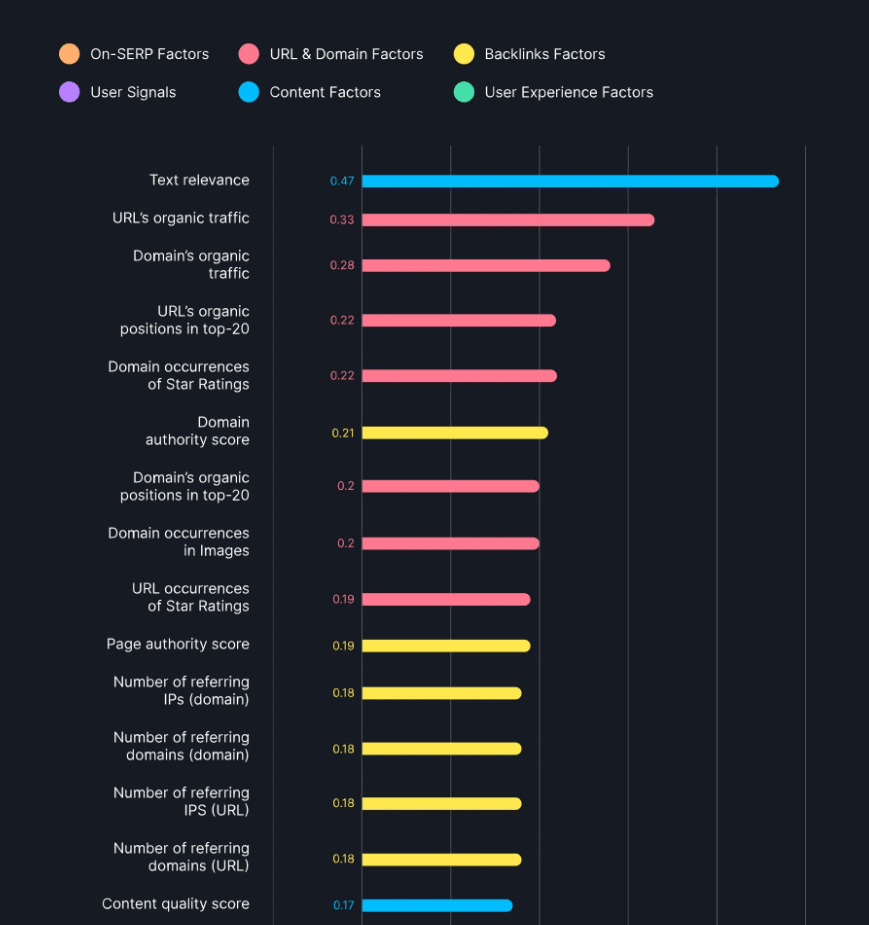
Furthermore, as the following graphs from Ahrefs research show, there’s a direct, positive correlation between unique referring domains and a web page’s total volume of ranking keywords and search traffic.
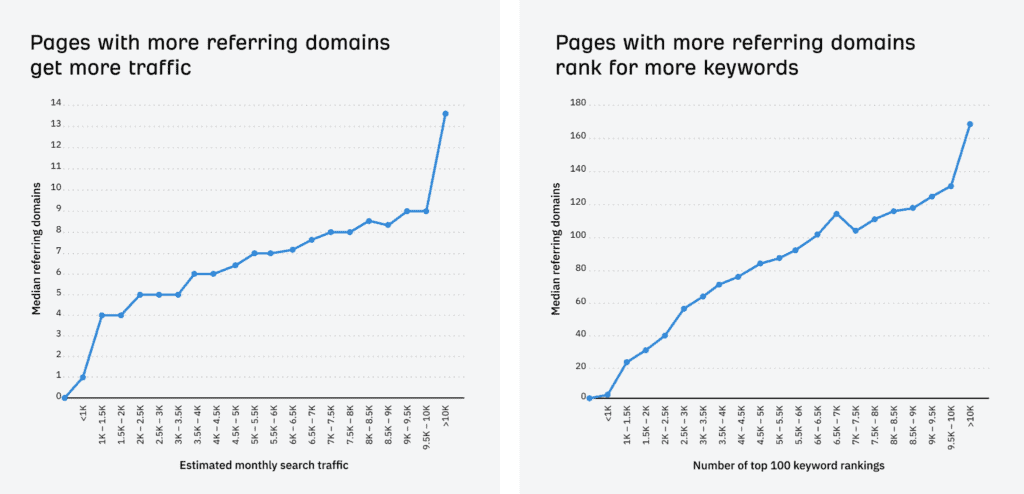
The conclusion is clear: The more high-quality backlinks your site has, the better it performs in SERPs.
Backlink monitoring and competitor analysis
Earning links from scratch is hard. Instead, use backlink monitoring for competitor analysis. Your rivals have likely done much of the legwork already.
Backlinks monitoring lets you learn from their wins without guesswork. A backlink monitor helps you:
- Identify your competitors’ most valuable backlink sources
- Uncover opportunities to strengthen your backlink profile
- Find industry journalists actively linking to your niche
- Spot trends in competitors’ backlink strategies
Through continuous monitoring, you can also track:
- Anchor text distributions
- Link velocity shifts
- Newly lost links
- And more
5 Steps to effective backlinks monitoring
You must follow certain steps to analyze your competitors’ link-building strategies with a backlink monitor.
Doing this will help you discover opportunities and refine your search engine optimization (SEO) strategy. Here is the step-by-step process:
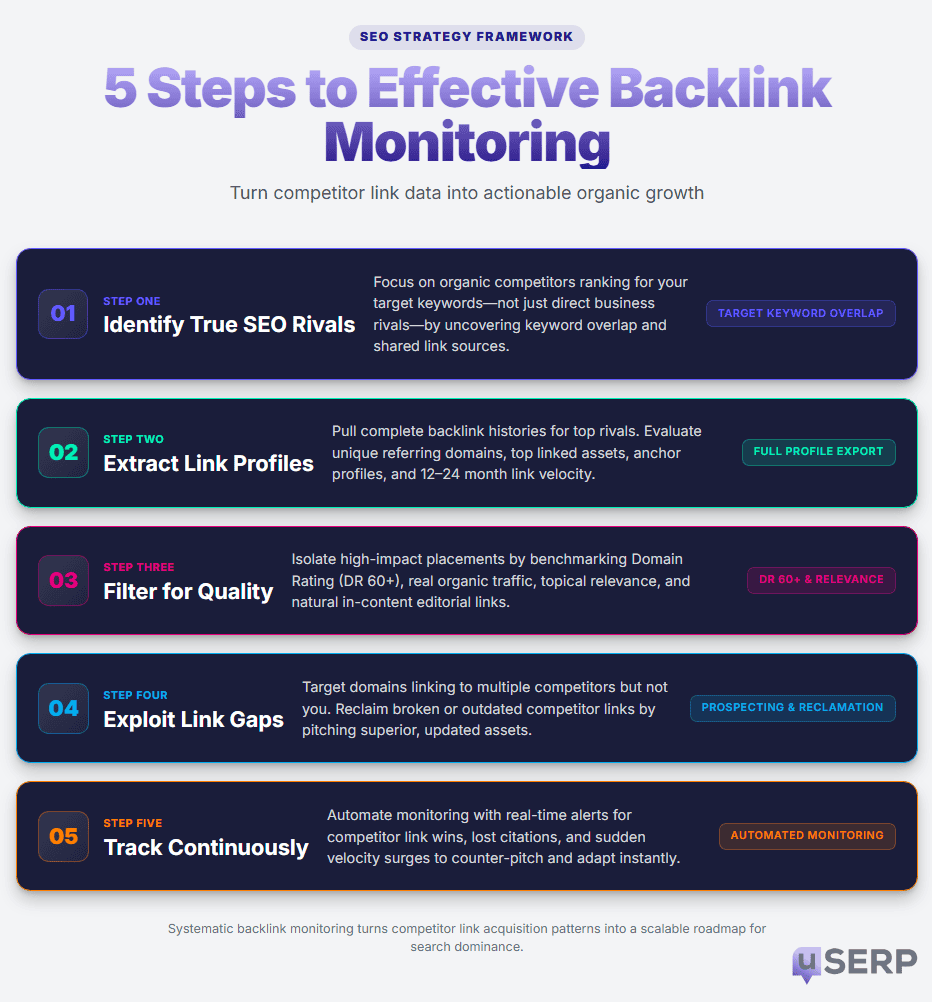
(Image created by author)
Step 1: Identify your real SEO competitors
Pick the right competitors for backlink analysis. Your business rivals might not be your SEO rivals. Blogs and niche sites may beat you in search.
Focus on rivals that rank for your target keywords and have solid backlink profiles.
How to pinpoint your true organic rivals
Here are some tips to help you find the right competitors to analyze:
- Use a backlink monitor to identify competitors: After putting your website in most backlink monitors’ search bar, you’ll see a list of competitors based on overlapping keywords and backlinks.
- Perform a keyword search: Use Google and other search engines to look for your primary keywords. The top-ranking websites are likely your direct competitors in terms of SEO.
- Check on sites that share sources: If another website shares a lot of the same backlink sources as you, they’re likely another relevant competitor to monitor.
Real-world example: Direct vs. indirect SEO competitors
Let’s look at an example. Imagine that you own a local coffee shop in Seattle. You believe your main competitor is Starbucks because of its market dominance.
Sure, this is true for business competition. But that doesn’t necessarily mean Starbucks is your biggest competitor when it comes to SEO.
In fact, when you do a Google search for the term “Seattle specialty coffee,” you find that many of the top organic results aren’t coffee shops. They’re specialty coffee blogs like Double Skinny Macchiato.
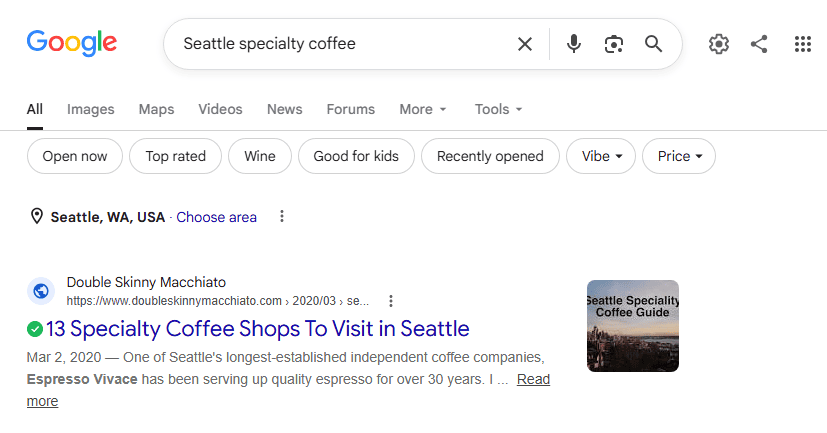
Screenshot provided by the author
These aren’t direct competitors because they’re not coffee shops. They don’t sell coffee at all. But they’re all your SEO competitors, and they’re outranking you for a critical keyword.
When you do a search for “best coffee shops in Capitol Hill,” you might get top organic results for yet another indirect competitor, like a Reddit forum.
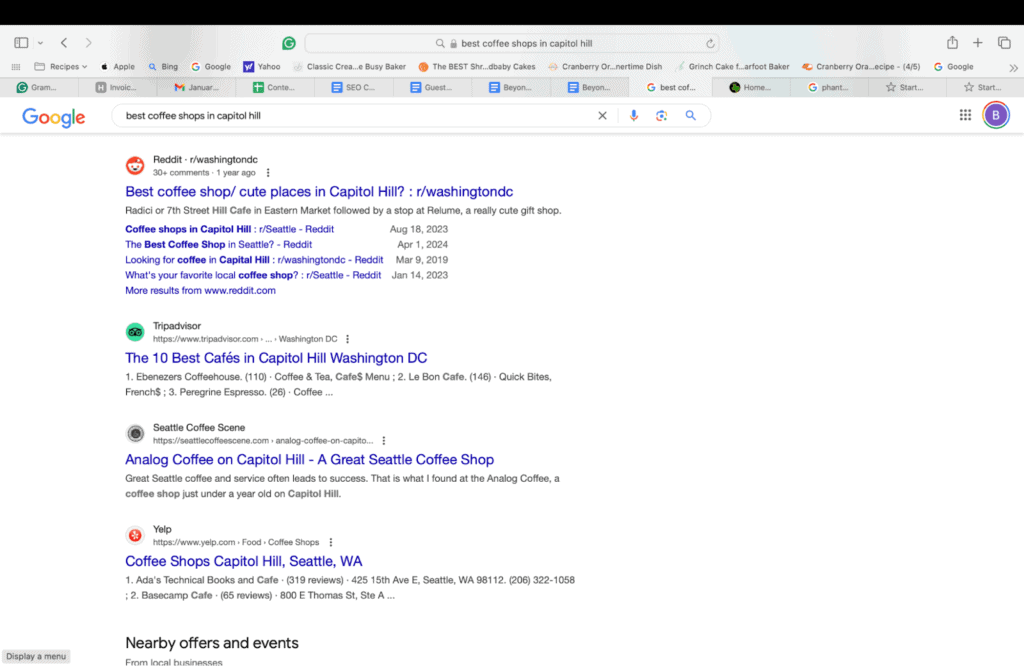
Screenshot provided by the author
By focusing on sites like Double Skinny Macchiato or your other SEO competitors, you can:
- Learn from their keyword strategy and create content that attracts backlinks, such as “Top 5 Coffee Shops to Visit in Seattle” or “Best Latte Art Cafés”
- Analyze their backlink profiles to see which local publications, influencers, or niche directories are linking to them
- Uncover opportunities to pitch your café to these same sources
Following this approach doesn’t mean you don’t need to look at your direct competitors. But it keeps you focused on the competitors impacting your SEO visibility.
So, when identifying competitors, always follow the SERPs.
Using your tool to extract competing domains
While doing manual searches helps you identify some SEO competitors, it’s tedious and slow. Backlink management software and link monitors are the solution.
- Start with your domain: Input your website URL into the tool. Look at your backlink profile to find referring domains and anchor text tied to your primary keywords.
- Check the top referring domains: Review the websites linking to your competitors’ domains.
- Analyze shared backlinks: Most tools show sites that link to both you and a rival, revealing similar link strategies.
- Spot ranking competitors: Focus on rivals that show up in your backlink reports and outrank you.
Step 2: Pull their backlink profile
Once you identify your top three to five true organic search competitors, you need to extract their complete link history.
Dig into websites linking to these competitors to identify:
- Opportunities
- Patterns
- Trends
From there, you’ll gain actionable insights to improve your link-building strategy.
Extracting comprehensive backlink data
So, how do you do that?
You start by entering each competitor’s domain or subfolder into a backlink tool like Ahrefs, Semrush, or another dedicated backlink checker tool. Export their full backlink index to evaluate their backlinks and referring domains at scale.
Make sure your export captures all critical data fields, including:
- Domain authority or rating
- Referring domain traffic
- Link rel attributes
- First seen dates
- Target URLs
- Anchor text
Core metrics to analyze in a backlink profile summary
Once you have the raw backlink data, it’s time to analyze it.
Start by assessing each website’s authority metrics and relevance:
- Review the Domain Authority (DA) or Domain Rating (DR) of the sites that link to your competitors. Backlinks from high-authority websites carry more SEO weight and “link juice.”
- Also, consider how relevant these sites are to your niche. Backlinks from topically relevant sites will have a more substantial impact on your own rankings.
Other fundamental metrics you should review across the competitor’s profile summary include:
- Anchor text profile: Anchor text reveals your rivals’ keyword strategy. Note the keywords helping them rank.
- Link types: Follow links pass SEO value. Nofollow links don’t help rankings directly, but they can still drive traffic.
- Total number of backlinks vs. unique referring domains: Look for healthy domain diversity rather than thousands of sitewide links originating from only a handful of domains.
- Top linked pages: Determine which commercial landing pages and informational blog posts attract the highest volume of inbound links.
Real-world example: Deconstructing Ahrefs’ top linking domains
These are the top linking domains to ahrefs.com:
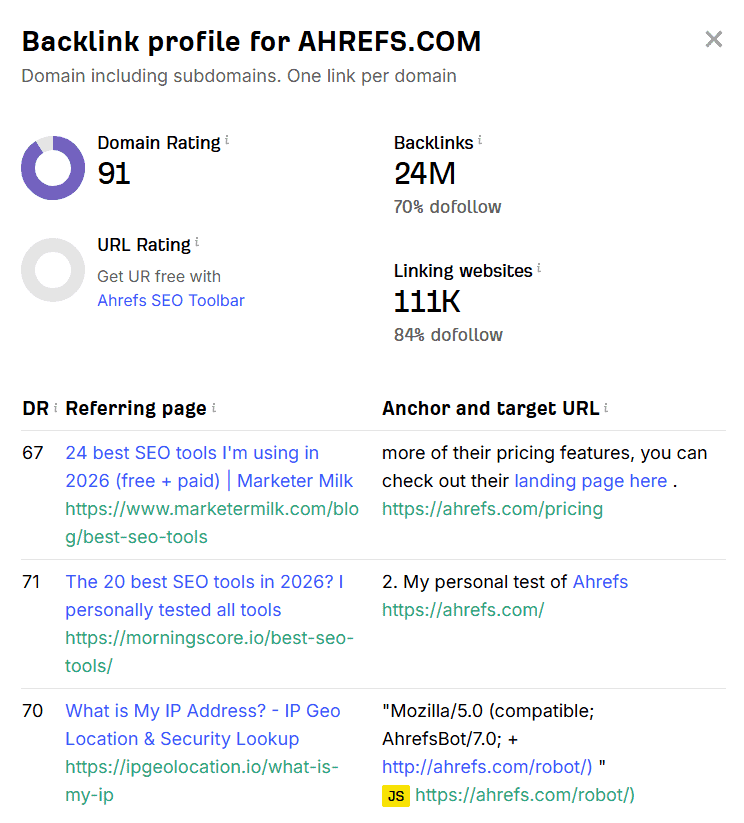
When you analyze a domain of this scale, clear link acquisition patterns emerge. In this example, you’ll notice high-DR editorial publications focused on marketing and SEO tools.
If you run a growing SaaS in marketing, these are the types of publications you want to be cited in.
Evaluating link acquisition patterns and velocity
Look at the competitor’s link growth velocity over the trailing 12 to 24 months. A smooth, steady upward link trajectory indicates consistent editorial link building. It could mean:
- A successful proactive outreach campaign
- A relevant whitepaper
- Ongoing Digital PR
Conversely, sharp vertical spikes followed by plateaus indicate:
- An unlinked brand mention reclamation campaign
- A major funding announcement
- One-time marketing pushes
- An interactive tool release
- A viral piece of content
Identifying these trends can help you replicate or capitalize on similar strategies.
Step 3: Segment by link quality and relevance
Raw link volume can be deceptive. A competitor with 20,000 links might appear unbeatable at first glance, but a granular backlink audit often reveals that 90% of those links reside on:
- Automated directories
- Low-tier scraper sites
- Irrelevant domains
Segmenting your data lets you filter out vanity noise and focus strictly on high-impact editorial authority.
Filtering by domain rating and authentic organic search traffic
Begin by applying strict filtering thresholds to your competitor’s backlink export. Filter the list to display only referring domains with a minimum Domain Rating of DR 50 or DR 60+.
Next, check those domains’ organic traffic. A high-DR site with no search traffic is worth far less.
Assessing topical relevance and contextual placement
Look for link patterns. Identify trends in the types of sites linking to your competitors. This might include:
- Educational or government sites
- Local directories
- Industry blogs
- News outlets
Examine the exact on-page location of each competitor backlink:
- Author bio links: Typical of contributed guest posts, these provide brand visibility but carry slightly less contextual weight than in-body mentions.
- Contextual in-content links: Editorial links embedded directly within body paragraphs pass maximum topical relevance and link equity.
- Footer and sidebar links: Often sitewide or boilerplate placements that search engines discount or ignore.
- Forum and comment links: User-generated content links that provide minimal search engine ranking value.
Isolating toxic backlinks and competitor mistakes
Learn from rivals’ mistakes too. Links from private blog networks (PBNs), directory spam, or paid links show up as repeated anchor text and sudden drops. Don’t copy these tactics.
Real-world example: Segmenting a B2B SaaS competitor’s backlink profile
Imagine you run a B2B project management software startup competing against an established platform like ClickUp or Asana. A full backlink export might return over 500,000 total backlinks across 15,000 referring domains.
Rather than attempting to review every link, you apply strict segmentation filters:
- Contextual follow links embedded in editorial articles
- minimum 5,000 monthly organic visits
- English-language content
- DR 65+
This cuts 15,000 domains down to 250 strong, relevant sites ready to pitch.
Step 4: Spot content and link gaps you can exploit
A backlink gap analysis shows you which authoritative websites link to several of your organic rivals while omitting your brand.
Running a multi-domain backlink gap analysis
Enter your domain and three or four top competitors into a backlink gap tool. Show sites that link to at least two competitors but not to you.
Reverse-engineering high-performing content formats
You now know about your competitors’ backlink sources. Adjust your link-building strategy to include these sources. For example, some of your competitors may be securing links from:
- Industry-specific forums
- Podcast interviews
- Influencer content
So, analyze which specific URLs on your competitors’ sites earn the highest volume of unique referring domains:
- Original research and industry benchmark reports: Data-driven surveys and statistical roundups earn massive passive citations from journalists looking for sources.
- Definitive frameworks and ultimate guides: Comprehensive long-form guides serve as standard educational reference points across industry blogs.
- Free tools, calculators, and templates: Practical utility assets attract continuous resource-page links and recommendations.
Building an actionable outreach tracking sheet
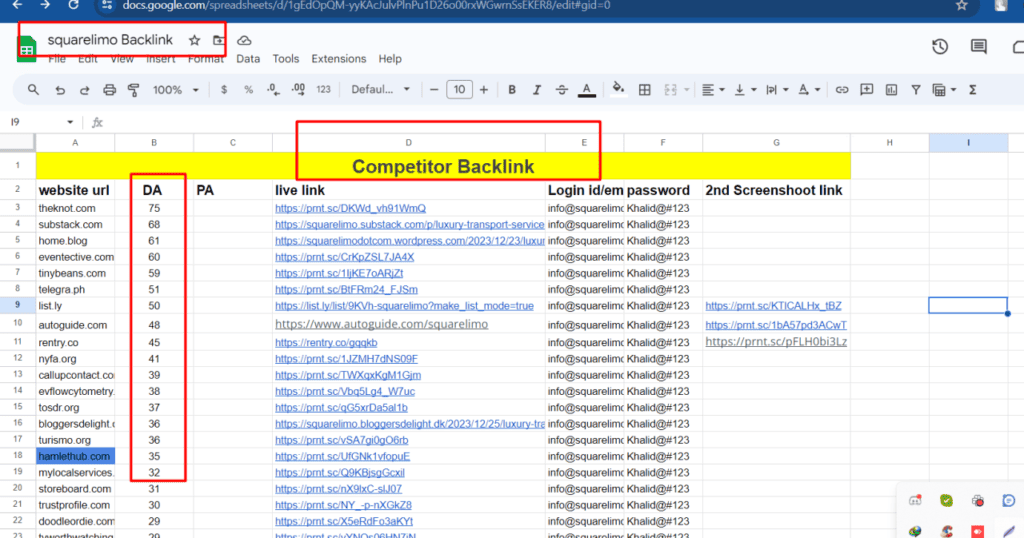
Outreach campaigns can get complex fast. Tracking 250 domains is easier if you organize information in a spreadsheet or use a CRM.
Real-world example: How an athletic apparel brand leverages competitor link gaps
Let’s end with an example.
You’re in the fitness industry. Your competitor, Fabletics, has multiple backlinks from health influencers on social media and fitness blogs. As you track these backlinks, you realize that these influencers often work with brands that promote fitness gear.


You don’t currently target that demographic.
However, given the data, you decide to pivot and target eco-friendly fitness influencers and blogs for your backlink-building campaigns.
Step 5: Track changes over time
Effective backlinks monitoring is a continuous operational discipline rather than an isolated, one-time project.
Search algorithms update constantly, and your competitors continuously execute new campaigns to capture market share.
Setting up automated alerts for new and lost backlinks
Configure daily or weekly automated notifications within your backlink monitoring tool to track two key events:
- Lost competitor backlinks: You can also use the “Lost Links” feature in your backlink monitoring tool to see backlinks that once pointed to your competitor’s site but are no longer active.
- New competitor backlinks: Discover new editorial wins, Digital PR coverage, or podcast appearances as soon as they get indexed.
Capitalizing on lost and broken competitor links
Lost links are backlinks that once pointed to a website but are no longer active. This can happen for many reasons, including:
- Voluntary link removals
- Page deletions
- URL changes
Lost links can reveal gaps in a rival’s strategy. If a link now points to a 404 error or a broken page, you can use link-building outreach for link placements of your own.
Reach out to the linking editor, notify them politely that they are linking to a broken 404 resource, and suggest your live, comprehensively updated asset as a drop-in replacement.
Detecting sudden link velocity surges
Keeping a close watch on competitor links lets you detect velocity spikes. If a rival brand suddenly picks up 40 referring domains in a single week, analyze the source immediately.
- Did their executive team appear on a major industry podcast circuit?
- Did they publish a new industry survey?
Real-world example: Reclaiming broken links from a competitor’s retired tool
Suppose a major competitor in your niche retires an outdated free ROI calculator, turning its original URL into a 404 error page.
By checking their lost links report in your backlink monitor, you find that over 35 high-authority marketing blogs still point active links to that dead tool.
You build a better ROI calculator, email those 35 editors about the dead link, and offer your tool instead. You secure 12 high-DR backlinks with little effort.
Best backlink monitoring tools compared
Selecting the right backlink monitoring tool depends on your team size, budget, and specific link-building goals. Whether you need a free backlink checker for basic link verification or a comprehensive suite of SEO tools for multi-domain competitor tracking, having the right software keeps your link acquisition workflow fast and accurate.
Here is a side-by-side comparison of the top backlink monitoring tools for 2026:
| Tool | Primary Focus | Core Monitoring Features | Competitor Intelligence Capabilities |
| Ahrefs | Complete backlink analysis and competitor tracking | Real-time new and lost link tracking, live anchor text analysis, and fastest live backlink index updates | Advanced multi-domain Link Intersect tool, historical link growth velocity, and broken backlink discovery |
| Semrush | All-in-one SEO suite and backlink auditing | Automated backlink audits, toxicity scoring, link velocity tracking, and integrated email outreach CRM | Backlink gap analysis against 4 competitors, target URL distribution, and referring IP mapping |
| Google Search Console | Verified first-party backlink monitoring | Direct first-party link indexing from Google, top linking root domains, and exact target page distribution | None (Strictly monitors your owned domain) |
| SE Ranking | Real-time link status and recovery tracking | Automated daily link status verification (dofollow/nofollow/dropped), page indexation checks | Competitor link tracking, historical backlink snapshots, and anchor text distribution |
| Majestic | Topical authority and link quality analysis | Proprietary Trust Flow and Citation Flow metrics, Topical Trust Flow categorization | Deep historical index comparison, link graph visualization, and mutual backlink discovery |
| Moz Pro | Authority metrics and link tracking | Domain Authority (DA) and Page Authority (PA) scoring, spam score analysis, and link tracking lists | Link Intersect gap analysis, competitor brand mention tracking |
| Linkody | Automated backlink tracking and instant alerts | 24/7 automated crawl alerts, visual link placement confirmation, and disavow file generator | Direct competitor profile tracking, lost link notifications on competitor URLs |
Turn competitor backlink intelligence into sustainable rankings
Competitor analysis opens up many link-building opportunities.
Your competitors could have impeccable backlink profiles. That might be discouraging, and you might wonder, “How can I top that?”
However, the data you uncover about their backlink strategies can be a gold mine. It shows what’s working and the content that naturally gets links.
Look at their approaches, and you, too, can be a backlink magnet.
Still need help with scoring backlinks? Book an intro call with uSERP. We are happy to help with the heavy lifting.
FAQs
What is the difference between backlink monitoring and a backlink audit?
Backlinks monitoring is ongoing and tracks new links, lost links, and competitor link velocity. A backlink audit is a periodic check for toxic links and other risks.
How often should you monitor competitor backlinks?
Check weekly or set real-time alerts in competitive niches. In slower industries, a monthly review is usually enough.
Can free backlink monitoring tools replace paid SEO platforms?
Free tools like Google Search Console show accurate data for your own site. But they lack history, competitor gap analysis, and alerts, so they can’t scale a link-building campaign.